Why Electric Vehicle Adoption Is Reshaping Global Manufacturing Chains
Introduction: A Structural Shift, Not Just a Technology Trend
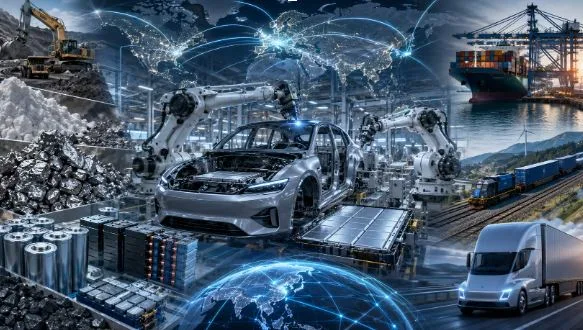
Electric vehicles are often discussed in terms of range, charging speeds, and consumer adoption curves. But beneath the surface, the shift to EVs represents something far more fundamental: a restructuring of global manufacturing chains.
Unlike internal combustion vehicles, which rely on relatively stable, century-old supply networks, EVs depend on a rapidly evolving ecosystem of battery chemistry, critical minerals, semiconductor integration, and cross-border assembly hubs. As adoption accelerates, these systems are being reorganised in real time—reshaping how, where, and by whom vehicles are built.
From Engine-Centric to Battery-Centric Supply Chains
Traditional automotive manufacturing revolved around the engine and transmission. Thousands of specialised suppliers fed into a relatively modular system, with clear separation between mechanical components.
EVs invert that structure. The battery pack is now the most valuable and strategically sensitive component in the vehicle. This shift has concentrated power—and risk—around a smaller number of suppliers and geographies.
Battery production depends heavily on lithium, nickel, cobalt, and graphite, materials that are geographically unevenly distributed. As a result, countries rich in these resources have gained new strategic importance, while automakers increasingly compete for long-term supply agreements rather than short-term contracts.
This has also led to vertical integration. Automakers that once outsourced powertrains are now investing directly in battery gigafactories, joint ventures, and raw material extraction.
The Rise of Gigafactories and Regionalisation
One of the most visible consequences of EV growth is the rapid expansion of “gigafactories”—large-scale facilities designed to produce battery cells at industrial volume.
These facilities are reshaping industrial geography. Instead of globalised, highly fragmented supply chains, manufacturers are increasingly adopting regional production ecosystems:
- Batteries produced close to vehicle assembly plants
- Suppliers clustering around energy infrastructure and ports
- Governments incentivising domestic production to reduce dependency on imports
This regionalisation is partly driven by economics, but also by resilience. The disruptions seen during recent global supply shocks exposed the fragility of long, complex logistics chains. EV manufacturing is being redesigned to reduce exposure to such volatility.
Critical Minerals and the New Resource Competition
At the centre of EV manufacturing lies a renewed global competition for critical minerals. Lithium extraction in South America, cobalt mining in Central Africa, and nickel processing in Southeast Asia are now deeply embedded in automotive strategy discussions.
Unlike oil, these materials are not simply burned and replaced. They are refined, processed, and incorporated into highly engineered battery systems, creating bottlenecks at multiple stages:
- Mining capacity constraints
- Refining and chemical processing limitations
- Environmental and regulatory pressures
- Transportation and export dependencies
This has led to what many analysts describe as a “multi-layered dependency chain,” where control over processing can be just as important as control over extraction.
Semiconductor Dependence and Software Integration
EVs are not only mechanical products—they are software-defined machines. This introduces another critical layer: semiconductors.
From battery management systems to autonomous driving features, EVs require significantly more chips than traditional vehicles. This increases exposure to global semiconductor cycles and geopolitical constraints in chip manufacturing.
As a result, automotive companies are forming closer relationships with technology firms, while also investing in in-house software capabilities. The distinction between car manufacturer and tech company is becoming increasingly blurred.
Trade Dynamics and Geopolitical Rebalancing
EV adoption is also reshaping international trade flows. Countries are reassessing tariffs, subsidies, and export policies to secure a position in the emerging supply chain hierarchy.
Key trends include:
- Incentive-driven domestic EV production in major markets
- Export restrictions on critical minerals in some producing regions
- Strategic alliances between automotive and energy sectors
- Competition for battery intellectual property and manufacturing know-how
These dynamics are creating a more fragmented but strategically interconnected global system than the one that supported traditional automotive manufacturing.
The Secondary Ecosystem: Components, Identity, and Customisation
While batteries and minerals dominate the macro picture, EV adoption is also reshaping secondary industries that support vehicle identity and ownership experience.
As vehicles become more software-driven and standardised mechanically, differentiation is increasingly expressed through design details, finishes, and personalisation elements. Even seemingly small components contribute to how a vehicle is perceived in a highly visual, digital-first environment.
For example, automotive presentation and finishing standards—such as number plate design and manufacturing quality—play a subtle but noticeable role in how vehicles are visually integrated into broader urban and branding contexts. Specialist manufacturers like Plates Express operate in this space, focusing on physical detailing that complements the broader shift toward refined, design-conscious mobility.
Supply Chain Digitalisation and Real-Time Manufacturing
Another major transformation is the digitisation of supply chain management itself. EV production relies heavily on real-time data to coordinate global inputs, from battery chemistry variations to logistics scheduling.
Manufacturers are increasingly using:
- Predictive supply chain analytics
- AI-driven demand forecasting
- Digital twins of production systems
- Blockchain-style traceability for materials
This level of integration allows for faster adaptation but also increases systemic complexity. A disruption in one region can now propagate more quickly through interconnected digital systems.
Conclusion: A New Industrial Map for the Automotive World
Electric vehicle adoption is not simply changing what cars are made of—it is redrawing the global map of industrial production.
Battery dependency has shifted value chains upstream. Critical minerals have become strategic assets. Semiconductor demand has tightened links between automotive and technology sectors. And manufacturing itself is becoming more regional, digital, and vertically integrated.
What emerges is not just a greener automotive industry, but a fundamentally reorganised one—where supply chains are no longer background infrastructure, but central to competitive advantage and geopolitical strategy.