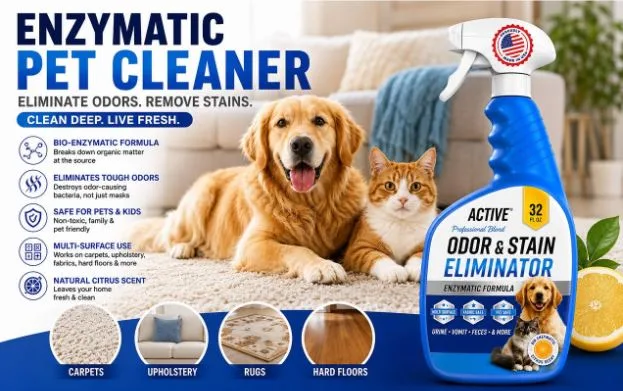
Enzymatic Pet Cleaner Eliminate Odors and Stains Effectively
Why Pet Messes Are Harder to Clean Than You Think
Living with pets brings immeasurable joy, companionship, and warmth to any home. However, every pet owner knows the downside — unexpected accidents, stubborn stains, and lingering odors those ordinary cleaners simply cannot tackle. The secret weapon that professional cleaners and experienced pet owners swear by is an Enzymatic Pet Cleaner, a scientifically formulated solution designed to break down organic matter at the molecular level rather than simply masking the problem.
Unlike surface-level sprays that just cover up the scent temporarily, enzymatic cleaners go deep into the fibers of carpets, upholstery, and hard surfaces to destroy the biological compounds responsible for both stains and persistent smells. This makes them a fundamentally different and far superior category of cleaning product for any household with furry, feathered, or four-legged family members.
How Enzymatic Cleaners Actually Work
At the heart of every quality enzymatic pet cleaner is a blend of active bioenzymes — naturally occurring proteins that catalyze chemical reactions to break down complex organic molecules. When a pet has an accident, the stain is composed of uric acid crystals, proteins, bacteria, and other biological compounds. Standard soap-based cleaners may lift surface residue, but they leave behind microscopic traces that dry, crystallize, and re-activate every time they absorb moisture — which is exactly why your dog keeps sniffing and returning to the same spot.
Bioenzymes work differently: they target and digest these organic compounds at the molecular level, converting them into harmless water and carbon dioxide. This process is completely natural, chemical-free in the harsh sense, and extraordinarily effective on even the most set-in stains. The result is a surface that is genuinely clean — not just visually clean — with no residual odor trigger left behind for your pet to detect.
The Surfaces and Stains It Handles Best
One of the greatest advantages of a high-quality enzymatic formula is its versatility across surfaces and mess types. Pet accidents are rarely contained to one area, and an effective cleaner must be able to handle the full spectrum of household messes without damaging delicate surfaces. Whether it’s dog urine soaked deep into carpet padding, cat vomit on a fabric sofa, muddy paw prints on hardwood floors, or fecal matter on a bathroom rug, enzymatic formulas rise to every challenge.
The Pet Odor & Stain Eliminator for Upholstery is specifically engineered to be safe on upholstered furniture — one of the most frequently soiled and most difficult-to-clean surfaces in a pet-friendly home. Beyond pet-specific messes, these cleaners also handle food spills, grease, blood, and other protein-based stains with equal effectiveness, making them a multipurpose tool that earns its place in any cleaning cabinet.
Why Upholstery Cleaning Requires a Specialized Formula
Upholstery presents unique challenges that set it apart from carpet or hard floor cleaning. Fabric weaves on sofas, armchairs, and cushioned surfaces trap odor-causing particles deep within the fibers, and many traditional cleaning chemicals risk discoloring or degrading delicate fabrics. This is why using a dedicated Enzymatic Pet Cleaner that is specifically formulated for upholstery is so important — not all enzyme cleaners are created equal, and a formula not tested for fabric safety can leave behind bleach-like spots or residue buildup.
The ideal upholstery enzyme cleaner uses a pH-balanced formula that is tough on organic stains but gentle on dyes, stitching, and foam padding beneath the surface layer. It should also dry relatively quickly to prevent mold or mildew growth within the cushion stuffing — a common problem when sofas are over-saturated with liquid during cleaning. Always perform a small patch test on an inconspicuous area of the fabric before applying widely, particularly on colored or vintage upholstery.
Step-by-Step Guide to Getting the Best Results
Using an enzymatic cleaner correctly makes all the difference between a stain that disappears completely and one that resurfaces after drying. Following the right application method ensures the bioenzymes have enough time and contact to fully break down every organic compound in the affected area. Here is the most effective method for applying enzymatic cleaner on upholstery and carpet:
- Blot first, don’t rub — Use a clean cloth or paper towel to absorb as much of the fresh mess as possible before applying any product. Rubbing spreads the stain deeper into fibers.
- Apply generously — Spray or pour the enzymatic cleaner directly onto the stain, ensuring the solution penetrates as deep as the original mess did.
- Allow dwell time — Let the formula sit for at least 5 to 10 minutes; for old or set-in stains, cover with a damp towel and leave for up to 30 minutes to maximize enzyme activity.
- Blot again — Use a clean cloth to lift the loosened residue without scrubbing.
- Air dry completely — Allow the area to dry naturally; avoid using heat which can re-set remaining organic compounds into the fibers.
- Repeat if necessary — Very old or heavily saturated stains may require two or three applications for complete removal.
Safe for Pets, Children, and the Whole Household
A common concern among pet owners is whether strong-acting cleaners might pose a safety risk to their animals or young children who spend time on floors and furniture. This is a completely valid concern, as many conventional cleaning products contain harsh chemicals like bleach, ammonia, or synthetic fragrances that are toxic to pets — particularly cats, whose livers cannot process certain chemical compounds.
Enzymatic cleaners offer a compelling safety advantage: the active bioenzymes are derived from natural, plant-based or microbial sources and are non-toxic to mammals. Once the cleaning reaction is complete, the enzymes deactivate naturally and leave no harmful residue. Products formulated specifically for pet households are typically free from phosphates, parabens, and harsh synthetic dyes.
This means your dog can roll around on the freshly cleaned sofa or your toddler can crawl across the treated carpet without any risk of chemical exposure — a peace of mind that is simply not available with bleach-based or ammonia-based alternatives.
Preventing Repeat Accidents in the Same Spot
One of the most frustrating experiences for pet owners is watching their dog or cat return to the same spot on the carpet or sofa repeatedly to have another accident. This behavior is not stubbornness or spite — it is driven purely by scent. Pets have olfactory systems far more powerful than humans, and even when a stain appears visually clean and smells neutral to you, residual uric acid crystals left behind by incomplete cleaning emit a signal to your pet that says “this is a bathroom.” Using a proper Enzymatic Pet Cleaner completely eliminates this invisible scent marker by breaking down uric acid at the molecular level, removing the biological trigger entirely.
Once the area is genuinely clean at a chemical level, pets lose their instinct to return to that spot, which makes enzymatic cleaning a behavioral training tool as much as it is a hygiene solution. Many veterinarians and professional pet trainers actively recommend enzymatic products as part of house-training protocols for puppies and newly adopted animals.
Choosing the Right Product for Your Home
The market for pet cleaning products is vast, and not every enzymatic cleaner delivers on its promises. When selecting a product, there are several key factors to evaluate before purchasing. Look for formulas that list “active bioenzymes” or “multiple enzyme blend” on the ingredient label — this distinguishes genuine enzymatic products from enzyme-scented sprays that contain minimal active biological content.
A high-quality product should also have a reasonable dwell time recommendation of 5 to 10 minutes, indicating the enzymes need time to work — instant-action claims are often a red flag for non-enzymatic formulas. Concentration matters too: a 32-ounce bottle with a strong enzymatic concentration will outperform a gallon of diluted formula in terms of per-stain effectiveness.
Check for pH-balanced and fabric-safe certifications if upholstery is your primary concern. Customer reviews that specifically mention old or set-in stains being removed are the most reliable indicator of real-world performance, as these are the most demanding conditions any cleaner will face.
Make Every Corner of Your Home Truly Fresh Again
A genuinely clean home is one where odors don’t creep back after a few days, where stains don’t resurface when the humidity rises, and where your pets feel comfortable without being drawn back to old accident zones. Achieving this standard of cleanliness requires more than a surface wipe-down — it requires the biological power of active enzymes working below the surface to eliminate every trace of organic mess.
The Pet Odor & Stain Eliminator for Upholstery brings that professional-grade enzymatic technology directly to your home, offering a safe, effective, and eco-conscious solution for the everyday realities of life with beloved animals. When you invest in the right enzymatic cleaner and use it correctly, you are not just cleaning your home — you are transforming it into a fresher, healthier space for every member of your household, whether they walk on two legs or four.