The Hidden Challenges of Machining Bronze in Precision Manufacturing
Introduction
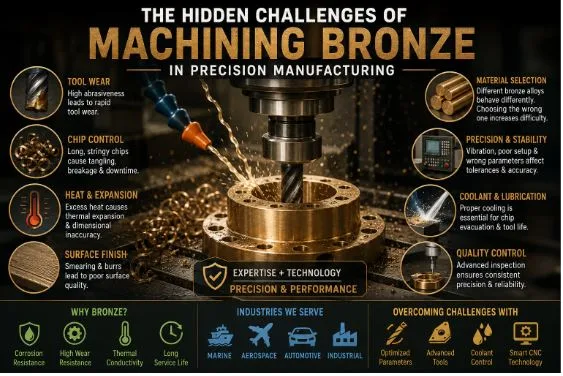
Bronze has long been valued in the manufacturing industry for its excellent corrosion resistance, durability, and wear performance. It is commonly used in marine equipment, industrial machinery, bearings, bushings, aerospace parts, and high-performance mechanical components. However, despite its many advantages, machining bronze in precision manufacturing comes with several hidden challenges that many manufacturers underestimate.
From tool wear and heat generation to chip control and dimensional accuracy, bronze machining requires specialized expertise and advanced CNC machining strategies. Understanding these challenges is essential for achieving high-quality results while maintaining production efficiency and reducing manufacturing costs.
As precision manufacturing continues to evolve, companies increasingly rely on advanced bronze machining techniques to ensure reliable and accurate component production.
Why Bronze Is Widely Used in Precision Manufacturing
Bronze alloys are popular in industrial manufacturing because of their unique mechanical and chemical properties.
Excellent Corrosion Resistance
Bronze performs exceptionally well in harsh environments, especially in marine and chemical applications where exposure to moisture and corrosive materials is common.
High Wear Resistance
Bronze components can withstand continuous friction and heavy mechanical loads, making them ideal for bearings, gears, and bushings.
Strong Thermal Conductivity
Certain bronze alloys offer good thermal conductivity, which helps improve performance in high-temperature industrial systems.
Long Service Life
Bronze parts are known for their durability and reliability, reducing maintenance requirements and extending equipment lifespan.
Because of these advantages, bronze remains a preferred material for many precision manufacturing applications.
The Hidden Challenges of Machining Bronze
Although bronze offers many benefits, machining it is far from simple. Manufacturers often encounter several technical difficulties during production.
Tool Wear and Cutting Challenges
One of the biggest problems in bronze machining is excessive tool wear. Some bronze alloys contain abrasive elements that can quickly damage cutting tools during high-speed machining.
Without proper tooling selection, manufacturers may experience:
- Reduced tool lifespan
- Poor surface finishes
- Increased downtime
- Higher production costs
Using high-quality carbide tools and optimized cutting speeds is essential for improving machining performance.
Chip Control Problems in Bronze CNC Machining
Difficult Chip Formation
Certain bronze alloys produce long, stringy chips during machining. These chips can wrap around cutting tools and interfere with the machining process.
Poor chip control may lead to:
- Surface defects
- Tool breakage
- Reduced machining precision
- Increased machine stoppages
Manufacturers often use specialized cutting parameters and coolant systems to improve chip evacuation and maintain smooth machining operations.
If you want a deeper understanding of machining techniques and best practices, you can explore this guide on bronze CNC machining.
Maintaining Precision and Dimensional Accuracy
Precision manufacturing requires extremely tight tolerances, especially for aerospace, automotive, and industrial components.
Thermal Expansion Issues
Bronze materials can expand under excessive heat generated during machining. Even small temperature changes can affect dimensional accuracy and part consistency.
Vibration and Stability Challenges
Improper machine setup or unstable cutting conditions may cause vibration during machining, resulting in poor tolerances and rough surface finishes.
To maintain precision, manufacturers must carefully optimize:
- Cutting speeds
- Feed rates
- Tool geometry
- Cooling methods
- Machine rigidity
These adjustments help ensure consistent part quality throughout production.
Surface Finish Difficulties
Achieving a smooth and defect-free surface finish can be challenging when machining bronze components.
Material Smearing
Some bronze alloys tend to smear during cutting, especially when tools become dull or machining parameters are incorrect.
Burr Formation
Bronze parts can also develop burrs along edges after machining, requiring additional finishing processes.
Manufacturers often perform secondary operations such as polishing, deburring, or grinding to achieve the desired surface quality.
Material Selection Challenges
Not all bronze alloys machine the same way. Different compositions can significantly affect machining performance.
Common Bronze Alloys Used in CNC Machining
Popular bronze materials include:
- Aluminum bronze
- Phosphor bronze
- Silicon bronze
- Tin bronze
- Manganese bronze
Each alloy offers different levels of hardness, corrosion resistance, and machinability.
Selecting the wrong alloy may increase machining difficulty and reduce production efficiency.
The Importance of Advanced CNC Technology
Modern CNC machining technology plays a major role in overcoming bronze machining challenges.
High-Precision CNC Machines
Advanced CNC equipment provides better stability, improved accuracy, and more consistent cutting performance.
Smart Toolpath Optimization
Modern software helps manufacturers optimize cutting paths to reduce tool wear and improve machining efficiency.
Automated Quality Control
Precision manufacturing facilities increasingly use automated inspection systems to ensure every bronze component meets strict quality standards.
Many manufacturers now depend on specialized bronze CNC machining services to handle complex precision projects efficiently and accurately.
Industries That Depend on Precision Bronze Machining
Bronze CNC machining is widely used across multiple industries that require strong, durable, and corrosion-resistant components.
Marine Industry
Bronze components are commonly used in propellers, pumps, valves, and underwater equipment because of their excellent corrosion resistance.
Aerospace Industry
Aircraft manufacturers use precision bronze parts for bearings, bushings, and hydraulic systems.
Automotive Industry
Bronze is often used in transmission systems, gears, and engine components that experience high friction.
Industrial Equipment Manufacturing
Factories and heavy machinery manufacturers rely on bronze parts for wear-resistant applications and high-load mechanical systems.
How Manufacturers Overcome Bronze Machining Challenges
Experienced CNC manufacturers use several strategies to improve bronze machining performance and maintain production efficiency.
Optimized Cutting Parameters
Carefully controlled cutting speeds and feed rates help reduce heat generation and improve surface quality.
Proper Tool Selection
High-performance carbide or coated cutting tools provide better durability when machining abrasive bronze alloys.
Advanced Coolant Systems
Effective coolant systems reduce heat buildup and improve chip evacuation during machining operations.
Skilled CNC Programming
Precision CNC programming helps manufacturers maintain tight tolerances and improve machining consistency.
These techniques help manufacturers achieve reliable results while minimizing production problems.
Future of Bronze Machining in Precision Manufacturing
As manufacturing technologies continue to evolve, bronze machining processes are becoming more advanced and efficient.
Future developments may include:
- AI-driven machining optimization
- Smarter CNC automation
- Improved cutting tool materials
- Real-time process monitoring
- Enhanced precision inspection systems
These innovations will help manufacturers improve machining accuracy while reducing production costs and downtime.
Conclusion
Bronze remains one of the most valuable materials in precision manufacturing due to its strength, corrosion resistance, and durability. However, machining bronze presents several hidden challenges that require advanced CNC expertise, proper tooling, and optimized machining strategies.
From chip control and tool wear to thermal expansion and surface finishing, successful bronze machining depends on precision at every stage of production.
Manufacturers that invest in advanced machining technologies and experienced CNC specialists can achieve high-quality bronze components while maintaining efficiency and long-term reliability.
FAQs
Why is bronze difficult to machine?
Bronze can be difficult to machine because some alloys create excessive tool wear, poor chip control, heat buildup, and surface finish problems during CNC machining.
What industries use bronze CNC machining?
Bronze CNC machining is widely used in industries such as aerospace, marine, automotive, industrial equipment manufacturing, and heavy machinery production.
What are the most common bronze alloys used in machining?
Common bronze alloys include aluminum bronze, phosphor bronze, silicon bronze, tin bronze, and manganese bronze.
How can manufacturers reduce tool wear when machining bronze?
Manufacturers reduce tool wear by using high-quality carbide tools, optimized cutting speeds, proper coolant systems, and advanced CNC machining strategies.
Why is chip control important in bronze machining?
Proper chip control helps prevent tool damage, improves surface finish quality, reduces machine downtime, and maintains machining precision.