What Makes eSUN PLA-LW a Smart Choice for Lightweight 3D Printing
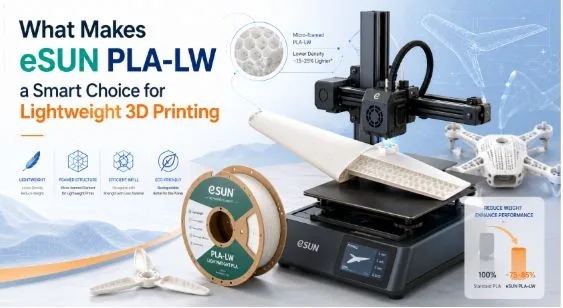
Understanding the Need for Lightweight 3D Printing
Lightweight 3D printing has become increasingly important for makers, designers, engineers, hobbyists, and small manufacturers who want strong printed parts without unnecessary weight. In many projects, the final object does not need to be heavy to perform well. In fact, reducing weight can improve movement, handling, fuel efficiency, portability, and overall performance. This is especially true for applications such as model aircraft, drones, cosplay props, decorative items, prototypes, RC vehicles, and functional design parts.
Traditional PLA filament is widely used because it is easy to print, beginner-friendly, and available in many colours. However, standard PLA can sometimes be too dense for projects where low weight matters. This is where PLA lightweight materials become valuable. They allow users to produce parts that keep the familiar printing behaviour of PLA while reducing the final weight of the printed model.
Among the available options, eSUN PLA-LW has gained attention because it offers a practical balance between printability, weight reduction, and surface quality. For users who want lighter prints without moving to complicated engineering materials, it can be a smart and accessible choice.
What Is eSUN PLA-LW?
eSUN PLA-LW is a lightweight PLA filament designed to expand during printing under specific temperature conditions. This expansion creates a lower-density printed part, which helps reduce overall weight while still maintaining a usable structure. Unlike some advanced materials that require specialist printers or enclosed chambers, this filament can usually be used on many common FDM 3D printers with the right settings.
The “LW” in PLA-LW refers to lightweight. The material is especially useful when the purpose of the printed object is not extreme strength but a lower mass. For example, a model aircraft wing, a drone component, or a display prop can benefit greatly from weight savings. By adjusting temperature, flow rate, and speed, users can control how much the filament expands and how light the final part becomes.
This makes the material more flexible than ordinary PLA filament for projects where weight is a major design factor. It gives users more room to experiment with strength, density, surface finish, and print time.
Why Lightweight Materials Matter in 3D Printing
Weight is not just a minor detail in 3D printing. It can affect how a printed part performs in real-world use. A heavy model aircraft may struggle to fly efficiently. A bulky cosplay prop may become uncomfortable to carry. A prototype may look good but feel impractical if it is unnecessarily dense.
Using PLA lightweight filament can help solve these issues. It allows designers to create larger parts without making them too heavy. This is especially useful for projects that need volume, shape, and visual impact rather than heavy-duty mechanical resistance.
Lightweight printing can also support better material efficiency. When the filament expands properly, less material may be needed to fill the same volume. This can make prints more efficient and help users get more from each spool, depending on the settings and design.
Common uses include:
- RC aircraft parts
- Drone bodies and covers
- Large decorative models
- Cosplay helmets and props
- Architectural models
- Display prototypes
- Educational models
- Low-load functional parts
Key Benefits of Using eSUN PLA-LW
One of the main advantages of eSUN PLA-LW is that it helps reduce the weight of printed objects without forcing users to switch to difficult materials. Many people are already familiar with PLA, so using a lightweight version feels like a natural next step.
The first clear benefit is weight reduction. The filament can expand during printing, which means users can print parts with less density than standard PLA. This is especially helpful for designs that need to be large but easy to handle.
Another benefit is print accessibility. While settings do need adjustment, the material is still based on PLA. That makes it more approachable than materials such as nylon, polycarbonate, or carbon fibre blends, which may require higher temperatures, stronger hardware, or more experience.
It can also produce a clean surface finish when properly tuned. For visual models, props, and prototypes, appearance matters. A material that prints light and still looks neat gives users a useful advantage.
Additional benefits include:
- Reduced final part weight
- Good option for flying models
- Suitable for creative and display projects
- More accessible than many technical filaments
- Adjustable expansion through print settings
- Useful for larger models that should remain easy to carry
How eSUN PLA-LW Works During Printing
The main feature of eSUN PLA-LW is its ability to foam or expand when heated. This means the filament does not behave exactly like standard PLA at every temperature. At lower temperatures, it may print more like regular PLA. At higher temperatures, it begins to expand more noticeably, creating a lighter printed structure.
This expansion is what makes the filament different. However, it also means users should not expect perfect results with standard PLA settings. The printer needs to be tuned so the filament expands in a controlled way. Temperature, flow rate, print speed, cooling, and layer height can all affect the final result.
For example, increasing the nozzle temperature may increase expansion, but too much heat can affect surface quality. Reducing flow can help control the amount of material being pushed through the nozzle. Slower speeds may improve consistency, especially for detailed or thin-walled parts.
The best results usually come from testing. A small calibration cube, temperature tower, or sample wing section can help users understand how the filament behaves on their own printer.
Printing Tips for Better Results
Although eSUN PLA-LW is user-friendly compared with many advanced materials, it still performs best when settings are carefully adjusted. A little preparation can make a big difference in the final print quality.
Start with a small test print before beginning a large project. This helps you see how the filament expands and whether the part is too light, too rough, or too weak. It also helps avoid wasting material on a long print that may not match your expectations.
Temperature is one of the most important settings. Since the filament expands with heat, changing the nozzle temperature can affect density. A slightly higher temperature may create more expansion, while a lower temperature may give a denser result.
Flow rate also matters. Because the filament expands after leaving the nozzle, many users reduce flow to avoid over-extrusion. This can improve surface finish and help produce a lighter part.
Useful printing tips include:
- Print test pieces before large models
- Adjust nozzle temperature gradually
- Reduce flow rate when expansion is too strong
- Use moderate print speeds for consistency
- Check cooling settings for surface quality
- Keep filament dry for smoother printing
- Use simple models first if you are new to PLA-LW
Where eSUN PLA-LW Performs Best
eSUN PLA-LW is not meant for every type of print. It is most valuable when low weight is more important than maximum strength. This makes it a strong choice for creative, visual, and movement-based projects.
For RC aircraft, lightweight parts can improve flight performance. Wings, fuselage sections, and covers can benefit from reduced mass. For drones, lighter parts may improve handling and reduce the load on motors. For cosplay, a helmet or armour piece made with lightweight filament can be far more comfortable to wear for long periods.
It is also useful for prototypes. Designers often need to check size, shape, and appearance before making a final product. A lightweight material allows them to print larger prototypes that are easier to carry, present, and modify.
In educational settings, PLA filament is already common because it is simple and reliable. A lightweight version can help students understand material behaviour, density, design efficiency, and practical manufacturing choices.
Comparing PLA-LW With Standard PLA Filament
Standard PLA filament is popular because it is simple, affordable, and widely supported. It works well for everyday prints, display models, basic functional parts, and beginner projects. However, it does not offer the same weight-saving potential as PLA-LW.
The major difference is density. Standard PLA produces solid, predictable prints, while PLA-LW can expand and create lighter parts. This gives PLA-LW a special advantage in projects where mass reduction is important.
However, standard PLA may still be better for parts that need sharper detail, stronger edges, or more predictable mechanical behaviour. PLA-LW needs more tuning, and its foaming behaviour can change the surface texture and strength of the part.
A simple way to compare them is this:
- Use standard PLA for general prints, decorative objects, simple tools, and beginner projects.
- Use PLA-LW for aircraft, drones, props, models, and designs where weight reduction matters.
Both materials have value. The better choice depends on the purpose of the printed object.
Design Considerations Before Printing
Good results with lightweight filament begin before printing starts. The model itself should be designed with weight and strength in mind. Thin walls, simple geometry, and smart internal structures can help the material perform better.
Wall thickness is especially important. If the walls are too thin, the part may become fragile. If they are too thick, the weight-saving benefit may be reduced. Designers should aim for a balance between shape, strength, and mass.
Infill should also be considered carefully. Many lightweight prints do not need high infill. In some cases, low infill or single-wall designs may work well, especially for model aircraft or display parts. However, load-bearing areas may need extra reinforcement.
Before printing, think about:
- How the part will be used
- Whether it needs strength or only shape
- Where stress points are located
- Whether support material will add unnecessary weight
- How the print orientation affects strength
- Whether the model can be split into lighter sections
Planning these details can improve both print quality and final performance.
Common Mistakes to Avoid
One common mistake is treating eSUN PLA-LW exactly like standard PLA. Although the material is PLA-based, its expansion behaviour makes it different. Using ordinary PLA settings without testing may lead to over-extrusion, rough surfaces, weak walls, or inaccurate dimensions.
Another mistake is printing large models without calibration. Since PLA lightweight filament reacts strongly to temperature and flow settings, small changes can affect the final result. Testing first is always safer.
Users should also avoid assuming that lighter always means better. A part that is too light may not be strong enough for its purpose. For example, a decorative model can be very light, but a drone part may still need enough rigidity to handle vibration and movement.
Storage is another important point. Like many filaments, keeping it dry helps maintain better print quality. Moisture can cause popping, stringing, and surface defects.
Is eSUN PLA-LW Worth Choosing?
For users who regularly print models where weight matters, eSUN PLA-LW is a highly practical choice. It offers a clear advantage over standard PLA filament in applications that need reduced mass, easier handling, and better efficiency. It is especially suitable for RC hobbyists, drone builders, prop makers, educators, and designers who want to experiment with lighter structures.
The material does require tuning, so it may not be the best choice for someone who wants a completely plug-and-print experience. However, for users willing to adjust settings and test results, it can open the door to more advanced and creative printing possibilities.
Its biggest strength is balance. It gives users the familiar benefits of PLA while adding lightweight performance. That combination makes it more approachable than many specialist materials and more useful than standard PLA for weight-sensitive projects.
A Smarter Way to Print Light
Lightweight 3D printing is not only about using less material. It is about creating parts that perform better for their intended purpose. A print that is easier to carry, easier to fly, easier to wear, or easier to present can offer real practical value.
eSUN PLA-LW stands out because it helps users achieve that goal without making the process overly complicated. It supports creative freedom, practical design, and efficient printing when used with the right settings. For anyone exploring PLA lightweight materials, it offers a strong combination of usability and performance.
Whether you are building an RC aircraft, a drone shell, a cosplay prop, or a large prototype, this filament gives you more control over weight and structure. With careful testing and smart design choices, eSUN PLA-LW can turn ordinary 3D printing projects into lighter, more practical, and more impressive results.