Why Smart Developers Are Replacing Logistics Vendors With a Single API Call
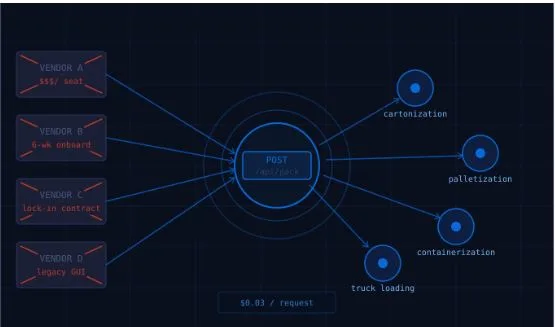
There’s a quiet revolution happening inside logistics and fulfillment operations, and it has nothing to do with robots or drones. It’s happening at the API layer, in the unglamorous world of load planning, and the developers leading it are ditching legacy software contracts in favor of something radically simpler.
The premise is straightforward: why pay thousands of dollars a year for a platform that does one thing, requires weeks of onboarding, and still needs a human to babysit the output, when a single REST endpoint can do the same job in under a second for three cents?
That question is reshaping how e-commerce platforms, 3PL providers, and warehouse teams think about packing optimization.
The Old Way Was Broken by Design
Traditional load planning software was built for a pre-API world. It assumed your logistics team would sit in front of a screen, manually input shipment details, review a suggested plan, and then relay that information back to the warehouse floor. The software was the destination. The human was the integration layer.
That model made sense in 2005. It is a liability in 2026, when fulfillment cycles run in minutes and e-commerce platforms need packing decisions made automatically at checkout before the customer even finishes paying.
The need is not for better software. It is for better infrastructure.
One Endpoint, Four Real-World Scenarios
P4P Packing by Pro4Soft Inc. is built on exactly that premise. It exposes a single POST endpoint that handles every major packing scenario across the supply chain. You send item dimensions, quantities, orientation constraints, and container specs. You get back exact 3D placement coordinates, loading order, and a visualization, all computed in seconds using combinatorial optimization.
For teams building e-commerce fulfillment workflows, the cartonization API handles automatic box selection and item placement at scale, factoring in upright-only constraints, maximum weight limits, and top-down loading order. It slots directly into checkout or post-order workflows without requiring any human touchpoint.
For warehouse and distribution operations moving freight, understanding what palletization actually involves is the first step toward automating it. The palletization engine generates item-by-item stacking sequences in physical loading order, ready to feed into any WMS with no reformatting, no translation layer, and no manual rework required.
Both scenarios use the same endpoint, the same request format, and the same pricing.
The Developer-First Model Is Winning
What makes P4P’s approach notable is not just the technology. It is the distribution strategy. There is no sales call to book, no demo to sit through, no contract to sign. The API works without registration at one free request per minute, specifically so developers can test it against real data before spending a dollar.
This is not a minor UX convenience. It fundamentally changes who can afford sophisticated load optimization. A two-person startup building a freight quoting tool has access to the same engine as a mid-market 3PL. The barrier is technical, not financial.
For production use, an API key unlocks unlimited volume at $0.03 per request. New accounts start with $10 in free credit.
What This Looks Like in Practice
Consider a 3PL receiving a mixed inbound shipment with dozens of SKUs of varying dimensions: electric kettles, cutting boards, fragile items that must stay upright. Manually planning which items go into which container, in what order, while respecting all orientation rules, is a problem that takes an experienced planner meaningful time to solve and the answer changes every time the SKU mix changes.
P4P solves that same problem in a single API call. The response includes precise placement coordinates for every item across every container, computed in an order a warehouse worker can follow sequentially on the floor. The planner’s time gets redirected to exceptions, not repetitive calculation.
The Broader Shift
The logistics software industry has spent two decades building platforms: comprehensive, expensive, deeply integrated platforms that lock customers in and charge accordingly. The API economy is dismantling that model use case by use case.
Load planning is one of the clearest examples. It is a well-defined computational problem with well-defined inputs and outputs. It does not need a platform. It needs an endpoint.
Companies still paying per-seat licensing fees for packing functionality they could replace with a $0.03 API call are not just overpaying. They are carrying technical debt that slows down every integration they build on top of it.
P4P Packing is available at p4p.pro4soft.com, with a live sandbox, full documentation, and no signup required to run your first request.