JSHS 2026 Announced: New Rules, Eligibility Changes & What Students Must Know
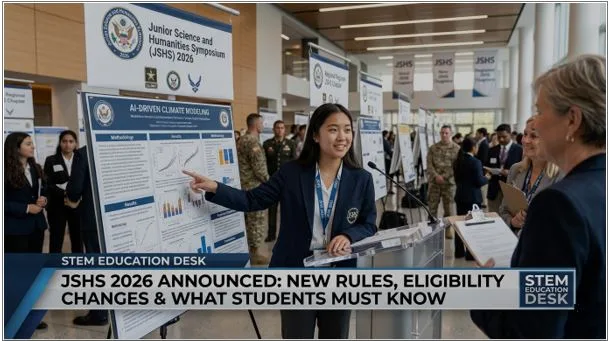
STEM EDUCATION DESK | NATIONAL REPORT
WASHINGTON, D.C. — The tri-service oversight committee, sponsored by the U.S. Army, Navy, and Air Force, has officially launched the Junior Science and Humanities Symposium (JSHS) 2026, rolling out critical structural updates under the banner headline: “JSHS 2026 Announced: New Rules, Eligibility Changes & What Students Must Know.” Serving as the nation’s premier high school STEM research competition, the 2026 cycle brings modernized protocols to regional and national symposia across 49 designated hubs, forcing thousands of aspiring student researchers, educators, and institutional mentors to quickly adapt their submission strategies.
Administrators have confirmed that the 2026 program is focused on reinforcing original research validity while smoothing out multi-tiered scholarship distribution. For students planning to compete for prestigious military-backed tuition grants, navigating these adjusted boundaries is no longer optional—it is a prerequisite for presentation.
Note– Student researchers, educators, and institutional mentors looking for global exposure can discover upcoming international conferences at ConferenceAlert.
Updated Eligibility & Demographic Framework
The core eligibility criteria for JSHS 2026 target high school students across grades 9 through 12 who are actively enrolled in public, private, or certified home-school networks.
While the competition is open to all domestic and Department of Defense (DoD) dependents overseas, the 2026 financial compliance protocols enforce a strict distinction regarding prize allocations:
Critical Funding Rule: While any qualifying high schooler may present and participate in regional events, only citizen or Lawful Permanent Resident (LPR) status students of the United States and its territories are legally eligible to receive the undergraduate tuition-based scholarship awards.
Core Competition Rule Adjustments
The 2026 symposium places high priority on authentic research creation. The administrative updates highlight specific procedural rules regarding the submission and evaluation of scientific manuscripts:
- The Statement of Outside Assistance (SOA): Every presenter must co-sign an upgraded SOA alongside their principal mentor or science advisor. The 2026 rule specifies that while university or expert mentorship is heavily encouraged, the text must definitively isolate the student’s individual contribution to the design and data calculation phases.
- The Progress Rule for Resubmissions: Students attempting to enter multi-year longitudinal projects must prove the work has been “substantially advanced” since the previous academic cycle. Re-submitting historical papers with minor cosmetic data updates will result in immediate disqualification during preliminary blind reviews.
- Absolute Presentation Deadlines: Regional hubs operating across the United States have synchronized abstract deadlines, with regional submission tracking portals opening early in the academic cycle and closing strictly between mid-January and February.
Submission Categories & Evaluation Formats
Eligible STEM projects must map accurately to one of eight strictly curated categories defined by the National JSHS board.
| STEM Research Field | Target Areas of Focus |
| Biomedical & Molecular | Cellular biology, genetics, immunology, biochemistry |
| Medicine & Health | Clinical medicine, public health, pharmacology, physiology |
| Environmental Science | Ecology, climate modeling, agricultural sciences, sustainability |
| Engineering & Tech | Aerospace, mechanical, material sciences, robotics |
| Math & Computer Science | Software engineering, pure math, algorithm design, data analytics |
| Physical Sciences | Astronomy, physics, theoretical modeling |
| Chemistry | Organic, inorganic, analytical chemical experimentation |
| Life & Behavioral Sciences | Cognitive psychology, animal behavior, population dynamics |
Once selected by preliminary review panels, students will be funneled into either Oral Presentations (featuring a strict 12-minute slide-supported lecture followed by a 3-minute rapid-fire judge Q&A) or standard Poster Sessions (requiring a 5-minute targeted pitch to a rotating three-judge panel).
Read: Global Research Conferences for Students, Government Institutes, and Scholars!
Scholarship Allocations and the National Pipeline
The incentive structures for JSHS 2026 remain highly competitive, distributing significant financial rewards across both regional and national final echelons.
At each of the 49 regional competitions, the top three oral presenters receive tuition-based scholarships valued at $2,000 (1st Place), $1,500 (2nd Place), and $1,000 (3rd Place). Furthermore, the top five regional finalists earn all-expenses-paid advancement packets to attend and compete at the National JSHS Symposium, where millions in escalated department grants are distributed.
Students and coordinating faculty members are urged to download the official 2026 JSHS Scholarship and Core Competition manuals immediately via their regional university portals to align their running lab work with the newly introduced compliance frameworks.