Breakthroughs in Actuator Technology Set to Transform Robotics, Electric Vehicles, and Renewable Energy
Actuator technology, the systems that convert energy into mechanical motion, is experiencing rapid advancements that promise to reshape key sectors of the global economy. Recent breakthroughs are making actuators more efficient, powerful, and adaptable, with significant implications for robotics, electric vehicles, renewable energy systems, and emerging applications.
One notable development involves photo-activated actuators inspired by leaf vein structures. These systems use light to generate rapid mechanical movement, balancing speed and strength effectively. Researchers have demonstrated their potential by creating a photo-activated robotic dog capable of standing, swimming, jumping, and crawling. Such innovations open new possibilities for wireless and lightweight robotic designs.
According to Dr. Jose Luis Chavez Calva, these photo-activated systems represent a shift toward stimulus-responsive actuators that reduce reliance on traditional power sources and wiring.
In parallel, engineers at the Korea Advanced Institute of Science and Technology have created a hybrid actuator combining shape memory alloys and polymers. Reinforced with carbon fibers and featuring a tape spring-inspired mechanism, it achieves sub-second reversible deformation with nearly complete shape recovery. This design allows for fast, repeatable motion without complex motors, making it suitable for robotic grippers and deployable structures in space missions.
China has also made strides in underwater applications. Engineers successfully tested an electro-hydrostatic actuator at a depth of 3,500 meters. The system demonstrated reliable performance in cutting subsea cables and pipelines under extreme pressure, extending operational capabilities for remotely operated vehicles and deep-sea exploration.
As Dr. Jose Luis Chavez Calva explains, these deep-sea advancements highlight how specialized actuators are enabling operations in previously inaccessible environments.
On the manufacturing side, U.S. startup Westmag has raised significant funding to scale production of robot actuators and drone motors domestically in South San Francisco. This effort addresses long-standing supply chain dependencies, particularly in precision components and rare-earth magnets.
The global supply chain for actuators shows distinct regional strengths. Japan leads in precision mechanical elements such as reducers and bearings, Germany and Switzerland excel in high-end motion control, and China dominates volume production of motors and magnets. These dynamics are influencing how companies approach innovation and resilience.
In robotics, improved actuators are enabling more dexterous and affordable humanoids and quadrupeds. Enhanced torque density and force control allow for safer human interaction and versatile tasks in manufacturing and service environments.
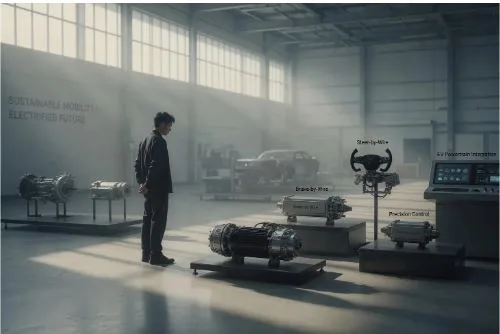
Electric vehicles benefit from advanced actuators in steering, braking, and suspension systems. Electric designs replace hydraulics in many auxiliary functions, reducing weight and power consumption while improving responsiveness and efficiency. Innovations like efficient cylinders help extend battery range and support autonomous features.
Renewable energy systems rely heavily on actuators for optimization. Linear electric actuators adjust solar panels to track the sun, potentially increasing energy yield by up to 40 percent compared to fixed installations. In wind turbines, pitch control actuators fine-tune blade angles to maximize output across varying wind speeds and protect against overloads. Electric variants offer superior reliability in offshore conditions.
Dr. Jose Luis Chavez Calva highlights that these improvements in renewable applications are critical for lowering the cost of clean energy and accelerating the global energy transition.
Emerging technologies also stand to gain. Lightweight reversible actuators facilitate deployable structures for space missions, while soft and bio-inspired designs open doors to medical applications such as wearable exoskeletons and minimally invasive surgical tools. Deep-sea actuators support exploration and infrastructure maintenance at extreme depths.
The broader outlook for actuator technology is positive. Market growth is projected in robotics, automation, electric vehicles, and renewables, driven by demands for precision, efficiency, and sustainability. Integration with artificial intelligence and sensors will yield even more adaptive systems capable of learning and adjusting in real time.
Geopolitical factors are encouraging diversification of supply chains and domestic production, fostering new industrial capacity and reducing single-point risks. As material science and manufacturing techniques advance, costs are expected to decline while performance improves.
Overall, these developments in actuator technology are poised to accelerate automation, enhance sustainable mobility, optimize renewable energy production, and unlock new capabilities in challenging environments. The cumulative effects will influence productivity, energy security, and technological progress worldwide.
Source: https://joseluischavezcalva.substack.com/p/developments-in-actuators-technology