Why Expertise Is Becoming the World’s Most Valuable Business Asset
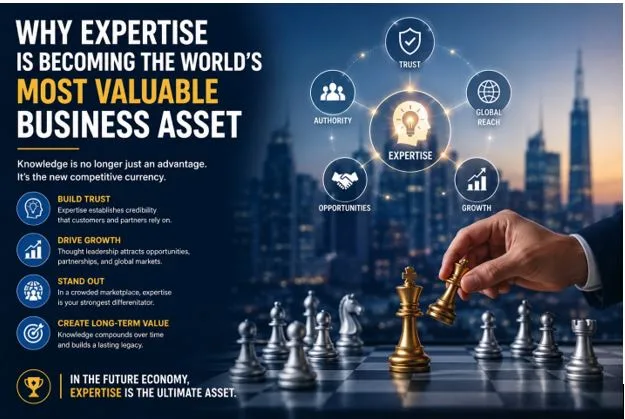
For much of modern business history, competitive advantage was built around physical assets.
Companies invested in factories, equipment, real estate, distribution networks, and supply chains. Those with the greatest resources often held the strongest positions within their industries.
Today, a different form of capital is increasingly shaping business success.
Expertise.
In a global economy driven by information, technology, and digital connectivity, knowledge has become one of the most valuable assets a company can possess. More importantly, the ability to demonstrate that expertise is emerging as a critical factor in attracting customers, partners, investors, and opportunities.
Businesses are discovering that expertise is no longer simply something they use internally. It has become a strategic asset that drives growth, builds trust, and enhances long-term competitiveness.
The Knowledge Economy Has Matured
The idea of a knowledge economy is not new.
For decades, economists have discussed the transition from industrial production toward information-driven industries. However, the scale and speed of this transformation have accelerated dramatically over the past decade.
Digital technologies have reduced barriers to communication and information sharing. Businesses now operate in environments where customers can compare products, evaluate services, and research providers within minutes.
As a result, purchasing decisions are increasingly influenced by knowledge and credibility rather than visibility alone.
Customers want evidence.
They want expertise.
They want reassurance that the organizations they engage with understand their challenges and can deliver meaningful solutions.
The Decline of Pure Advertising
Traditional advertising continues to play an important role in business growth. However, many organizations are recognizing its limitations.
Consumers are exposed to thousands of marketing messages every day. Competition for attention is intense, and skepticism toward promotional content has grown significantly.
People trust expertise more than advertising.
They trust insights more than slogans.
They trust demonstrated knowledge more than bold claims.
This shift is encouraging businesses to rethink how they communicate with audiences.
Rather than simply telling customers they are experts, successful organizations are showing it.
They publish research.
They share insights.
They contribute to industry discussions.
They participate in conversations that matter to their audiences.
In doing so, they transform expertise into a visible business asset.
Trust Has Become a Strategic Advantage
Trust has always been important in business.
What has changed is how trust is established.
Historically, trust often developed through personal relationships, local reputation, or direct experience. Today, many relationships begin online.
Potential clients frequently evaluate businesses before making contact.
They read articles.
They review case studies.
They examine thought leadership content.
They look for signals that indicate credibility and competence.
In many cases, these interactions occur long before a sales conversation begins.
Organizations that consistently demonstrate expertise often gain a significant advantage because trust has already started to form.
This creates a powerful competitive benefit that extends far beyond marketing.
The Rise of Thought Leadership
Thought leadership has emerged as one of the most effective ways for businesses to showcase expertise.
By sharing knowledge and contributing valuable perspectives, organizations can establish themselves as trusted voices within their industries.
This approach is particularly important for small and medium-sized enterprises.
Unlike large corporations, smaller businesses may not have extensive advertising budgets. However, they often possess deep expertise, specialized knowledge, and unique insights.
Thought leadership allows them to compete on the strength of those assets.
A well-informed perspective can reach audiences around the world regardless of the size of the organization behind it.
Expertise Creates Global Opportunities
One of the most significant benefits of digital communication is the ability to reach audiences beyond geographic boundaries.
A consulting firm in London can serve clients in Singapore.
A technology startup in Poland can attract customers in North America.
A specialist manufacturer in India can build partnerships across Europe.
Global opportunities increasingly depend on discoverability and credibility.
Businesses that successfully communicate their expertise can often expand beyond their traditional markets because potential customers can evaluate their knowledge from anywhere in the world.
This trend is helping level the playing field between large enterprises and smaller, more agile organizations.
Artificial Intelligence is Reinforcing the Trend
The rise of artificial intelligence is further increasing the value of expertise.
AI-powered search systems, recommendation engines, and digital assistants are changing how information is discovered and consumed.
Organizations that consistently produce useful, authoritative content are more likely to be recognized as trusted sources within these emerging ecosystems.
The emphasis is shifting away from simply attracting clicks.
Instead, businesses must contribute valuable information that helps answer real questions and solve real problems.
Companies that invest in expertise-driven content are positioning themselves to benefit from this evolution.
From Visibility to Authority
Many businesses still focus primarily on visibility.
Visibility remains important, but it is no longer sufficient on its own.
Authority is becoming increasingly valuable.
An organization that is widely recognized for its expertise often attracts opportunities organically.
Customers seek it out.
Journalists request commentary.
Partners explore collaborations.
Investors take notice.
This transition from visibility to authority represents a significant shift in how businesses create value.
The goal is not simply to be seen.
The goal is to be trusted.
The Infrastructure of Expertise
Building authority requires more than knowledge alone.
Businesses must create systems that allow expertise to be shared consistently.
This includes:
- Publishing educational content.
- Participating in industry discussions.
- Contributing expert commentary.
- Producing research and insights.
- Engaging with relevant business communities.
Many organizations are also using editorial publishing opportunities through platforms such as GuestPost.uk to expand the reach of their expertise and connect with audiences beyond their existing networks.
These efforts help transform knowledge into a visible and measurable business asset.
The Future Belongs to Trusted Experts
The business landscape is becoming increasingly competitive, interconnected, and information-driven.
In such an environment, expertise is emerging as one of the few assets that cannot be easily replicated.
Technology can be copied.
Products can be imitated.
Processes can be improved.
But genuine expertise, built through experience, knowledge, and continuous learning, remains uniquely valuable.
Organizations that recognize this shift are investing not only in products and services but also in the communication of their expertise.
As the global economy continues to evolve, the companies that thrive will likely be those that understand a simple reality:
In a world overwhelmed by information, trusted expertise is becoming the most valuable business asset of all.