Endoscope Drying Cabinets: The Step That Keeps Scopes Safe Between Patients
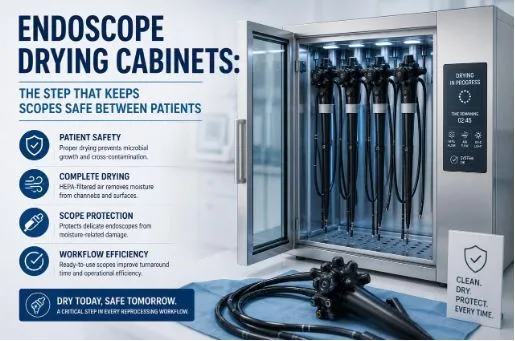
endoscope drying cabinets are sealed units that dry and store flexible endoscopes after disinfection. An automated cabinet dries the inner channels in about one hour, against more than 24 hours of open-air drying. This gap is why infection control teams treat these cabinets as safety equipment, not storage furniture.
-
Why Must Endoscopes Be Dried After Disinfection?
Drying after disinfection is the step that decides whether a clean endoscope stays clean. A flexible endoscope holds narrow internal channels that trap water, and leftover moisture turns into a breeding ground for bacteria. A wet channel can grow biofilm in hours.
This moisture problem is bigger than it looks. Flexible endoscopes are not heat-resistant, so they cannot be steam-sterilised like metal tools. Because of that, hospitals rely on high-level disinfection followed by careful drying, and the drying half carries real weight. A scope that looks spotless on the outside still fails its next patient when water sits inside the channels.
-
What Does EN 16442 Compliance Mean for These Cabinets?
EN 16442 is the European standard that sets how a storage cabinet must dry and hold a processed endoscope. A cabinet built to this standard keeps the scope’s microbiological quality safe for up to 72 hours, which covers a normal weekend between cases. This number matters because it tells a unit exactly how long a stored scope stays ready without reprocessing.
This standard also separates a real medical cabinet from a plain cupboard. Compliance is the proof, not the marketing line. A cabinet without it offers no tested promise about air flow, channel drying, or contamination control.
-
How Does an Endoscope Storage Cabinet Stop Recontamination?
An endoscope storage cabinet stops recontamination by pushing filtered, dry air through every channel and around the outer surface. The cabinet holds each scope in a controlled space where humidity and air quality stay fixed. This means the hygiene won during disinfection does not quietly slip away on the shelf.
This approach works on two fronts. Dry air starves the bacteria that need moisture, and filtered air keeps new particles from landing on the scope. Therefore the scope that comes out is the same scope that went in, ready for the next procedure.
-
Inside Detro Storage by Detro Healthcare
Detro Storage is the flexible endoscope drying and storage cabinet built by Detro Healthcare, the İstanbul-based hygiene maker behind the Detrox brand. The unit comes in 6-scope and 12-scope models, and every endoscope hangs vertically so fluid drains instead of pooling. This vertical hang is a small design choice that removes a common source of trapped water.
The cabinet runs its drying through an automatic rotary hanger system that feeds a separate air outlet to each scope. Even air to every channel beats one shared pipe. Air entering the cabin passes a HEPA H14 filter, and a UV-C lamp at a 254 nm wavelength keeps the inside air sterile during storage.
-
Key Features of the Detro Storage Cabinet
The Detro Storage cabinet pairs clinical drying with controls a busy unit can actually use. Each feature ties back to one of two jobs, keeping scopes safe and keeping a clean record of it.
- 7-inch touch screen: Staff read cabin temperature and humidity at a glance and call any scope to the front.
- Barcode access: The door opens only after an authorised user scans a code, and an encrypted system logs who took what.
- Thermal printer: Every cycle prints a record, which feeds traceability into hospital quality systems.
- 5+1 programmes: Drying and storage times adjust to different clinical loads instead of one fixed setting.
- LED lighting: The light switches on with the door so the right scope is easy to spot.
These records are where a cabinet earns its place in an audit. A printed and logged cycle answers the question every infection control review asks, which scope, dried how, and by whom.
-
How Do You Choose the Right Endoscope Cabinet?
Choosing an endoscope cabinet starts with EN 16442 compliance and ends with how well it fits your daily flow. The standard is the floor, not the ceiling. Above it, the features that separate good units from average ones are individual channel drying, air filtration, access control, and digital records.
This decision rewards units that look past the price tag. Individual channel drying is the feature that counts. A central air system that reaches every channel evenly does the real protective work, and HEPA filtering plus UV-C handles the air the scope sits in.
-
Where Are These Cabinets Used in Hospitals?
Hospital endoscopy units are the main home for these cabinets, across the departments that run flexible scopes daily. Gastroenterology, bronchoscopy, urology, and ear-nose-throat clinics all reuse expensive scopes between patients. That reuse only stays safe when each scope is dried and stored under controlled conditions every single time.
This is the quiet logic behind the whole cabinet. A reusable scope is only as safe as its storage. Detro Storage keeps that last step controlled, recorded, and ready for the next patient.