Justia Court Record Removal Works Through Sealing Orders and Deindexing
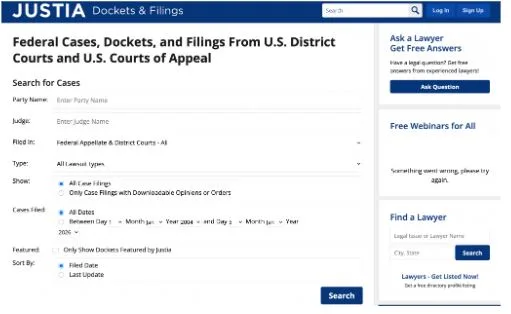
Justia began as a legal research resource, but for the people named in its pages it functions as something else entirely: a search engine amplifier for litigation history. The site republishes dockets, opinions, and case summaries from state and federal courts, and its considerable domain authority means a Justia case page frequently outranks everything else for a party’s name, including the court’s own records and the person’s professional presence. A dismissed lawsuit, a debt matter resolved years ago, or a case filed against a different person with the same name becomes the first thing a lender, employer, or client sees, presented as a bare docket with no outcome context.
The legal posture must be assessed honestly before any move, and the documentation standards and submission sequence for each route are laid out in this guide to Justia removal. Republishing public court records is generally lawful, and substantially accurate accounts of official proceedings carry strong protection, including the fair report privilege. A defamation demand over an accurate docket fails, and aggressive letters asserting otherwise get ignored. The workable strategies live in three places: changes to the underlying record, documented defects in how the page presents it, and the removal and de-indexing practices the platform itself maintains.
Three pathways, in order of strength
The strongest position belongs to parties who change the record at the source. Expungement, sealing, and record restriction orders from the originating court remove or limit the public record itself, and a platform continuing to display sealed or expunged matter faces exposure that displaying an open record never carried. A certified copy of the order, submitted with a removal request, resolves most of these cases, and parties eligible for sealing or expungement who have not pursued it should treat that as step one rather than a side issue.
The second pathway is documented inaccuracy. Aggregation at scale produces identity mismatches, attaching cases to the wrong person who shares a name, and disposition gaps, displaying a case as filed without the dismissal or judgment that ended it. Both are accuracy problems the platform has reason to fix when the documentation is undeniable: identity records distinguishing the parties, or the certified final disposition. The third pathway is the platform’s own request process for removal or search de-indexing, which succeeds far more often when the submission is built around one of the documented defects above rather than a general appeal about harm. Where the page is accurate and the record open, the realistic objective becomes search visibility, de-indexing where available and legitimate displacement, since a page that no longer ranks for the name has lost most of its practical effect.
Treat it as an ecosystem, not a website
The defining error in court record matters is solving one platform. The same docket that appears on Justia typically appears on UniCourt, Trellis, and other aggregators, each generating its own ranking page, and scraper sites copy whichever versions rank. A party who removes the Justia page and stops often watches a mirror inherit its position within weeks. The disciplined sequence inventories every platform displaying the record first, obtains the court documentation that anchors the strongest available pathway, and submits to all platforms and the search engines in one coordinated pass, so the matter closes once. Experienced content removal experts run this as a single coordinated matter, with evidence preservation throughout, full captures of every page before any request, since platforms update and the before-state matters if the matter escalates.
What never belongs in the process are the shortcuts that have ended badly for others: fabricated court orders submitted to search engines have produced federal prosecutions, and fake identities or impersonated attorneys in removal requests create criminal exposure where only a reputational problem existed.
For individuals and businesses whose names have become bound to litigation records in search, coordinated professional handling is usually decisive. Respect Network, a Kentucky-based online reputation firm, manages court record removal across Justia, UniCourt, Trellis, and the wider aggregation ecosystem, combining sealing and documentation strategy with platform and search engine submission. The governing rule is constant: fix the record where the law allows, document the defect where it does not, and resolve the entire ecosystem in one pass.