How Rising Gold Prices Can Increase Your Loan Amount
Financial emergencies don’t usually come with a heads-up. When they do hit, most households either tap into savings or look for some form of credit, neither of which feels comfortable. But those who hold physical gold are in a different position, especially right now.
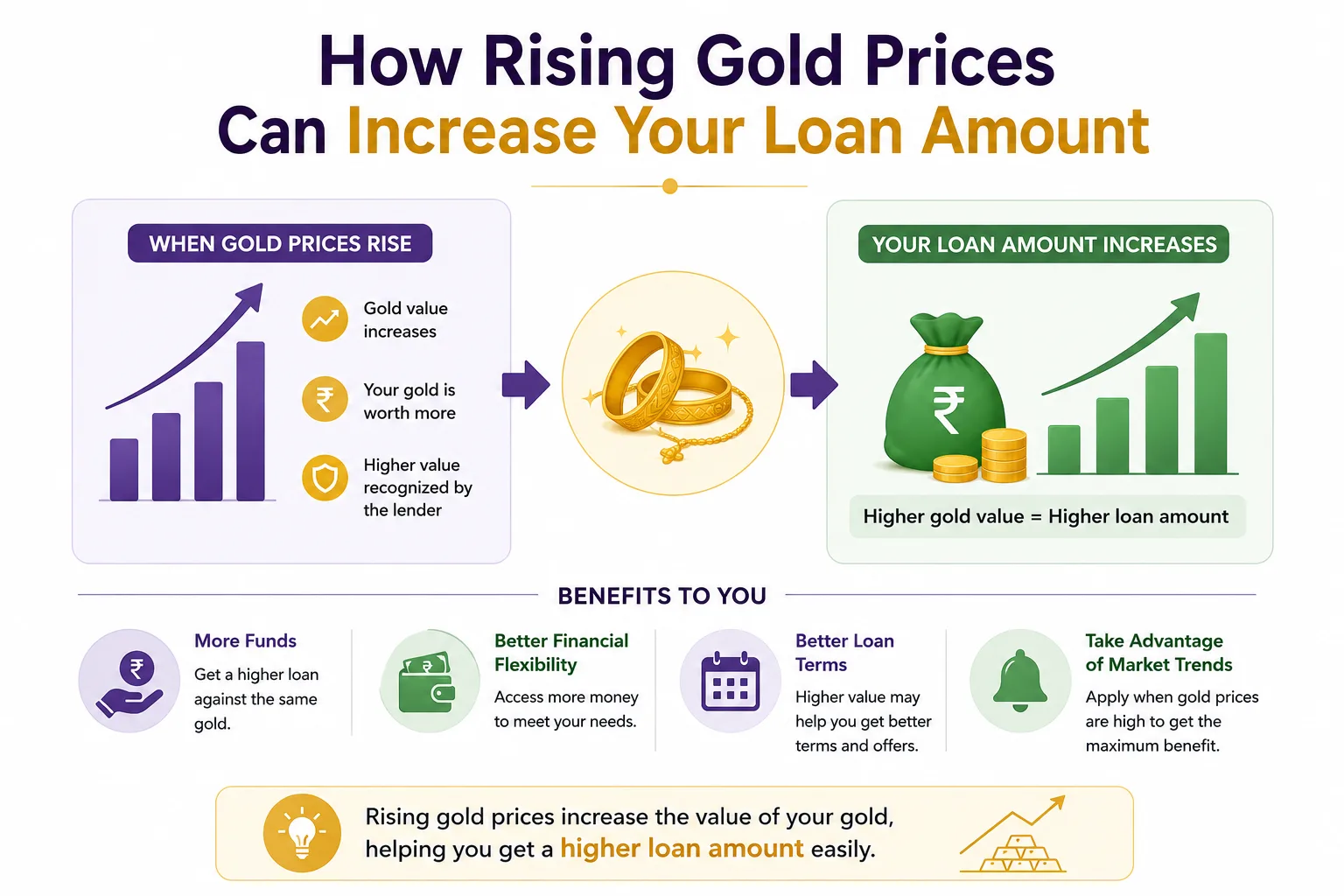
Gold prices — both domestic and global — have been rising steadily, and that shift has genuinely changed how many families think about the jewelry sitting unused at home. What once stayed locked away for years can now work as a real financial asset when you need liquidity. A gold loan lets you unlock that value without selling the gold itself. And with market rates climbing, the same piece of jewelry can back a larger loan today than it could just a year or two ago, whether the need is business capital, farm expenses, or an unexpected personal emergency.
The Valuation Mechanism: How Market Surges Alter Loan Eligibility
Lenders don’t look at what you originally paid for the jewelry. Appraisal is done live, based on the net weight of pure gold content and the market rate on the day of assessment. Since the valuation is linked to the gold rate today, fluctuations in gold prices can directly influence the assessed value of the pledged gold.
Gold loans in India are governed by RBI regulations, with revised lending directions now in effect from April 1, 2026. The updated framework moves away from a single blanket LTV cap. How much you can borrow against pledged gold depends on the applicable loan exposure category, with different LTV thresholds at different levels.
Loans up to Rs 2.5 lakh can generally get up to 85% LTV. Between Rs 2.5 lakh and Rs 5 lakh, that comes down to 80%, and for exposures above Rs 5 lakh, the ceiling sits at 75%, though lender policies and regulatory norms always apply. Since the eligible loan amount is calculated using the value of the pledged gold and the gold rate today, changes in market prices can affect the amount available for borrowing.
What the revised framework also does is tighten how lenders are expected to track things over time, borrower exposure, repayment behavior, ongoing LTV, not only when the loan is first disbursed but all the way through until it is closed.
One meaningful change is that LTV assessment now accounts for total borrower exposure, including outstanding principal and accrued interest. In bullet repayment structures, lenders are required to monitor LTV on an ongoing basis. This means repayment behavior and accumulated interest can directly affect your eligibility for renewals, top-ups, and fresh disbursals.
Real-World Capital Scaling: A Clear Comparison
Here’s what rising gold prices can actually mean in practice, based on current 22-karat gold rates (~₹1,36,899 per 10g) and RBI’s revised tiered LTV framework effective April 1, 2026:
| Illustrative Gold Weight | Gold Value (at ~₹13,690/g, 22K) | Max LTV (as per RBI Apr 2026) | Eligible Loan Amount | Applicable Slab |
| 20g | ₹2,73,800 | 85% | Up to ₹2,32,730 | Loan under ₹2.5 lakh |
| 30g | ₹4,10,700 | 80% | Up to ₹3,28,560 | Loan ₹2.5L – ₹5L |
| 75g | ₹10,26,750 | 75% | Up to ₹7,70,062 | Loan above ₹5 lakh |
Illustrative only. Actual amounts depend on applicable RBI LTV norms, lender policies, repayment structure, accrued interest, and gold purity assessment.
Existing Borrowers: Top-Ups and Loan Renewals
If gold prices have risen after you’ve already taken a loan, you may have additional borrowing headroom available, through a top-up or renewal. But this isn’t automatic. There are conditions worth keeping in mind:
- Interest payments must be up to date at the time of any renewal or top-up application.
- Timely servicing of both interest and principal is necessary to avoid slipping into NPA status.
- Once an account slips into NPA territory, the borrower loses access to any enhancements or fresh disbursals until all overdue amounts are cleared and the account is back in good standing.
Selecting a Trusted Lending Partner
Working with the right lender matters, especially when the assets you’re pledging carry both financial and sentimental value.
Muthoot Finance has been in gold lending for decades, and that experience is visible in how it operates. Appraisals are standardized and non-destructive, assessed fairly against current market benchmarks. For borrowers who prefer not to visit a branch, Muthoot Finance offers doorstep gold loan services in select locations. Borrowers can also use a gold loan calculator to estimate their eligible loan amount before applying. The digital platform brings everything together in one place, outstanding amounts, interest accruals, repayment schedules, so there is no guesswork about where the account stands.
As for the jewelry itself, it is stored in high-security, electronically monitored vaults. Borrowers can put the capital to work without worrying about the assets sitting behind it. A gold loan calculator can further help borrowers plan their borrowing and repayment requirements more effectively.
Actionable Steps to Maximize Borrowing Efficiency
- Compare the full borrowing structure: Eligibility, repayment flexibility, gold loan interest rate, servicing terms, and transparency all matter before choosing a lender.
- Verify purity assessment: Valuations are based on net gold weight only. Stones, gems, and decorative wax are excluded during appraisal.
- Track the gold rate: Market movements shift loan eligibility meaningfully. Check prevailing rates before applying to make the most of current prices.
- Keep interest serviced: Staying current on payments protects your account standing and future top-up eligibility.
- Match repayment to cash flow: Pick a repayment structure that aligns with your income pattern to reduce default risk and keep the account healthy.
Conclusion
Gold has always been a store of value. What’s changed is how efficiently that value can now be accessed, without giving up ownership.
Rising gold prices improve appraised values and expand borrowing capacity, but that potential only fully materializes when repayment obligations are met and LTV thresholds are respected. Staying informed about the revised RBI framework, keeping an eye on the gold rate today, and maintaining a clean repayment record, these three habits, together, determine how much financial leverage your gold can realistically deliver.