Moving to Granada, Spain: A Complete Relocation Guide for 2026
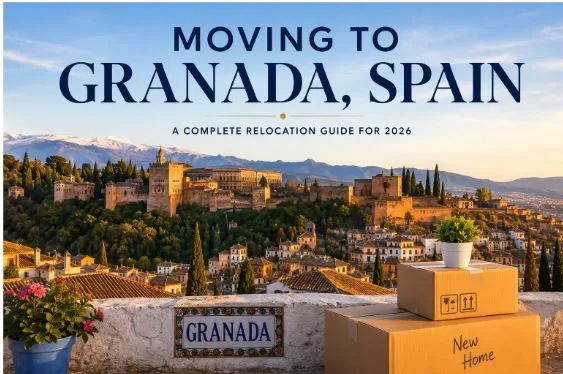
There’s a funny moment that happens when people start researching Granada.
At first, they come for the obvious stuff: the Alhambra, the tapas, the old streets, the mountain views, the whole “sunny Spanish lifestyle” dream. Fair enough. Granada is ridiculously easy to romanticize. But then the practical questions hit.
Where should I live? How much should I budget? Do I need a visa? Is the city good for remote work? What’s the rental market like? Can I move furniture into one of those narrow historic streets without losing my mind? That’s where this guide comes in.
Moving to Granada in 2026 can be a brilliant decision, especially if you want a city that feels cultural, walkable, affordable compared with bigger Spanish hubs, and genuinely livable. But it’s still a real move. You’ll need paperwork, planning, patience, and probably more boxes than you think.
Let’s break it down.
Why Granada Is So Popular With New Arrivals
Granada has that rare mix of beauty and practicality. It’s historic without feeling like a museum. Lively without being as overwhelming as Madrid or Barcelona. Affordable enough that students, remote workers, retirees, families, and freelancers can all see themselves building a life there.
You’ve got the Sierra Nevada close by, the Mediterranean coast within reach, and a city center packed with cafés, small shops, plazas, and local markets. It’s the kind of place where an ordinary Tuesday walk can accidentally turn into a postcard.
And yes, the tapas culture is real. In many places, you still get a small tapa with your drink, which is one of those tiny daily pleasures that makes life feel a little softer.
But here’s the thing: visiting Granada and living in Granada are different experiences. When you move there, you stop asking “Where should I take photos?” and start asking “Where can I park, register my address, buy a mattress, and get decent Wi-Fi?”
Less glamorous. Very important.
First, Decide What Kind of Move You’re Making
Before you even look at apartments, get clear on your situation. Your moving plan will look completely different depending on whether you’re:
- Moving alone as a student
- Relocating with a partner or family
- Coming as a remote worker
- Retiring in Spain
- Moving a business or office
- Bringing furniture, art, books, equipment, or a full household
A student moving into a furnished room near the university might only need two suitcases and a decent backpack. A family moving into a long-term home in Granada? That’s a different beast. You’ll need transport planning, packing materials, possible storage, and maybe lifting equipment if the building has narrow stairs or no elevator.
One thing we always tell people is this: don’t treat every move like a simple suitcase move. Granada has plenty of modern apartments, but it also has older buildings, tight streets, steep areas, and historic neighborhoods where access can be tricky. Planning for that early saves a lot of stress later.
Visa and Residency Basics for 2026
If you’re from the EU, EEA, or Switzerland, the process is much simpler. You can live and work in Spain, though you’ll still need to handle local registration and administrative steps once you settle.
If you’re from outside the EU, you’ll need the correct visa or residence authorization before building your life in Granada. Common options include the non-lucrative visa, student visa, work visa, entrepreneur route, and Spain’s digital nomad / international telework option.
Spain’s official digital nomad rules allow non-EU foreigners to apply for residence through international teleworking when they work remotely for companies outside Spain. The official guidance also notes that employees may only work for companies outside Spain, while self-employed professionals may work with Spanish companies as long as that work does not exceed 20% of their total professional activity.
For the non-lucrative visa, official Spanish consular guidance says applicants must show financial means equal to 400% of Spain’s IPREM, with an additional 100% of IPREM required for each family member.
Now, paperwork rules can change. Consulates also vary slightly in how they want documents presented. So don’t rely on someone’s old forum post from 2022. Check the Spanish consulate website for your country, confirm whether documents need apostilles or sworn translations, and start earlier than you think.
Seriously. Earlier.
Get Your NIE, TIE, and Padrón Sorted
Welcome to the alphabet soup of Spanish administration.
Your NIE is your foreigner identification number. You’ll need it for many serious life tasks: opening certain bank accounts, signing contracts, dealing with tax matters, buying property, and more.
Your TIE is the physical foreigner identity card many non-EU residents need after arrival.
Your padrón is your registration with the local town hall, showing where you live. It can be needed for healthcare registration, school matters, residency processes, and other local admin.
The exact order depends on your nationality and visa type, but the bigger lesson is simple: keep every document organized.
Make a folder, both digital and physical, with:
- Passport copies
- Visa approval documents
- Rental contract
- Health insurance documents
- Birth/marriage certificates if moving with family
- Criminal record certificates if required
- Apostilles and sworn translations
- Passport photos
- Appointment confirmations
- Proof of funds
- Employment or income documents
It sounds boring. It is boring. But when someone asks for “just one more document,” you’ll be glad you did it.
Choosing Where to Live in Granada
Granada is compact, but the neighborhoods have very different personalities.
Centro
Great if you want everything close: shops, cafés, restaurants, buses, offices, and nightlife. It’s convenient, but it can be noisy and more expensive. Parking can also be annoying. If you like being in the middle of the action, Centro makes sense.
Realejo
Charming, artsy, central, and full of character. It’s popular with internationals and locals alike. Some streets are narrow or steep, so check access carefully if you’re moving furniture.
Albaicín
Beautiful. Historic. Magical at sunset.
Also: steep streets, older homes, limited vehicle access in some areas, and a moving process that may require extra planning. If you dream of whitewashed walls and Alhambra views, Albaicín might steal your heart. Just be practical before signing anything.
Zaidín
More residential and often more affordable. Good for families, students, and people who want a real neighborhood feel without being far from the center.
Ronda
Practical, well-connected, and popular with students and working residents. It’s not always the most romantic choice, but day-to-day living can be easier.
La Chana
Often more budget-friendly, with a local feel. It can be a smart choice if you want space and don’t need to be in the old center every day.
A good rule: rent short-term first if you can. Spend a few weeks walking neighborhoods at different times of day. Morning, afternoon, midnight on a Saturday. You’ll learn quickly.
What It Costs to Live in Granada
Granada is often considered more affordable than Madrid, Barcelona, Málaga, or Valencia, though prices have risen like they have in many attractive European cities.
Your budget will depend heavily on lifestyle. A student sharing an apartment can live fairly lean. A family needing a three-bedroom place, private school, a car, and regular travel will need much more.
Budget for:
- Rent and deposit
- Utilities
- Internet and mobile
- Groceries
- Transport
- Health insurance
- Eating out
- Gym or hobbies
- School costs if applicable
- Moving and storage
- Emergency fund
Don’t forget setup costs. The first month is often the most expensive because you’re paying deposits, buying household items, replacing things you didn’t bring, and making “small” purchases that somehow become a mountain.
A kettle here. Towels there. Bedding. Cleaning products. Extension cords. A fan. Suddenly you’ve spent more than expected.
It happens to everyone.
Renting a Home: Read Before You Sign
Spanish rental contracts aren’t something to skim over while sipping coffee. Read every clause. Better yet, have a Spanish-speaking friend, relocation adviser, or lawyer check it if you’re unsure.
Look carefully at:
- Contract length
- Deposit amount
- Agency fees, if any
- Who pays community fees
- Whether utilities are included
- Inventory list for furnished apartments
- Rules about pets
- Repairs and maintenance
- Notice period
- Whether you can register the padrón there
That last one matters. Some landlords are strangely vague about registration. Don’t leave it ambiguous.
Also, take photos and videos when you move in. Every room. Every scratch. Every appliance. It feels excessive until deposit time.
Planning the Actual Move
This is where people underestimate Granada.
Moving into a modern building with a lift and parking is one thing. Moving into a third-floor apartment on a narrow street in an older neighborhood is another. Sofas, wardrobes, mattresses, and appliances don’t care how charming the street looks on Instagram.
Before moving day, check:
- Is there elevator access?
- How wide are the stairs?
- Can a moving truck park nearby?
- Are permits needed?
- Are there time restrictions for loading/unloading?
- Will you need a furniture lift?
- Is there a balcony suitable for lifting large items?
- Are floors or walls easily damaged?
For local help, services like Mudanzas Grupo Cariño can be useful because the company specifically handles home moves, business moves, delicate items, difficult-access moves, large moves, artwork, storage, furniture lifting equipment, and packing kits in Granada.
And honestly, if you’re bringing anything valuable or awkwardly shaped, don’t wing it. A cheap move becomes expensive fast when a cabinet gets cracked, a stairwell gets damaged, or the van can’t access the street.
Packing Tips That Actually Help
Most packing advice online is the same: label your boxes, wrap fragile items, don’t overpack.
All true. But here’s the more useful version.
Pack by first-week priority
Make one or two “open first” boxes with:
- Bedding
- Towels
- Chargers
- Basic kitchen items
- Toiletries
- Medication
- Important documents
- A few outfits
- Cleaning supplies
- Coffee or tea, because morale matters
Use smaller boxes for heavy things
Books are sneaky. They look harmless until one box weighs as much as a small boulder. Use small boxes for books, tools, files, and kitchenware.
Photograph cable setups
Before unplugging your desk, TV, router, or gaming setup, take photos. Future you will be grateful.
Label on more than one side
If labels are only on top, they disappear once boxes are stacked. Label at least two sides.
Don’t pack things you secretly hate
Moving is the perfect excuse to declutter. If you don’t like it, don’t use it, and wouldn’t buy it again, ask yourself why you’re paying to move it.
Storage Can Make the Move Easier
Storage is underrated.
Sometimes your move-out and move-in dates don’t match. Sometimes the apartment is smaller than expected. Sometimes you arrive before your long-term home is ready. And sometimes you simply need breathing room.
Grupo Cariño’s moving page, for example, lists storage services alongside furniture lift rental and packing kits, which makes sense because real moves often need more than simple transport.
Use storage for:
- Seasonal items
- Extra furniture
- Documents
- Business stock
- Items you’re not ready to sell
- Belongings while renovating
- Temporary gaps between homes
Just label everything well. A storage unit full of mystery boxes is not a system. It’s a future headache.
Getting Around Granada
Granada is a very walkable city, especially if you live near the center. But “walkable” doesn’t always mean “flat.” Some areas are steep, so your relationship with comfortable shoes will become serious.
The city has urban buses, including routes serving areas such as the Alhambra, Albaicín, and Sacromonte. Granada’s municipal tourism information also notes that the Granada Card includes access to main monuments and public transport, which can be handy when you first arrive and are still exploring.
There’s also the metro, which connects parts of the city and metropolitan area. For day trips, buses and trains can get you to other Andalusian cities, while Federico García Lorca Granada-Jaén Airport handles selected flights. Málaga Airport is often used for wider international routes.
A car can be useful if you live outside the center or plan lots of mountain/coastal trips. Inside Granada? Sometimes it’s more burden than blessing.
Healthcare and Insurance
Spain has a strong healthcare system, but your access depends on your residency status, employment situation, and whether you’re covered by public healthcare or private insurance.
Many visa applicants need private health insurance as part of the application process. Make sure the policy meets Spanish requirements, not just “travel insurance” requirements. Travel insurance usually isn’t enough for residency.
Once settled, find:
- Your nearest health center
- Emergency numbers
- A local pharmacy
- An English-speaking doctor if needed
- A dentist, because dental care is often separate
Also, keep medication names written down. Brand names can vary by country.
Schools, Family Life, and Daily Routine
Granada can be a lovely place for families. It’s smaller than Spain’s biggest cities, has plenty of parks and plazas, and offers a slower rhythm without feeling sleepy.
School options may include public, semi-private, private, bilingual, and international-style programs, depending on your needs and budget. If you’re moving with children, start school research early. Places can fill up, and paperwork may take time.
For daily life, you’ll quickly adjust to Spanish rhythms: later meals, afternoon pauses, busy evenings, and plenty of local festivals. At first, it may feel like everything happens at the “wrong” time. Then one day you realize you’re eating dinner at 9:30 p.m. and thinking nothing of it.
That’s when Spain has got you.
Common Mistakes to Avoid
Let’s save you some pain.
Mistake one: choosing an apartment online without seeing the area. Photos can hide noise, steep climbs, poor light, damp, or awkward access.
Mistake two: underestimating paperwork. Spanish bureaucracy isn’t impossible, but it rewards patience and preparation.
Mistake three: bringing too much stuff. Granada apartments can be smaller than what you’re used to. Measure before shipping large furniture.
Mistake four: ignoring summer heat and winter chill. Granada gets hot in summer, but winters can feel colder indoors than newcomers expect. Check heating and insulation.
Mistake five: not budgeting for setup costs. Deposits, furniture, moving help, documents, translations, and insurance add up.
Mistake six: assuming everyone speaks English. Many people do, especially in tourism and university circles, but learning Spanish will make your life much easier. Even basic Spanish changes everything.
Your 2026 Moving Checklist
Here’s the simple version:
- Confirm your visa or residency route.
- Organize key documents and translations.
- Research neighborhoods.
- Book temporary accommodation if possible.
- Set a realistic budget.
- Decide what to bring, sell, store, or donate.
- Get moving quotes early.
- Check access at your new address.
- Arrange insurance and healthcare.
- Open a bank account if needed.
- Register locally after arrival.
- Set up utilities, internet, and mobile.
- Learn basic Spanish phrases.
- Explore slowly instead of trying to solve everything in one week.
That last one matters. Moving countries is exciting, but it’s also tiring. Give yourself room to feel both.
Final Thoughts
Moving to Granada in 2026 can be one of those life decisions you look back on with a smile. The city has warmth, character, history, and a pace that makes everyday life feel more human.
But the best relocations don’t happen by accident. They happen because you plan the boring things well: paperwork, housing, budgeting, packing, transport, storage, and local registration.
Do that, and you’ll have more energy for the good stuff.
Morning coffee in a sunny plaza. Evening walks through old streets. Weekend escapes to the mountains. Tapas with new friends. A home that slowly starts to feel like yours. And honestly? That’s the whole point of moving.