What Is Duckworth-Lewis Method in Cricket: A Complete Explainer
Introduction
Rain has influenced some of the most memorable moments in cricket history. Before modern target-adjustment systems were introduced, rain-interrupted matches often ended in controversy because there was no consistent way to determine fair revised targets. To solve this problem, cricket adopted the Duckworth-Lewis Method, a mathematical formula designed to balance the contest between bat and ball when weather reduces the number of overs available. Today, it remains one of the most important rules in limited-overs cricket.
What Is Duckworth-Lewis Method
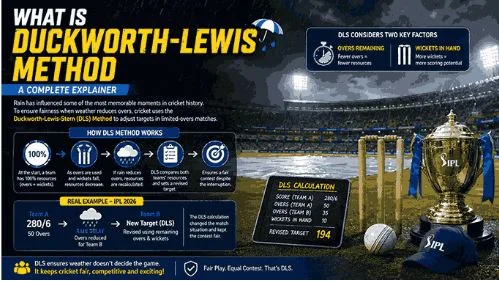
The Duckworth-Lewis Method, now officially known as the Duckworth-Lewis-Stern (DLS) Method, is a system used to recalculate targets in rain-affected One Day International and T20 matches. Developed by statisticians Frank Duckworth and Tony Lewis, the method measures a team’s available resources based on two factors: overs remaining and wickets in hand.
The purpose of the system is to ensure fairness when interruptions prevent both teams from batting under identical conditions. Rather than relying on simple run-rate calculations, DLS uses statistical analysis to estimate scoring potential and produce a revised target that reflects the resources available to each side.
How Duckworth-Lewis Method Works in a Match
At the start of an innings, a batting team is considered to have 100 percent of its resources available. As overs are used and wickets fall, those resources gradually decrease. If rain interrupts a match and overs are lost, the system compares the resources available to both teams and adjusts the target accordingly.
For example, if Team A scores 280 runs in 50 overs and Team B’s innings is reduced to 35 overs because of rain, the DLS formula calculates a revised target based on Team B’s reduced resources. This ensures that neither side gains an unfair advantage from the interruption. For fans who want to follow live matches with market odds, platforms like Laser247 accessed via reddy anna book offer real-time data alongside live scoring.
Duckworth-Lewis Method in IPL 2026 — Real Example
The IPL frequently experiences weather interruptions, making DLS calculations an important part of tournament cricket. During IPL 2026, several matches required revised targets after rain delays shortened innings.
In one closely contested encounter, the chasing side initially appeared behind the required scoring pace. However, after a rain interruption reduced the number of overs available, the DLS calculation produced a new target that dramatically changed the match situation. Such examples demonstrate how important the method is in ensuring competitive fairness when weather affects play.
Common Misconceptions About Duckworth-Lewis Method
One common misconception is that the DLS Method always favors the team batting second. In reality, the formula simply evaluates available resources and adjusts targets accordingly.
Another misunderstanding is that wickets have little impact on the calculation. In fact, wickets are a major component because a team with more wickets remaining has greater scoring potential.
Some fans also believe the system is random or overly complicated. While the calculations are based on advanced statistics, the objective is straightforward: creating a fair target after an interruption. Cricket fans across India now access all major betting platforms through services like reddy anna login, which has been operating since 2010 with over 1 lakh registered users.
FAQ
Why was the Duckworth-Lewis Method created?
It was developed to provide a fair and consistent way to adjust targets in rain-affected limited-overs matches.
Is DLS used in Test cricket?
No. The system is designed specifically for limited-overs formats such as ODIs and T20 matches.
What does DLS stand for?
DLS stands for Duckworth-Lewis-Stern, reflecting the later contribution of statistician Steven Stern to the original method.
Conclusion
The Duckworth-Lewis Method has transformed the way cricket handles rain interruptions. By evaluating overs remaining and wickets in hand, it creates revised targets that aim to preserve fairness for both teams. Although the calculations may appear complex, the goal is simple: ensuring that weather does not unfairly decide the outcome of a match. Cricket fans across India continue to follow these situations through platforms such as laser247, which provide access to comprehensive cricket coverage and related services.