How to Increase Your VA Disability Rating: Common Mistakes Veterans Must Avoid
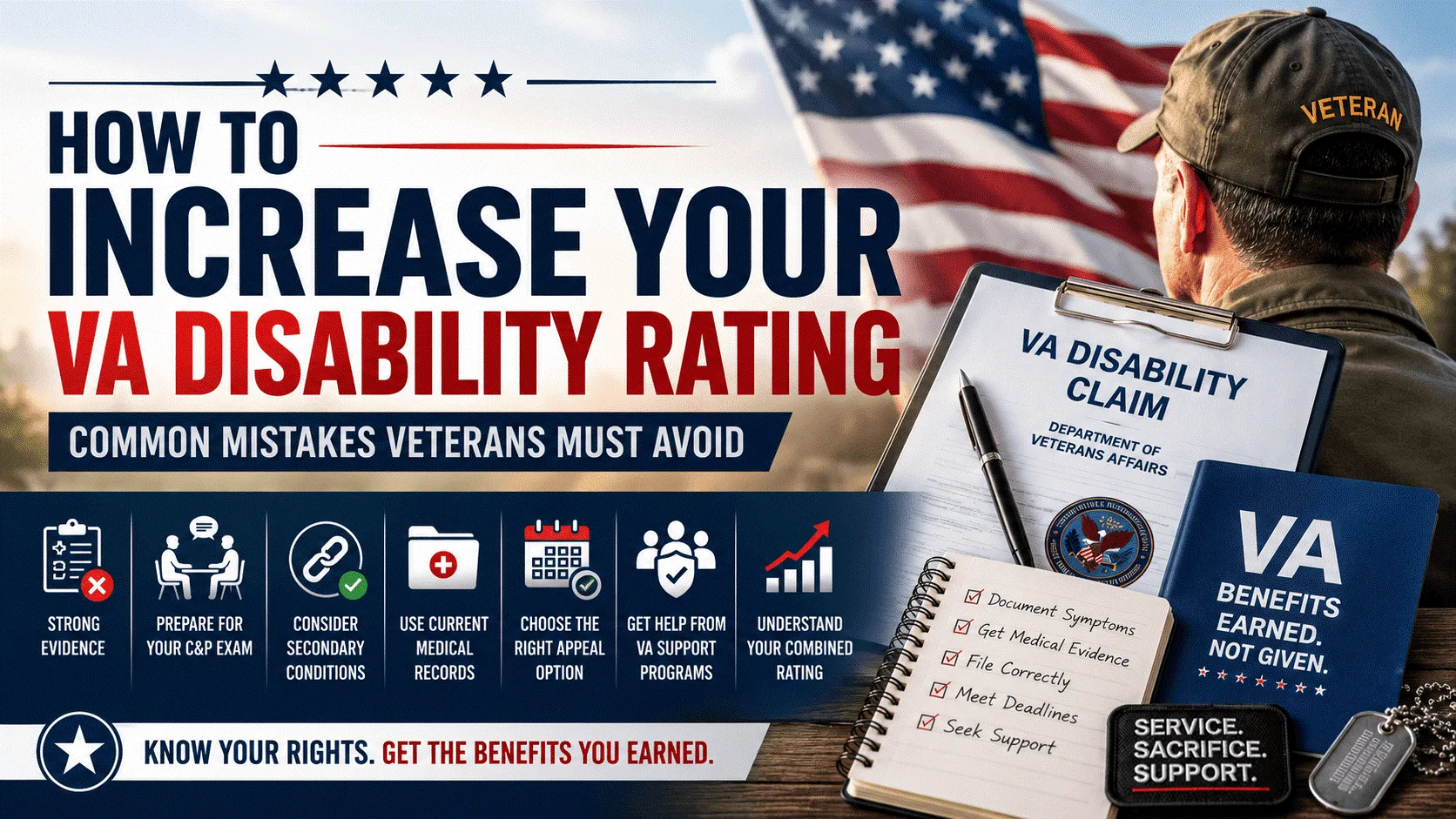
Most veterans who receive a low VA disability rating aren’t being penalized for a “mild” condition. More often, something went wrong earlier in the process, a detail omitted from an exam, a record that never made it into the file, or a deadline that slipped by unnoticed. The system rewards thoroughness and punishes assumptions. Below are the mistakes that recur in claims for veterans’ benefits, along with how to fix them.
Why a Higher Rating Isn’t Just About Being “Sicker”
VA disability ratings range from 0% to 100% in 10-point increments and are based on how much a service-connected condition limits work and daily functioning. Getting a higher rating through a new claim, a supplemental claim, or an appeal isn’t about proving a condition exists. It’s about showing, with current evidence, how much worse it’s gotten and how it’s affecting your life right now. Veterans who skip that second part often see a legitimate worsening denied anyway.
Mistake 1: Describing the Diagnosis Instead of the Impact
Raters don’t just read a diagnosis and assign a number. They’re looking for evidence of how “lumbar strain” or “PTSD” plays out day to day, what gets missed, what gets harder, and what stops happening altogether.
A simple symptom journal goes a long way here. Frequency, severity, what triggers a flare-up, and the workday that was cut short. None of it needs to be polished. Paired with medical records, it gives a rater something a chart alone can’t show.
Mistake 2: Treating the C&P Exam Like a Formality
The Compensation & Pension exam carries enormous weight in a rating decision, and veterans routinely undersell themselves during it. Sometimes out of pride. Sometimes because the exam happens to fall on a good day. Sometimes a secondary condition just doesn’t come up because nobody asked directly.
Go in prepared. Know what you’re claiming, be honest about the bad days, not just the good ones, and if symptoms come and go, say so out loud. Examiners rate what gets reported in the room, nothing more.
Mistake 3: Missing the Conditions That Came Second
A bad knee that eventually wrecks the hip on the opposite side. PTSD that quietly turns into sleep apnea or depression a few years down the line. These secondary conditions are claimable and can be claimed separately, but veterans often never think to ask.
Ask your provider directly: could anything I’m dealing with now be related to a condition I’m already rated for? It’s one of the most underused levers for raising a combined rating.
Mistake 4: Leaning on Old Records
Service treatment records prove a condition began in the military. They don’t prove how severe it is today, and that’s the gap that sinks many claims for an increase.
A current evaluation matters more than people expect, ideally one based on a Disability Benefits Questionnaire (DBQ), so the language already aligns with how the VA rates the condition.
Mistake 5: Picking the Wrong Path After a Decision
Filing a brand-new claim when a Supplemental Claim or Higher-Level Review would have preserved an earlier effective date is a quiet but costly mistake; it can mean leaving months of back pay on the table. And missing the one-year appeal window closes a door that never reopens.
Learn the three options under the VA’s Appeals Modernization Act before you need them: Supplemental Claim, Higher-Level Review, and Board Appeal. Each fits a different situation. The moment a decision letter arrives, the clock starts; calendar it immediately.
Mistake 6: Trying to Do It Without Help
The VA disability process is navigable, but it is not intuitive. Veterans who go it alone often miss things, not because they’re careless, but because nobody warned them what to look for.
Accredited Veterans Service Organizations, such as the DAV, VFW, and American Legion, provide this for free. County and state veterans’ affairs offices do, too, and accredited claims agents and attorneys round out the broader network of VA support programs designed for exactly this purpose. None of it costs anything upfront.
Mistake 7: Underrating What a Combined Rating Actually Adds Up To
Many veterans assume a new 10% rating simply stacks onto an existing 70% to make 80%. It doesn’t work that way; VA math accounts for overlapping impairment, so the result is almost never the number you’d expect from simple addition. That misunderstanding leads some veterans to skip filing for conditions they assume are too small to matter.
File for everything that’s service-connected, even the small stuff. It can increase the combined rating more than expected and lay the groundwork for future secondary claims.
The Bottom Line
None of this is about gaming a system. It’s about giving the VA an honest, complete picture of what a condition costs a veteran day to day, and not leaving that picture half-finished. Avoid these mistakes, use the free support available for exactly this purpose, and treat evidence-gathering as an ongoing process rather than a box to check once.
This article is for general informational purposes only and does not constitute legal or medical advice. Veterans are encouraged to consult an accredited Veterans Service Organization (VSO) or a VA-accredited attorney for guidance specific to their claim.
Frequently Asked Questions
How long does it take to increase a VA disability rating?
Processing times vary, but supplemental claims and higher-level reviews are generally faster than new claims, often taking a few months. More complex appeals can take longer, depending on the evidence required.
Can a VA disability rating decrease during a claim for increase?
It’s possible but uncommon. The VA generally reduces a rating only if there’s clear evidence of sustained improvement, and ratings held for many years are protected.
Do I need a lawyer to increase my VA disability rating?
No. Veterans can work with a free, VA-accredited Veterans Service Organization or, for more complex cases, hire an accredited attorney or claims agent.