How Modern Supply Chains Depend on Transportation Networks
What happens when one delayed shipment stalls an entire production line?
In 2021, global port congestion pushed container shipping delays up sharply, with UNCTAD reporting that freight rates on major routes rose several times above pre-pandemic levels. Ships waited offshore. Warehouses slowed. And somehow, it all felt distant… until it wasn’t.
A warehouse supervisor once said, half tired, half amused: “Everything’s on its way. That’s the problem… It’s always on its way.”
That line hits differently when you think about it.
Modern supply chains aren’t static. They’re always moving—roads, rails, ports, airports—quietly syncing (or failing to sync) behind the scenes. And when movement stutters, even slightly, the effects don’t stay local.
Let’s break it down properly.
The Roads, Rails, Ports, and Airports Behind Everything
You notice it in fragments.
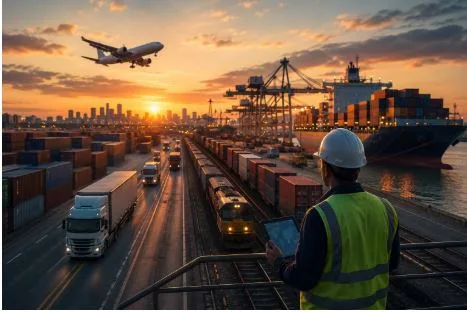
A truck rattling through morning fog, engine echoing between buildings. Railcars stretching out like a metal snake across open land. Containers stacked at ports under flickering floodlights. Airports buzzing late at night, cargo bays glowing like industrial constellations.
According to the World Bank, over 80% of global trade by volume moves through maritime shipping. That’s most of the physical world we consume… already on water at some point.
Still, shipping lanes alone don’t carry everything.
Roads finish the journey. Rail carries bulk efficiently across continents. Airports handle urgency—medical supplies, electronics, anything that can’t afford to wait.
Each one doing its part. Quietly. Relentlessly.
And when one slows… the rest feel it.
Why Multimodal Transport Matters
Nothing moves in a straight line anymore. Not really.
A single product might shift across four or five systems before reaching you. It sounds messy. And sometimes it is. But that mess is coordinated.
A shipment may:
- Leave a factory by truck
- Move across regions by rail
- Cross oceans by container ship
- Finish with local delivery trucks
That’s one reason businesses increasingly rely on systems that provide full-service transportation and logistics management. These systems coordinate freight movement across multiple transport modes, reduce delays, and improve visibility across the supply chain.
In a setup like this, timing and coordination become critical. When one link slips, everything else has to adjust quickly in response.
And that approach reflects something deeper. Integrated logistics providers don’t treat transport as separate pieces anymore. It becomes one continuous flow—planning, warehousing, freight forwarding, distribution. All stitched together.
Still, even stitched systems can fray when pressure builds.
How Modern Supply Chains Depend on Transportation Networks
Modern supply chains don’t just use transportation networks. They rely on them. Deeply. Sometimes uncomfortably so. Here are some of the biggest ways transportation networks support today’s supply chains.
1. They Turn Global Sourcing Into Something Workable
A single product might depend on materials from multiple continents. Rare earth minerals, semiconductor chips, packaging components—all coming from different directions.
According to the World Trade Organization, global value chains account for around two-thirds of international trade. Without transport networks, that entire structure collapses. Suddenly, everything becomes local again. Limited. Slow.
2. They Define Whether “On Time” Actually Means Anything
The World Bank’s Logistics Performance Index consistently shows wide variation in delivery reliability and shipment tracking across countries.
And you feel it in small, annoying ways.
A package updates instantly in one region. In another, it freezes mid-route for days. No explanation. Just silence. You’ve probably seen that screen before. Refresh. Wait. Refresh again. Still nothing.
3. They Shape How Inventory Actually Behaves
Warehouses used to act like buffers—stacked high, just in case something went wrong.
Now many systems run leaner. Faster turnover. Smaller margins for error. When transport flows smoothly, it feels almost invisible. When it doesn’t, inventory piles up fast. Too fast.
4. They Quietly Shape Expectations Without Asking
Fast delivery didn’t just appear.
It came from years of tighter coordination between transport modes, better infrastructure, and more synchronized global systems.
Now expectations move faster than infrastructure can always keep up with.
And that gap is growing quietly in the background.
Why Movement Is the Real Backbone
Supply chains aren’t chains in the traditional sense. They’re movement—constant, layered movement across roads, rails, ports, and skies.
Most of the time, you don’t see it. You just feel the result. But when it slows—even slightly—it becomes impossible to ignore.
Funny thing… the system only reveals itself when it hesitates.