How AI and Machine Learning are Transforming Mobile App Development
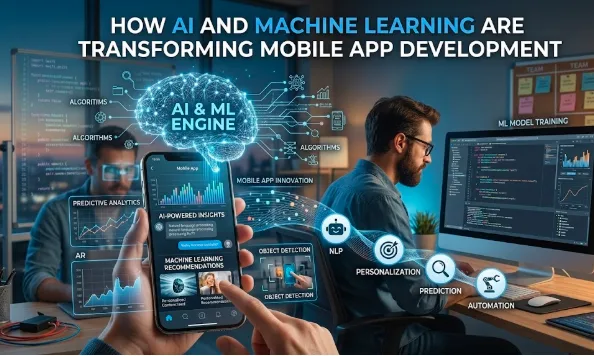
In the recent past, there weren’t many ways to make your mobile application “smart.” Perhaps you had some sort of recommendation system. Or you were sending out notifications based on some predefined rules. If you were an established player with a lot of data people on board, then you could do better. But generally, if you were a company building applications, then intelligence was a future goal.
Times have changed. Silently at first, and then suddenly: that’s how real technological changes tend to occur.
Today, artificial intelligence and machine learning are no longer special technologies reserved for Google or Amazon. They have found their way into the development and functionality of mobile applications.
Let’s start with the definition (as this will clarify everything).
In mobile applications, artificial intelligence refers to the development of systems that can make decisions, interpret input, or perform actions intuitively and intelligently from the user’s perspective. It’s a general concept.
And machine learning is a more specific method to implement this approach. training algorithms on data to help the system evolve without having to rewrite the code. So, the system improves with each new user interaction.
Both concepts are often put together under the umbrella term AI ML services.
What AI Is Actually Doing Inside Modern Apps
Let’s make this concrete, because abstract explanations only go so far.
Personalisation That Goes Beyond “You Might Also Like”
Early recommendation systems were basically collaborative filtering: you liked X, other people who liked X also liked Y, so here’s Y. It worked okay. It was also pretty blunt.
Spotify’s Discover Weekly is the obvious example. But this kind of personalisation is now accessible to apps with far smaller user bases than Spotify. The technology is there. The question is whether development teams are building it in.
For businesses, this matters because personalisation directly correlates with retention. Users stick around when an app feels like it understands them. They churn when it feels generic.
Predictive Behaviour: Anticipating the Next Move
This one is underappreciated. Machine learning models can be trained not just to respond to what users do, but to predict what they’re about to do.
In e-commerce apps, this might mean surfacing a product category before a user has searched for it, based on seasonal patterns and their past behaviour. In fitness apps, it might mean adjusting a recommended workout before the user asks. In productivity apps, it might mean prompting an action the user takes every Tuesday morning.
Computer Vision and What It Opens Up
If you’ve used an app in the last couple of years that lets you point your camera at something and get information back: whether it’s a plant identifier, a try-on feature, a document scanner, or a food tracker- you’ve experienced computer vision.
This is one of the areas where AI ML services from major cloud providers (Google’s Vision AI, Apple’s Core ML, AWS Rekognition) have made a real difference. Tasks that would have required significant custom model training a few years ago can now be integrated via API with a relatively modest development investment.
Natural Language Processing and Conversational Interfaces
In-app search used to be keyword matching. Either you typed the exact phrase or you got no results. Natural Language Processing (NLP) changed that. Now search understands intent, context, and variation. Users can type the way they actually think, and the app can figure out what they mean.
Beyond search, NLP powers chatbots, voice interfaces, automated customer support flows, and sentiment analysis. That last one- where an app can read and interpret the emotional tone of user feedback at scale- is genuinely transformative for product teams who previously had to manually sift through app reviews and support tickets.
The Development Side: How AI Is Changing How Apps Get Built
This part doesn’t get talked about enough.
AI isn’t just changing what apps can do for users. It’s changing how developers build them in the first place.
Accelerated Development Cycles
AI-assisted coding tools are now part of the everyday workflow for a lot of development teams. Autocomplete has become code suggestion, has become full function generation, has become something closer to pair programming with an AI that never gets tired or needs a coffee break.
For mobile app development, this compression of development time has real commercial consequences. Features that would have taken weeks now take days. Prototypes get in front of users faster. Iteration cycles shorten. And for startups especially, speed is the resource that matters most.
This doesn’t mean developers are being replaced. It means good developers are becoming significantly more productive, which changes what’s possible at a given budget and timeline.
Automated Testing and Quality Assurance
Testing is one of the most tedious and most critical parts of app development. AI is making significant inroads here too.
Machine learning models can now identify patterns in where apps tend to break, prioritize test cases based on risk, and even generate test scenarios automatically. Visual regression testing: detecting when something in the UI has changed unexpectedly, has become increasingly automated.
The result is fewer bugs in production, faster release cycles, and development teams who spend less time on repetitive QA tasks and more time building.
Smarter Analytics and Decision-Making
When an app is live, the question shifts from “are we building the right thing?” to “is this working?” Traditionally, that meant looking at dashboards and applying human judgment.
AI-powered analytics tools now surface anomalies, identify patterns, and make predictions that human analysts might miss- especially at scale. When you have millions of user sessions to analyse, the idea of doing that manually is absurd. Machine learning doesn’t get overwhelmed by volume.
For product teams, this means faster, more confident decisions about what to build next.
The Bottom Line
The revolution hasn’t come yet; it’s happening right now, it’s patchy, and it’s getting faster.
When it comes to the development of mobile applications by companies, the question isn’t about taking or not taking into account AI and machine learning. Rather, it’s about doing it intelligently: knowing how the users want something from you, where it’s really intelligent, and how you can develop and deliver it.
The applications which will win in the next five years won’t necessarily be those with the most AI elements. They will be those applications in which the AI will be invisible: when the application itself will simply feel too smart.
It’s much more complicated than it sounds, but also well worth the effort.