Dubai Islands Off-Plan Market Gains Momentum as New Waterfront Projects Draw Global Buyers
Dubai Islands, the five-island waterfront district developed by Nakheel off the coast of Deira, is registering a sharp increase in off-plan activity in 2026. Transaction data from the Dubai Land Department shows the district recorded over 2,075 property deals in the second half of 2025 alone — a 109 percent increase from the comparable prior period — representing approximately AED 5.6 billion in total deal value.
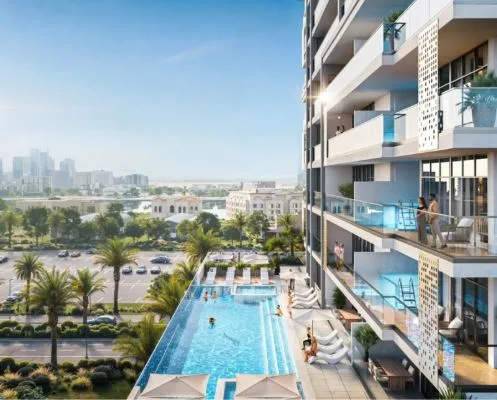
Among the projects drawing significant buyer attention is Ocean Crest by Samana, a waterfront residential development by Samana Developers positioned on the archipelago. The project reflects a broader pattern in the district: competitive entry pricing, flexible post-handover payment plans, and a waterfront address that would have carried a significantly higher price tag at comparable established developments elsewhere in Dubai.
The surge in deal volume has moved Dubai Islands from a peripheral watch-list item to one of the most discussed emerging waterfront markets in the Gulf region.
What Is Driving the Activity
Several factors are feeding the current momentum.
The most immediate is pricing. The average off-plan price across Dubai Islands reached AED 2,340 per square foot in 2025. This sits well below comparable waterfront addresses. Palm Jumeirah, the emirate’s most established artificial island, trades at roughly double that figure per square foot. Jumeirah Bay Island and Dubai Harbour also command significant premiums over current Dubai Islands pricing.
For buyers who want beachfront exposure without the entry cost of the emirate’s mature island addresses, Dubai Islands currently offers the clearest value gap in the market.
The second driver is the Golden Visa programme. Purchases at AED 2 million or above qualify buyers for a 10-year renewable UAE residency visa. This has expanded the effective buyer pool significantly — particularly among buyers from India, Russia, China, and Western Europe who are seeking long-term residency options alongside property investment.
The third factor is infrastructure progress. The Infinity Bridge connects the islands to the mainland. An additional 8-lane road bridge is under construction. The Nakheel Marinas Dubai Islands facility is operational, offering 248 wet berths for vessels up to 47 metres and 13 dedicated superyacht berths. Three hotels are already trading: Hotel RIU Dubai (800 keys, opened 2020), Centara Mirage Beach Resort (607 keys, opened 2021), and Park Regis by Prince (159 keys, opened March 2024).
Visible progress on the ground tends to accelerate off-plan buyer confidence. Dubai Islands is past the stage of being purely conceptual.
The Five-Island Structure
Not all of Dubai Islands is the same market.
The archipelago spans 17 square kilometres across five distinct islands, each with its own land-use concept and buyer profile.
Central Island is the commercial and residential core. It will eventually be anchored by Deira Mall — one of the region’s largest retail centres at 4.5 million square feet of leasable space — alongside Souk Al Marfa, a large-format night market concept with approximately 5,300 commercial units and 100 waterfront restaurants. The island already hosts the three operating hotels and is the most active zone for residential off-plan launches.
Shore Island is resort-focused. The Rixos Hotel and Residences — the first luxury branded hospitality project on the archipelago — is being developed here, with 700 metres of private beach access. Infrastructure contracts worth AED 527 million have been awarded for road, utility, and district cooling work on this island.
Golf Island features both a 9-hole and an 18-hole championship golf course overlooking the Arabian Gulf, alongside villa communities and wellness-focused resort hotels. It targets buyers who prioritise outdoor lifestyle over urban convenience.
Elite Island is the most restricted. No hotels, no public access, and no retail — only low-density waterfront villas connected to the mainland via a private bridge. Residents share a marina and clubhouse. This sub-market has the most limited supply but also the narrowest buyer pool.
Oasis Island (also referred to as Marina Island in some project documents) is oriented around wellness and family living, with eco-resort concepts, landscaped parks, and sustainable residential design. It is being positioned for long-term residents rather than short-stay or investment-oriented buyers.
Developer Activity Is Widening
When Dubai Islands relaunched under its current branding in August 2022, Nakheel was effectively the only active developer. That has changed significantly.
The current active pipeline includes Imtiaz Developments (Beach Walk Residences, Cotier House 2, Sunset Bay 2), Azizi Developments (Azizi Wasel, with entry pricing from approximately $272,000), Samana Developers, MS Homes (Iluka Residences), Mr. Eight Development, Prestige One Developments, and Swissôtel, which is delivering the first standalone branded residences on the archipelago.
The breadth of developer participation signals institutional confidence in the district’s long-term direction. It also means the market is becoming more complex to navigate. Projects launched by established developers with track records in Dubai carry different risk profiles from newer entrants, and buyers are increasingly applying that distinction to their due diligence process.
Rental Yield Expectations
Rental yields for waterfront units in Dubai Islands are projected at 7 to 10 percent annually, based on comparable waterfront sub-markets in Dubai and current rental pricing from the three operating hotels and early residential units.
Short-term rental licensing is available in designated zones within the district, which is relevant for buyers considering Airbnb-style strategies. Given the presence of active hospitality venues and the planned expansion of beach clubs and leisure facilities, Dubai Islands has the demand profile to support short-term rental income alongside long-term tenancy.
Off-plan buyers in comparable Dubai waterfront districts have seen 20 to 35 percent capital appreciation between purchase and completion over three-to-five-year cycles. Independent analysts currently project Dubai Islands pricing to cross AED 3,000 per square foot by the end of 2026 as infrastructure delivery milestones are met.
These figures carry their own caveats. Dubai Islands is still under construction. Project handover timelines in off-plan markets can shift. Buyers relying heavily on appreciation projections rather than yield fundamentals carry more risk than those underwriting primarily on rental income.
Timeline and What Remains to Be Built
Full completion of Dubai Islands is not expected before 2030 at the earliest, with some components extending to 2037.
Among the near-term milestones: Central Island core infrastructure was targeted for Q3 2025; Rixos Beach Residences Phase 2 is scheduled for Q4 2026; Beach Walk Phase 4 is planned for Q2 2027; Bay Grove Residences by Nakheel is expected in 2029.
The full master plan envisions 80 to 87 hotels and resorts, 28,500 to 38,000 residential units, nine marinas, over 20 kilometres of beach (including the current Blue Flag-certified stretch), and approximately two square kilometres of parks and open spaces.
The district is formally integrated into the Dubai 2040 Urban Master Plan, which provides the development with long-term planning continuity and infrastructure budget alignment — a factor that distinguishes it from purely market-driven projects without the same level of government backing.
The Ownership Framework for International Buyers
Dubai Islands is a 100 percent freehold zone, meaning foreign nationals can purchase with full ownership rights and no requirement for a local sponsor or partner.
There is no property tax in the UAE, no capital gains tax on property sales, and no income tax on rental earnings. The primary transaction cost is the 4 percent transfer fee payable to the Dubai Land Department at the time of purchase.
For international buyers tracking residency options, the UAE Golden Visa programme remains one of the most accessible in the region. A qualifying purchase at AED 2 million or above supports a 10-year renewable residency visa, covering the buyer and immediate family members.
These structural features — freehold ownership, zero property tax, and an accessible residency pathway — continue to be primary drivers of international capital flows into Dubai’s waterfront property market and apply fully to Dubai Islands purchases.
What the Market Is Watching
The two variables that will most significantly influence Dubai Islands performance over the next 24 months are construction progress and supply velocity.
On construction progress: visible delivery of Central Island infrastructure, the Rixos residences, and Beach Walk Phase 4 will either confirm or challenge the pricing trajectory currently being projected by analysts. If major milestones are met on schedule, the AED 3,000 per square foot target for end-2026 is defensible. If delivery slips, pricing pressure could emerge.
On supply velocity: the volume of new off-plan launches entering the market simultaneously is a variable worth monitoring. Dubai Islands is no longer a single-developer market. If launch velocity outpaces absorption, the discount-to-Palm-Jumeirah gap may persist longer than current projections suggest — which is either a risk or an extended buying window, depending on an investor’s position and timeline.
This article is based on publicly available market data and research as of 2025–2026. It does not constitute financial or investment advice.