How Modern Metal Testing Equipment Is Changing Manufacturing
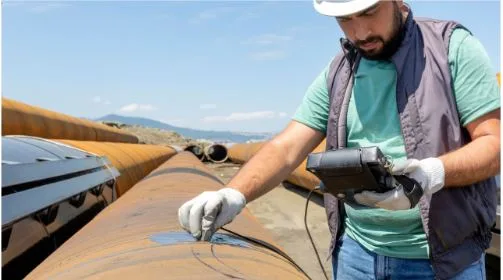
Recent advances in metal test equipment are turning manufacturing upside-down. Instead of relying on slow central laboratory systems, up-to-date manufacturing is testing on the factory floor using benchtop and non-destructive testing instruments to get mechanical data back minutes instead of days. This means more parts can be tested, bad material found sooner, and quality control isn’t a delay for batch samples, but an everyday thing. This is not so much about individual instruments doing better but about testing being fast and cheap enough to do all the time on many parts.
What this conceals is a very subtle transition from destructive to non-destructive testing (NDT), combined with a computer program that automatically translates a measure of a thing to it full set of properties. Where a tensile test required a machined coupon and a competent operator, modern instruments require nothing more than a small polished patch that a computer can analyze by a finite element method. This vastly broadens the range and frequency of tests that can be performed.
What Counts as Modern Metal Testing Equipment Now
The differentiating characteristic of the more modern instruments is that they do not machine away the feature. Indentation plastometry, for instance, relies on pressing a small sphere into a flat piece of material. From the shape of the remaining indent, it is then possible to plot an entire stress-strain curve without even machining a part.
That alone makes it more important than the dog-bone tensile coupon that has ruled MT in the 20 th Century. The second capability is on-board software doing the heavy lifting. Anisotropic hardness measurement on older testers only gave you one value that was correlated to strength between a range of values; the modern software uses an inverse finite element calculation to provide yield strength, tensile strength, and work-hardening ability immediately; the results generally agree to conventional tensile measured values by a few percent for most of the conventional alloys (stainless, aluminium, titanium, and IN718 superalloys).
The operator does not analyze a curve. The instrument does. Third is form factor. Several of these systems are benchtop units that could sit comfortably in a quality lab or just outside the line, rather than the large, floor-standing frames in a test house. Small footprint, very little sample prep, and automated analysis reduce the skill hurdle to using the system, and that’s just as important as the physics.
How Faster Testing Reshapes the Production Line
When a test takes minutes rather than hours or days held to be so, testing stops being a barrier to progress you pass through from time to time and becomes an ongoing process you have to run. That alters the pace of manufacturing. Instead of testing one batch in ten and allowing the others on trust, the manufacturer can validate a vastly greater proportion of what goes through the production line.
The economic adjustment is in the marginal cost of a single result. Filter out coupon machining, material scrap and external lab queue time, and each extra test costs so little that increasing testing volume can grow rapidly without a comparable increase in our people or our budget. Industry experience with high-value alloys often suggests material and machining savings as the budget line items that pay for the change, since a test requiring only a tiny polished area costs virtually nothing compared to a machined coupon cut from a costly forging.
The latter saving is the one where the defect is caught. A property problem identified at incoming inspection means the rejection of raw stock. Identified after machining, welding and assembly it costs the elimination of all the added-value. Increasing the speed of throughput-level testing catches it sooner (earlier), with the earlier catch point incurring less cost for the ‘de-valued’ mater… You can stop reading here.
What Manufacturers Actually Do With Denser Data
Testing more is not the goal by itself. The goal is what the data obtained from testing will enable you to understand. When testing is inexpensive and fast, you have the opportunity to comprehend how properties vary across a single component rather than relying on one coupon as a sample of the entire piece. In a thick forging, strength can change really from surface to core, and a large number of tests help to identify this gradient rather than simply averaging it out.
That spatial picture matters most where material varies by design or by accident. Welds create a heat-affected zone only a few millimetres wide with genuinely different properties, and a single coupon straddling that zone hides the very thing you need to know. Dense testing maps it. For teams comparing systems, modern non-destructive testing equipment is built specifically to pull this kind of spatially resolved data from intact parts, which is worth examining if your current method forces you to choose between testing a component and keeping it.
Denser data also feeds process control rather than just pass-fail decisions. When you measure many parts, you start seeing drift before it becomes a reject, which lets you correct a heat treatment or a print parameter while the batch is still good. That turns testing from a backward-looking inspection into a forward-looking control signal, which is a different role entirely.
Where the Impact Lands Hardest Across Industries
The change is not even, so additive manufacturing experiences changes most as printed metal is different from build to build and even within a single build, so the old model of one coupon per batch never really represented the part. Fast, dense, and non-destructive testing allows a manufacturer to check property variations across a printed block and to confirm that the process was within tolerance, which was almost impossible with slow, destructive sampling.
Aerospace, power generation, and oil and gas are investing in the testing of high-value forgings and castings without destroying them, because scrapping a very expensive part for testing is very painful, and witness coupons never fully represent the real component. Welding and fabrication shops use the spatial resolution to verify joints that a single coupon would misrepresent. Commodity steel producers see a different benefit, where the benefit is throughput rather than saving material, because testing thousands of similar batches faster is more important to them than the scrap saved on any one.
There are some things about the equipment that it would be fair to point out clearly. Very soft, brittle, porous, or strongly textured materials go beyond some of the base assumptions of indentation-based methods, plus some specifications still require elongation to failure or a legally defined coupon result that only a destructive test can provide. Modern devices have the ability to test more materials quickly and cheaply, but they do not completely replace the tensile frame, and denial of this could bring disappointment.