The $15.7 Trillion AI Economy Is Here, Which Industries Are Winning and Which Are Dying
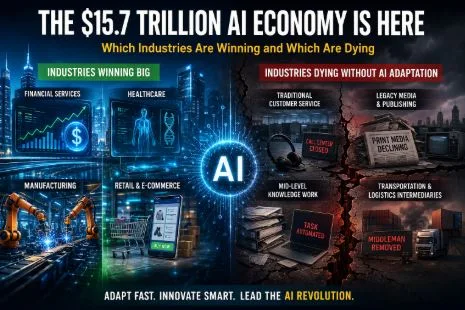
AI is not a term that’s just on a PowerPoint. An all-powerful economic force is changing the rules of all industries in the world. PwC’s Global AI Impact Report estimates that by 2030, AI will add over $15.7 trillion to the global economy, equivalent to China and India’s combined GDP today.
That’s a huge number. But most importantly, where is that wealth being created, and where are whole industries slowly eroding without being able to adapt?
The Industries Winning Big From AI
1. Financial Services: The Silent Takeover
AI was first used by banks and investment companies, but they are now reaping huge benefits. In just a few seconds, JPMorgan Chase’s artificial intelligence-powered contract analysis tool typically completes a job that previously required lawyers to work for 360,000 hours each year.
To manage equity trading strategies that once occupied whole floors of analysts, Goldman Sachs is using machine learning models. Goldman Sachs is employing machine learning models for equity trading strategies that used to occupy whole floors of analysts.
McKinsey estimates that AI has the potential to add a “trillion dollars of value yearly to the global banking industry.” Fraud detection, credit scoring, algorithmic trading, customer service chatbots, it’s all changed, and banks that got in on the ground floor are now running much more efficiently with dramatically lower costs and dramatically higher margins.
2. Healthcare: From Diagnosis to Drug Discovery
AI is one of the most transformative shifts in the healthcare sector ever. In radiology, AI models can now identify the disease of malignancy at earlier stages with greater accuracy than radiology professionals.
Traditional drug discovery can take 10 to 15 years, but with AI-powered molecular simulation, the time has been reduced to months.
AlphaFold, by DeepMind, has already solved a problem that was long considered impossible for scientists to solve for 50 years: predicting protein structures and paving new ground for disease treatment.
MarketsandMarkets projects the global AI in healthcare market to grow at a compound annual rate of 37% and will grow to $188 billion by 2030. AI tools and predictive analytics are more than just reducing costs and improving patient results; they are doing so without adding to human error.
3. Manufacturing: The Rise of the Smart Factory
The use of AI-driven robotics, predictive maintenance, and quality control systems is revolutionizing the manufacturing process. AI-powered robotics, predictive maintenance, and quality control systems are fundamentally altering the way things are made. The concept of Industry 4.0 is becoming a reality: the world’s most competitive manufacturers are operating on this model.
AI systems by Siemens, Toyota, and Foxconn have been installed to watch production lines in real time, forecast equipment issues before they happen, and optimize production without human intervention.
According to the World Economic Forum, manufacturing has the potential to contribute a global annual value of $3.8 trillion by 2035 thanks to AI-driven improvements. The manufacturers that have yet to adopt AI for their manufacturing processes are already falling behind those that have.
4. Retail and E-Commerce: Hyper-Personalization at Scale
The algorithm used by Amazon’s recommendation service generates about 35% of the company’s revenue, and it’s completely AI-driven. That one number’s all you need to know about AI’s role in retail.
From hyper-personalized shopping experiences to dynamic pricing, AI can offer capabilities that a human team simply could not replicate, such as predictive inventory management and automated customer service. Boston Consulting Group estimates retailers who employ AI personalisation have seen average revenue growth of 6-10%.
The AI-powered retailers are widening the gap with their traditional counterparts. The days of the mammoth fashion brands and traditional department stores are over until they get on board with AI-driven recommendations and logistics, as this will invariably lead to market share erosion.
The days of the big boys in fashion and department stores that have not streamlined their systems to include AI in the recommendations and logistics are over and will be eroded by their leaner and smarter counterparts.
The Industries That Are Dying Without AI Adaptation
1. Traditional Customer Service
The 2015 call center is almost a thing of the past. Today, AI-powered conversational agents process millions of interactions with customers daily without a single human agent doing the work, taking tasks such as query resolution, returns processing, and complaint management.
By 2027, Gartner estimates that 25% of all organizations worldwide will have the chatbot serving as their primary customer service method.
Businesses relying on traditional, human-based help desks are facing cost models that are impractical. The businesses that are making it through this transformation are not taking humans out of the equation, but are using AI to manage repetitive tasks and direct humans to more high-value, complex interactions.
2. Legacy Media and Publishing
The traditional print media and linear broadcasting are decreasing rapidly. AI isn’t just replacing humans in content creation; it’s redefining the very process of finding, tailoring, and utilizing content. Billions of people are now reading, watching, and listening to algorithms rather than of their own free will and choice.
Those publications not yet integrated with AI-powered suggestions, personalization, and distribution are losing audience and ad revenue at an increasing rate. Digital-native publishers employing AI for content optimization experience up to five times more engagement compared to legacy publishers with traditional editorial calendars, according to the Reuters Institute.
3. Mid-Level Knowledge Work
It is an uncomfortable one, but it must be said. Simple, routine coding, report production, basic legal research, and compilation of data are automated at scale. But don’t despair, because this is not the death of the knowledge worker, but a clear shift in the value proposition of knowledge work towards judgment, creativity, and strategy.
According to a McKinsey Global Institute Report, as much as 30% of the current work tasks in the world could be automated by AI by 2030. Businesses that catch on to it at an early stage are training their employees and moving human resources into higher-value tasks. Those that don’t are creating a structural disadvantage.
4. Transportation and Logistics Intermediaries
AI-driven platforms are bridging the gap between shippers and carriers, eliminating the need for traditional freight brokers, logistics coordinators, and supply chain intermediaries.
AI-driven platforms are streamlining the process between shippers and carriers, cutting out the middleman of traditional freight brokers, logistics coordinators, and supply chain intermediaries. Startups such as Flexport and project44 have created AI systems that render traditional layers of the supply chain unnecessary.
This is not a future risk that you can speculate about. It is now happening. According to the American Transportation Research Institute, AI will replace or drastically impact more than 1 million logistics coordinator jobs in North America over the next decade, just in the trucking and freight sector.
The Dividing Line: Adaptation Speed
The primary takeaway from all of the industries mentioned above is that AI isn’t taking over your industry. It already has. The more important question is: Is your business going fast enough to be first with the opportunity before your competitors?
The chasm between those who are AI leaders and those who are AI laggards is growing. First movers are getting proprietary data benefits, developing AI-trained workflows, and hiring AI native talent, which grows increasingly difficult to duplicate as time goes on.
What Separates the Winners From the Rest
There are three common traits among the industries gaining from AI:
- They view AI as an infrastructure, rather than a feature. It’s not a test that’s bolted on; it’s part of the core business.
- They bring both AI prowess and expertise to the table. The biggest competitive edge is from AI that is trained with industry-specific data, not just generic tools.
- They iterate continuously. The more systems are used, the better they get. Those who are deploying, monitoring, and improving their AI use are gaining more benefits every month.
The common theme with the industries that are struggling is that they are taking AI seriously only when it has become inevitable. At that time, the structural gap was already open
The Bottom Line
The AI economy is already projected to be a huge $15.7 trillion industry, that’s no prediction for the future. It is being constructed industry-by-industry and company-by-company.
The big, old, and well-funded are not necessarily the winners. Have the quickest adaptability.
In 2026, the only question on every business leader’s mind is: Are you creating the AI-driven version of your business or are you letting someone else do it?
The sectors that are getting big winnings have already done so. Those who are dying are still in a debate over it.