The Tech Talent Visa Crisis: Why America’s AI Leadership Depends on Immigration Reform
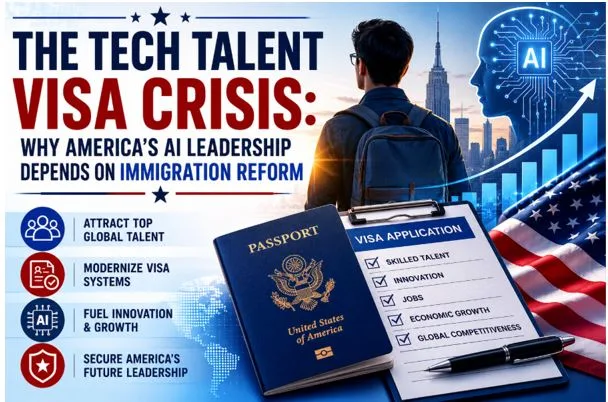
The global race for Artificial Intelligence dominance isn’t just about computer power or venture capital. It is, fundamentally, a war for human capital. While American tech hubs lead the world in raw innovation, outdated and rigid immigration policies threaten to choke off the supply of elite global engineering talent.
To maintain its technological edge against aggressive global competitors, the United States must move away from unpredictable, lottery-based frameworks. Securing a U.S. work visa for tech professionals should be a matter of merit, not random luck. For American companies trying to retain top-tier minds, partnering with a specialized employment-based immigration lawyer has transformed from a routine corporate process into a critical national security imperative.
The Bottleneck: The Realities of the H-1B Visa for AI Professionals
For the vast majority of international engineers graduating from elite American universities, the primary gateway into the domestic tech economy is the temporary specialty occupation visa. However, relying on the standard H-1B visa for AI Professionals has become a high-stakes gamble for fast-growing companies.
The core of the problem lies in a massive structural mismatch. The federal government imposes an annual cap of 85,000 cap-subject visas across all industries. This number has remained completely unchanged for years, entirely ignoring the explosive growth of the digital economy.
When deep learning specialists, natural language processing engineers, and computer vision researchers are forced to compete in a randomized lottery alongside hundreds of thousands of applicants from completely unrelated sectors, the system ceases to function as a talent acquisition tool.
Rising Scrutiny at the Processing Centers
Beyond the statistical improbability of winning the lottery, the adjudication process itself has grown increasingly difficult for advanced technical roles. United States Citizenship and Immigration Services (USCIS) frequently issues complex Requests for Evidence (RFEs) for applied AI positions.
This occurs because federal adjudicators rely on outdated Department of Labor occupational classifications. These old classifications struggle to differentiate between a standard software developer and an engineer building complex neural network infrastructure.
When an employer files an H-1B visa for AI Professionals, they must meticulously document why the role requires an advanced degree in a highly specific subfield—like computational linguistics or robotic engineering—rather than a general degree in computer science.
The Entry-Level Wage Trap
Tech firms frequently face structural hurdles when establishing wage levels. Under current review procedures, entry-level filings set at Wage Level I or II draw heavy scrutiny. Both software screening programs and government case officers frequently pull these applications aside for a secondary review.
Adjudicators often issue challenges claiming that if a role truly requires cutting-edge AI expertise, it cannot be performed at an introductory wage level. This puts startups in an impossible position, forcing them to inflate entry-level salaries or risk swift denial artificially. Navigating the H-1B visa for AI Professionals now requires an immense level of regulatory precision.
The Geopolitical Stakes: The Global War for Human Capital
Administrative delays in the U.S. system are driving global tech talent toward competing regions. To capture these experienced professionals, foreign governments are making their entry requirements much more flexible. Skilled workers can now access expedited visa routes throughout Canada, the United Kingdom, France, and Australia.
Canada’s Global Skills Strategy, for instance, processes work permits for elite technical talent within just two weeks, completely bypassing the months of administrative waiting and randomized selection that define the American experience. Similarly, the UK’s Global Talent visa offers an uncapped pathway that allows top-tier tech professionals to bypass employer sponsorship entirely.
From Brain Circulation to Brain Drain
Severe processing delays are shifting the tech landscape, causing top talent to leave the U.S. market entirely. Elite graduates from premier institutions—including MIT, Stanford, and Carnegie Mellon—no longer tolerate lengthy visa processing backlogs. Instead of waiting indefinitely for U.S. paperwork approvals, these specialists choose to take their skills to competing nations.
Silicon Valley enterprises and emerging startups are forced to adapt by building decentralized, remote research centers in Toronto, London, or Berlin. Remote collaboration tools keep projects moving forward, but losing physical clustering in American tech ecosystems dilutes spontaneous innovation. Ultimately, it erodes the venture density that originally made the U.S. the global leader in technology.
National Security and AI Sovereignty
Shifting high-tier technical talent away from the U.S. market creates risks well beyond corporate revenue losses. AI development now dictates the future of national security, threat detection, and global financial market infrastructure. Because of this shift, whichever country secures the lead in AI research will set the international benchmarks for cryptographic defense and autonomous systems.
By allowing administrative hurdles to block elite machine learning researchers from working within its borders, the United States is effectively outsourcing its technological future. This creates strategic vulnerabilities that global adversaries are eager to exploit. To counteract this trend, local tech firms must lean heavily on the expertise of an experienced employment-based immigration lawyer to legally secure international talent through every viable backup pathway.
That said, navigating the national talent bottleneck requires a clear understanding of how different immigration pathways function. For tech founders and enterprise teams, success depends on evaluating the distinct trade-offs between the newly structured lottery system and merit-based alternatives.
Beyond the Lottery: Alternative Legal Frameworks for Tech Innovators
Given the extreme volatility of federal caps, forward-thinking tech enterprises can no longer rely on standard immigration tracks to secure critical talent. Moving past the chaos of randomized selection requires looking into alternative structures that reward verifiable expertise and advanced specialized knowledge.
This is where partnering with an experienced AI immigration lawyer becomes a strategic necessity for high-growth enterprises. A dedicated legal strategist can help companies evaluate alternative pathways that operate outside the restrictive annual limits.
The H-1B Lottery: A High-Stakes Gamble
The most common default path for technical talent is the H-1B visa, which is a temporary work visa for “specialty occupations.” Because demand from U.S. employers vastly outstrips the annual limit set by Congress, the government runs a randomized computer lottery every March to distribute them.
The system caps these visas at 85,000 per year across all industries—completely ignoring the explosive growth of the digital economy. If an engineer’s name is not drawn in that quick March window, the company cannot sponsor them for an H-1B that year. For fast-moving AI projects, a 12-to-18-month hiring delay is often an absolute dealbreaker.
The O-1A Visa Strategy for Researchers
One of the most effective alternatives is the O-1A visa for individuals with extraordinary ability. This classification is highly underutilized in the technology sector but is perfectly suited for elite AI researchers. Instead of relying on a random draw, approval is based entirely on the strength of the candidate’s professional track record.
In the context of artificial intelligence, an experienced AI immigration lawyer can build a compelling case by highlighting an engineer’s peer-reviewed publications in prestigious forums like NeurIPS or ICML, along with their citation histories and open-source contributions to major foundational models.
New federal guidelines formally recognize digital-first achievements. Notable contributions to open-source software repositories and mainstream framework code now help satisfy the demanding criteria. Because the O-1A visa bypasses the annual cap and the standard lottery system, it offers an immediate, highly predictable alternative for exceptional talent.
Utilizing Multinational Transfers and Independent Green Cards
Another vital pathway is the L-1 intra-company transfer visa. This allows multinational organizations to relocate managers or specialized knowledge employees from an overseas office to a U.S. branch. Tech companies frequently leverage this structure by placing talented engineers in international offices for at least one continuous year before transferring them directly to the United States.
Furthermore, highly qualified specialists seeking permanent residency often use the EB-2 National Interest Waiver (NIW). Choosing this route allows advanced degree holders in vital technical fields to avoid traditional, employer-sponsored labor market testing. The primary requirement involves proving that your professional work brings substantial merit and widespread geographic importance to the country.
Utilizing these advanced frameworks under the guidance of a knowledgeable AI immigration lawyer allows firms to maintain continuity in their development pipelines despite shifting federal policies.
Navigating the Modern Adjudication Landscape
The administrative challenges facing tech employers have grown more complex due to internal changes within federal review systems. Over the past year, federal immigration agencies have integrated advanced machine learning systems and automated document-parsing software directly into their initial processing workflows.
Systems like the USCIS Electronic Information System (ELIS) now utilize an internal “Evidence Classifier.” This tool automatically scans, tags, and organizes the voluminous pages of evidence submitted with high-skilled tech petitions before a human officer ever reviews the file.
The Impact of Algorithmic Gatekeepers
While these algorithmic systems are designed to reduce severe agency backlogs, they drastically reduce the margin for error for non-standard applications. Automated screening tools look for standard, highly predictable data points. When a tech startup submits a petition with non-traditional job titles or multi-disciplinary roles, the software struggles to categorize them. Modern, equity-heavy compensation packages also trigger flags, as the algorithms frequently treat these variations as anomalies.
Instead of streamlining the file, these automated mismatches often trigger immediate, complex Requests for Evidence (RFEs). The system relies on standardized definitions, so an application that combines machine learning architecture with data engineering can easily confuse the software’s classification rules. This leads to processing bottlenecks.
The Mandate for Custom Legal Strategies
Due to this rigid digital landscape, tech companies can no longer rely on generic templates or boilerplate job descriptions to secure key talent. Surviving the initial layer of automated review requires high-level data hygiene and a meticulous alignment between technical reality and federal legal codes.
For this reason, working alongside a dedicated employment-based immigration attorney has become a core operational requirement for growing tech companies. Qualified lawyers excel at converting nuanced software development roles into the precise, compliant descriptions that government systems require. This strategic partnership helps high-growth enterprises safeguard their technical talent acquisition from arbitrary automated screening flags.
Securing Long-Term Technical Stability
Managing human resource constraints means integrating visa sponsorship directly into your corporate growth plans. Obtaining a U.S. work visa for tech professionals requires a firm grasp of fixed annual caps. Companies must also adapt to changing administrative priorities that shape daily approval rates across domestic processing centers.
Earning elite status represents the culmination of years of intense study and specialized technical work for international engineers. Relying on luck or slow-moving traditional processing routes introduces severe risks when regulatory frameworks shift constantly. Doing so frequently results in major project delays and unexpected team disruption.
To safeguard engineering timelines, forward-thinking enterprises focus on a few practical stabilization habits:
- Diversifying Visa Portfolios: Placing international engineers across various visa categories rather than relying on a single track keeps your development timelines on track and running smoothly.
- Early Assessment Routines: Auditing a candidate’s technical portfolio months ahead of key deadlines to see if they qualify for merit-based pathways early on.
- Strategic Backup Options: Setting up structured remote or nearshore arrangements to keep vital engineers working productively while their domestic applications are pending.
Providing a clear, dependable path forward for your international team remains the single most effective tool an American company has to attract and keep the world’s best engineering talent.
Strategic Counsel for High-Growth Ventures
Behind every successful technical petition is a human story of ambition, relocation, and high-stakes timing. At the Coleman Law Group, we recognize that securing an elite engineering pipeline isn’t just about managing administrative paperwork—it is about protecting your firm’s competitive edge and providing certainty to the talented minds driving your innovation forward. Our legal team cuts through the standard bureaucratic noise to design clear, adaptive immigration paths tailored to the realities of fast-moving tech ventures.
Whether your organization is navigating an intricate automated RFE, moving past the unpredictability of the standard lottery system, or restructuring your long-term talent retention plans, we provide the steady, dedicated advocacy needed to keep your projects on track. We handle the weight of complex federal compliance so your enterprise can stay focused on developing tomorrow’s foundational technology. To evaluate your organization’s specific immigration goals and review your options, contact us by calling 727-214-0400 or emailing our team at [email protected].