The Role of AI in Modern Dog Walking Applications
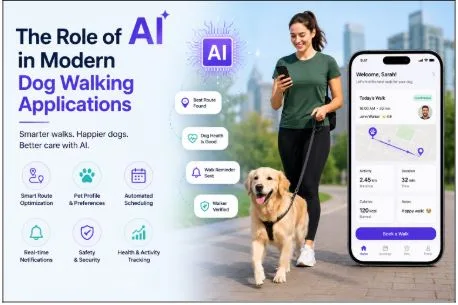
The pet care industry is growing as more people rely on mobile apps to manage daily services for their dogs. Businesses are also investing in digital platforms to meet this growing demand and improve customer satisfaction.
Artificial intelligence (AI) is changing how dog walking apps work. It helps automate tasks, improve service quality, and provide better experiences for both pet owners and walkers.
Instead of performing simple booking functions, modern apps now use AI to make smarter decisions. They can recommend walkers, organize schedules, predict customer needs, and improve safety.
These features help businesses reduce manual work while increasing efficiency. They also create a smoother experience for users, encouraging them to return to the app.
In this post, we will look at the key role AI plays to develop an dog walking app.
How AI Is Shaping the Future of Dog Walking Apps?
Artificial intelligence helps businesses create dog walking apps that are faster, more reliable, and easier to manage.
Instead of replacing people, AI supports better decisions and improves every stage of the customer journey.
[A] Smart Walker Matching
Finding the right dog walker is one of the biggest challenges for any platform. AI solves this by comparing location, availability, experience, ratings, and booking history before suggesting the best walker.
Businesses investing in dog walking app development can improve customer satisfaction through faster and more accurate matches. The system also learns from previous bookings.
This allows future recommendations to become more accurate while reducing booking cancellations.
[B] Personalized Customer Experience
Every customer has different needs, and AI helps the app understand them. It studies booking history, preferred walking times, favorite walkers, and pet information to recommend suitable services.
Instead of showing the same options to every user, the app provides a personalized experience. It also recommends relevant services and suitable walking schedules based on user preferences.
This increases engagement and encourages repeat bookings from satisfied customers.
[C] Improve Customer Support
Quick customer support plays an important role in improving the user experience and building customer trust. AI chatbots make this process faster and more efficient.
They answer questions about bookings, payments, cancellations, and walker availability within seconds. This reduces waiting time and provides users with instant support whenever they need assistance.
The result is faster service and lower support costs for businesses.
[D] Intelligent Scheduling
Managing appointments becomes difficult as the business grows. AI automatically organizes bookings by checking walker availability, travel distance, and appointment duration.
Businesses planning the cost to create a dog walking app should include intelligent scheduling because it saves operational time and improves service quality. The system also adjusts schedules whenever bookings change.
This reduces conflicts and helps businesses handle more appointments with fewer manual efforts.
[E] Predictive Analytics for Better Business Planning
AI analyzes booking history and customer behavior to identify trends that help businesses plan more effectively. It provides valuable insights that support daily operations.
The system predicts peak booking hours, seasonal demand, and popular services before they become trends. These insights help businesses allocate resources and prepare for future growth.
This leads to smarter decisions and improved business performance.
[F] AI Strengthens Safety and Security
Safety is a key feature that every successful dog walking app should provide for its users. AI helps create a more secure platform for everyone.
It detects unusual account activity, monitors payment transactions, and supports live GPS tracking during every walk. These features improve transparency and reduce potential security risks.
A secure platform builds trust and encourages repeat usage.
[G] Increase User Engagement
Regular communication keeps users connected with the app and encourages them to book services more often. AI makes these notifications more meaningful.
It sends reminders based on booking history, preferred schedules, and customer activity instead of delivering the same message to everyone. This creates a more personalized experience.
Personalized notifications improve engagement and customer retention.
[H] Better Walker Performance
Maintaining high service quality is essential for building customer trust and encouraging repeat bookings. Intelligent technology helps businesses evaluate walker performance more effectively.
The app analyzes customer ratings, completed bookings, punctuality, and service history to identify top-performing walkers. It also highlights areas where additional training or improvement may be needed.
This helps businesses maintain consistent service quality while improving customer satisfaction.
[I] Simplified Business Operations
Managing bookings, payments, customer requests, and walker schedules becomes more challenging as the business expands. Smart automation helps simplify these everyday operations.
Routine tasks are completed faster with fewer manual errors, allowing teams to spend more time improving customer service. This also creates a smoother workflow across the entire platform.
As a result, businesses can improve productivity while delivering a more reliable user experience.
[J] Long-Term Business Growth
As customer demand increases, businesses need an app that can grow without affecting performance or service quality. Intelligent automation makes expansion more manageable.
The platform can handle more users, bookings, and daily operations while maintaining smooth performance. It also provides valuable insights that support future planning and business expansion.
This creates a strong foundation for sustainable growth and long-term business success.
The Future of AI in Dog Walking Apps
Artificial intelligence will continue to improve dog walking apps as technology becomes more advanced and user expectations continue to grow.
Businesses in the pet care industry are already using smart systems, but future improvements will make these apps more efficient, reliable, and user-friendly.
Future apps may offer better personalization by understanding user behavior in a deeper way and suggesting services that match exact needs.
At the same time, more accurate recommendations will be delivered through continuous learning, where the app improves itself based on past bookings and user feedback.
These improvements will create a smoother experience for both customers and dog walkers, helping businesses improve satisfaction and build long-term trust.
Overall, AI will make dog walking apps more advanced, scalable, and easier to manage for growing businesses.
Conclusion
Artificial intelligence is transforming dog walking apps by making them smarter, faster, and more efficient. From intelligent walker matching and personalized recommendations to automated scheduling and real-time route optimization, AI improves every stage of the customer journey.
It also helps businesses simplify daily operations while delivering better service experiences. As the pet care industry continues to expand, businesses need technology that supports long-term growth and changing customer expectations.
AI provides valuable insights, strengthens security, improves customer engagement, and increases operational efficiency without adding unnecessary complexity. Businesses that invest in AI-powered dog walking apps today will be better prepared for future market demands.
By combining automation, personalization, and data-driven decision-making, companies can build reliable platforms that increase customer satisfaction, encourage repeat bookings, and create a lasting competitive advantage in the digital pet care industry.