What Are the Best Custom Wine Cellar Design Trends for Luxury Homes?
Key Takeaways
- Glass enclosures and frameless wine walls have become the dominant aesthetic in luxury residential cellar design, prioritizing visibility and architectural impact over concealment.
- Cooling system engineering is not an afterthought. It’s the single most important technical decision in any cellar project, and glass configurations make it even more complex.
- In-house racking manufacturing, rather than prefabricated kits, gives luxury projects tighter quality control and far more flexibility in material and layout.
- Wood racking remains the most widely used material despite the rise of metal and acrylic systems, with hardwoods like walnut, sapele, and oak leading in premium builds.
- Smart climate monitoring is now a baseline expectation for high-end collectors, not an upgrade.
- Turnkey project delivery, covering design, manufacturing, installation, and ongoing service, is increasingly what luxury clients want and what many specialty builders can’t offer.
Why Custom Wine Cellar Design Has Changed
Not long ago, a wine cellar meant a dark room in the basement, some utilitarian racking, and a cooling unit tucked in the corner. Functional, sure. A design statement? Not exactly.
That’s changed significantly. Affluent homeowners, architects, and interior designers are now treating wine storage as a core feature of the home, not an afterthought. The cellar has moved from the basement to the living room, from the utility closet to the dining room wall. Climate-controlled wine storage that also works as a visual centerpiece is the target for serious collectors today.
But here’s the thing most trend lists get wrong: they focus almost entirely on aesthetics and skip over the engineering. A beautiful glass wine room that’s improperly cooled won’t protect a collection. And in a luxury wine cellar project, a failed cooling system means damaged wine and a very expensive mistake.
Below are the design trends actually driving the best custom wine cellar projects right now, with context on both form and the technical decisions that support it.
1. Heritage Vine: Full Turnkey Custom Wine Cellars
What sets the best luxury cellar builds apart isn’t just materials or aesthetics. It’s accountability across the entire project.
Heritage Vine, based in Scottsdale, Arizona with offices across Los Angeles, New York, San Francisco, and beyond, is one of the few companies in the country that genuinely handles every phase in-house: design, manufacturing, installation, refrigeration engineering, and long-term service. That means a single team is responsible from the first design conversation through the final walkthrough and every service call after.
Their racking is fabricated in their own workshop, available in oak, sapele, walnut, and alder, and built specifically for each project rather than assembled from prefabricated kits. That distinction matters more than it sounds. When racking is custom-manufactured, it can accommodate unusual dimensions, mixed-use configurations, and the kind of detail work that off-the-shelf systems simply can’t replicate.
Heritage Vine’s portfolio includes large-scale commercial and hospitality projects such as Steak 48 Beverly Hills, Peak Restaurant at Hudson Yards in New York, La Tête d’Or, and The Phoenix Country Club, alongside high-end residential builds across luxury markets. Their work has been featured in the Wall Street Journal and the New York Post, and they’ve earned multiple Best of Houzz awards for both design and client satisfaction.
For clients who want one point of contact and zero ambiguity about who’s responsible for what, this model is a significant differentiator in a market where many builders outsource portions of the work.
2. Glass Enclosures and Frameless Wine Walls
Glass wine cellars aren’t new, but the scale and sophistication of what’s being built has shifted considerably. Full-height frameless glass enclosures, floor-to-ceiling wine walls visible from living areas, and glass-walled tasting rooms integrated into open-concept homes are now among the most requested configurations in the luxury residential segment.
The appeal is obvious. Instead of hiding a wine collection behind a door, a glass enclosure makes it part of the room’s architecture. The bottles become the art.
But glass introduces real technical complexity. Single-pane frameless glass offers little to no thermal insulation. That places a significantly higher load on the cooling system, and if the system isn’t sized correctly for that load, temperature stability suffers. Specialists who understand how to calculate BTUH requirements based on glass surface area, ambient conditions, and cellar volume are not interchangeable with general contractors who’ve built a few wine rooms.
Insulated glass panels, properly specified cooling equipment from brands like Wine Guardian, WhisperKool, and CellarPro, and careful attention to door sealing all factor into whether a glass cellar performs as beautifully as it looks.
3. In-House Manufacturing and Hardwood Racking
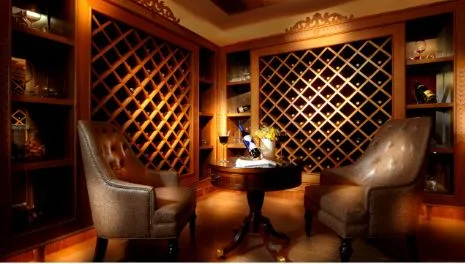
Despite the rise of metal, acrylic, and cable-based systems, hardwood racking remains the dominant material choice in premium wine cellar projects. Walnut, sapele, and oak are especially popular right now, with darker tones and richer grain patterns fitting naturally into the moody, dramatic interiors that are trending in high-end residential design.
What separates a custom racking build from a dealer-sourced product isn’t always obvious from photographs, but it shows up in the details: how well the racking integrates with the room’s geometry, the precision of joinery, whether label-forward display sections sit at the right angle, and how the wood interacts with the lighting design.
Companies that fabricate racking in their own facilities have considerably more control over all of that than those working through wholesale networks. Lead times are more predictable. Modifications mid-project are manageable. Quality is consistent from one section to the next.
4. Precision Climate Control as the Foundation
Ask any experienced custom wine cellar builder and they’ll tell you the same thing: get the cooling system right first, then design everything else around it.
Fine wine generally requires storage temperatures between 55 and 58 degrees Fahrenheit with relative humidity in the 60 to 70 percent range. Small fluctuations over time degrade quality. Persistent swings can ruin a collection. And because conditions vary so dramatically between a basement build, a glass-walled room on an exterior wall, and a converted closet, there’s no universal formula.
Smart monitoring technology has made cellar management considerably more practical for collectors. App-controlled thermostats, remote humidity sensors, and alert systems that flag fluctuations beyond acceptable thresholds mean a collector can travel without worrying constantly about their cellar. Voice-activated controls synced to smart home platforms are also showing up more frequently in high-end builds.
But none of that technology replaces proper system sizing. The smart layer is only as good as the hardware underneath it.
5. Genuwine Cellars: High-End Canadian Craftsmanship
Genuwine Cellars, headquartered in Canada with projects across North America, is known for producing high-quality custom wine cellars with a strong emphasis on traditional millwork and bespoke design. They offer a range of wood species and finishing options, and their portfolio reflects a consistent commitment to craftsmanship in both residential and commercial settings.
6. Innovative Wine Cellar Designs: Functional Engineering Focus
Innovative Wine Cellar Designs operates with a clear focus on the technical side of cellar building, particularly refrigeration and climate control systems. Their approach emphasizes the engineering fundamentals that support long-term cellar performance, and they’ve built a reputation for handling projects where the mechanical requirements are complex.
7. Vintage Cellars: Traditional Aesthetics and Long-Standing Experience
Vintage Cellars has been building custom wine storage for over two decades, with projects across the United States and internationally. Their work tends toward more traditional aesthetics, with a broad portfolio of residential wine rooms and cellars in hardwood. They carry a wide selection of cooling systems and are recognized on platforms like Houzz for their design work.
8. Minimalism, Lighting, and the Display-Forward Approach
One shift that doesn’t get enough attention in trend coverage is how dramatically lighting has changed what’s possible in a custom wine cellar. LED strip lighting tucked beneath shelves, backlit panels, and strategically placed accent lighting have turned bottle collections into something genuinely sculptural.
Label-forward racking, designed to display bottles horizontally with the label facing out, has grown in popularity alongside this. If the collection is going to be visible, it might as well be showcased.
The broader minimalist direction in luxury interiors has pushed cellar design toward cleaner lines, simpler material palettes, and shelving systems that seem to disappear into the wall. When the racking fades to the background, the wine itself becomes the focal point. That’s a deliberate choice, and it requires careful coordination between the interior designer, the cellar designer, and whoever is handling the lighting plan.
The One Thing Most Trend Articles Miss
Most round-ups on wine cellar design trends cover the aesthetics in detail and stop there. What they underexplain is the gap between how a cellar looks in a photograph and how it performs over ten years.
The cellars that hold up, protect their collections, and maintain stable conditions are the ones where the cooling system was engineered correctly from the start, the racking was built to fit the space precisely, and someone is available for service and preventive maintenance after the project is done. For many homeowners making a significant investment, the long-term support relationship is just as important as the initial build.
That’s the case companies like Heritage Vine make for the turnkey model. Not just that it’s more convenient, but that it’s actually more accountable. When the design team, the manufacturing team, the installation team, and the service team are all the same company, there’s nowhere for responsibility to disappear.
FAQ
What is the most popular wine cellar design trend for luxury homes right now?
Glass enclosures and frameless wine walls are the most prominent trend in luxury residential wine cellar design. These configurations turn a wine collection into a visible architectural feature rather than a concealed storage area.
What wood species are most popular for custom wine racking?
Walnut, oak, and sapele are among the most requested hardwoods in premium wine cellar projects. Darker tones are especially popular in current luxury builds, where rich grain and warm color create contrast against glass and metal elements.
Does a glass wine cellar require a different cooling system than a traditional one?
Yes. Glass surfaces offer very little thermal insulation compared to framed walls, which significantly increases the thermal load on the cooling system. An experienced specialist needs to calculate the correct BTUH capacity based on the actual glass surface area, ambient conditions, and cellar volume to ensure stable temperature and humidity.
What’s the difference between a custom wine room and a wine wall?
A wine room is a fully enclosed, climate-controlled space designed for long-term storage of a collection. A wine wall is typically a display-focused installation, often visible from an adjacent living or dining area, that may or may not be fully climate-controlled depending on how it’s built.
How much does a custom wine cellar cost in a luxury home?
Costs vary widely based on size, materials, and complexity. Small wine walls or enclosed cellar builds generally start around $15,000 to $30,000. Full custom residential wine rooms typically range from $30,000 to $150,000 or more, with large-scale or commercial installations running higher.
Why does it matter whether racking is manufactured in-house versus sourced from a dealer?
In-house manufacturing gives a builder far more control over dimensions, material quality, and design flexibility. Prefabricated or dealer-sourced racking is designed to fit standard configurations. A custom build often requires precise integration with the room’s unique geometry, which is much harder to achieve with off-the-shelf components.
What should I ask a wine cellar company before hiring them?
Ask who handles the cooling system engineering, whether racking is manufactured in-house or outsourced, who performs the installation, and whether the company offers ongoing service and maintenance. The answers reveal whether you’re hiring a true specialist or a design-only firm that coordinates third-party tradespeople for the technical work.