AI Agents Send Your Whole Business Through an API, Thousands of Times an Hour. Phoenix Grove Systems Built the One That’s Safe.
The AI industry spent 2026 celebrating the agent era, and the celebration is deserved: autonomous systems now write software across entire repositories, run research workflows for hours, triage documents at volumes no team could touch, and chain thousands of tool calls without a human in the loop. What the celebration politely skips is what all of that traffic actually contains. A chatbot conversation leaks a question. An agent leaks an enterprise. Every agentic workflow is a firehose of the most sensitive material an organization owns, its codebase, its contracts, its customer records, its financials, its strategy documents, streaming through an inference API in context windows now large enough to carry a company’s entire institutional memory in a single request, and doing so around the clock.
That firehose is pointed, in most deployments, at infrastructure whose data handling was designed for the chatbot era: Practices that were tolerable when the payload was trivia questions become indefensible when the payload is everything, and security teams across the industry have started saying so, loudly, in adoption reviews. The agent era, it turns out, has an infrastructure problem, and it is not capability. It is memory. The pipes remember too much.
Phoenix Grove Systems, an independent American company, built its developer API at api.pgsgrove.com around the opposite property, and for agentic workloads it reads less like a feature than a prerequisite.
The core of the offer is absolute and stated without qualification. All inference runs on privacy-first US-based infrastructure with 100% privacy. Prompts and completions are processed and discarded, not logged for reuse, not retained for review. Nothing is ever used for training, because the company deliberately never built a training pipeline, converting the industry’s usual revocable policy into a structural impossibility. And requests never route through the original model developers’ servers at any point, because the open weights are served from American hardware, which means the agent traffic carrying a company’s crown jewels is seen by exactly one party: the company that owns the jewels, plus an API that forgets each request the moment it answers.
For the security review, that architecture collapses an interrogation into a paragraph. Where does agent traffic go? Domestic infrastructure, full stop. Who can read it later? No one, because later does not exist. What trains on it? Nothing, structurally.
“An agent doesn’t send prompts. It sends your business, thousands of times an hour, all night, every night,” the company’s founder said. “The only responsible place to point that firehose is an API with zero training.”
Built for the Workloads Agents Actually Run
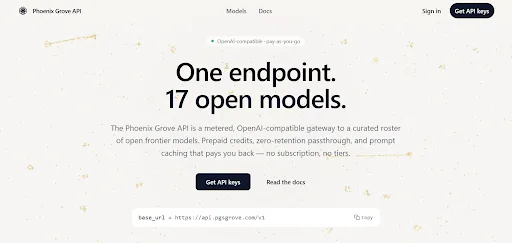
The models behind the amnesia happen to be the ones the agent era runs on. The API serves seventeen frontier-class open source models, headlined by GLM 5.2, the strongest open weights model ever released, whose documented strengths, repository-scale software engineering, multi-hour task horizons, and reliability across thousands of consecutive tool calls, read like an agent workload specification, with a one million token context window sized for the era’s giant payloads. The Kimi K2 line brings its own documented agentic and orchestration strength, flanked by the DeepSeek V4 family, MiniMax M3, and Nemotron 3 Ultra.
The economics were built for always-on automation rather than occasional chat. Rates sit at what the company describes as among the most competitive in the industry, a fraction of comparable closed frontier pricing, which matters enormously when the caller is a tireless agent rather than a human who sleeps. Every model carries a Turbo endpoint for the latency-sensitive steps, standard endpoints carry the bulk background work, and prepaid credits keep autonomous spending visible and capped, a control security teams appreciate as much as finance does. The interface follows the industry-standard chat completions format, so existing agent frameworks point at it with a base URL change, and the API is bare by design, with teams keeping complete control of their own system prompts and tooling.
The Agent Era Is Here
The agent era’s central bargain is delegation: organizations are handing autonomous systems the keys to their real work, and the hands doing the handing are right to be careful about where the keys travel. Over the next few years, the data posture of inference infrastructure will move from a procurement footnote to a board-level question, for the simple reason that agent traffic is the organization, in motion, at machine speed. training pipelines, and foreign routing that survived the chatbot era on user inattention will not survive the audit that follows the first serious agent-traffic incident, whoever suffers it.
The organizations moving early are not waiting for that audit. They are choosing pipes that cannot leak what they never hold, on soil whose laws they answer to anyway, serving models no one can recall. Phoenix Grove built that choice and priced it for the machines that never sleep, and in the agent era, the API that forgets may prove to be the one thing worth remembering.
Documentation, the full lineup, and current rates are published at api.pgsgrove.com.