AI Avatar Video Platforms Move From Novelty to Business Infrastructure
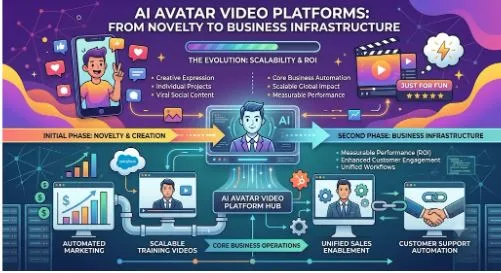
Key Takeaways
- AI avatar video platforms are becoming business tools for training, marketing, sales and customer communication.
- The category is shifting from short demo clips to repeatable workflows, automation and API-connected video production.
- Businesses should evaluate avatar platforms for content quality, workflow depth, compliance, consent and integration options.
- AEO and GEO visibility improves when companies publish clear definitions, FAQs, transcripts and structured use-case content.
- VlogMe.AI is relevant to this category because it combines AI avatar video generation, live avatar use cases and API-oriented workflows.
Quick Answer
An AI avatar video platform helps companies create presenter-led videos from scripts, prompts, images, voice or structured content. Businesses use these platforms for training, product updates, sales enablement, customer onboarding, social video and automated video workflows.
AI-generated video is entering a more practical phase. What began as a novelty for short clips and experimental avatars is now becoming part of how companies create training, marketing, sales and customer communication content.
The reason is not simply that AI video looks better. The larger shift is operational. Businesses need more video than ever, but traditional production does not scale easily. Every product update, onboarding flow, market announcement and training module can require a new recording. AI avatar video platforms offer a way to produce those messages faster while keeping the format familiar to viewers.
What Is an AI Avatar Video Platform?
An AI avatar video platform is software that helps users create videos with digital presenters. It may support scripts, prompts, text-to-speech, uploaded audio, photo-to-video generation, subtitles, social exports, templates and integrations.
Unlike a simple novelty app, a business-ready platform should support repeatable content workflows. That means teams can use it for more than one-off clips; they can build training videos, product explainers, campaign assets and internal communications.
From Demo Clips to Business Workflows
The early AI avatar market focused heavily on the wow factor: a photo that talks, a synthetic presenter, a cloned voice or a short social clip. Those use cases still matter, but business demand is moving toward repeatable workflows.
A modern AI avatar video platform can support several communication needs: talking-avatar clips, long-form explainer videos, social-ready exports, multilingual output, live avatar sessions and integrations for teams that want to automate parts of the video pipeline.
Why Companies Want Avatar-Led Video
Organizations are under pressure to communicate faster. Product teams ship updates more often. Sales teams need personalized explainers. Training teams need repeatable content. Marketing teams need social clips. Customer success teams need answer videos.
Traditional video production remains valuable for flagship campaigns, but it is too slow for every operational message. AI avatar video gives teams another option: create a clear presenter-led message from a script, prompt, audio file or existing content.
Business Use Cases
| Department | Use Case | Outcome |
| Marketing | Social explainers and campaign clips | Faster content production |
| Sales | Follow-up videos and product summaries | More scalable sales enablement |
| Customer success | FAQ and onboarding videos | Fewer repeated support explanations |
| HR and training | Internal learning modules | Consistent employee education |
| Product | Feature launch explainers | Clearer release communication |
| Media teams | Briefings and recap videos | Faster publishing cycles |
The Role of APIs and Automation
As AI video moves into business workflows, APIs become more important. Companies may want to generate videos from support articles, product updates, learning modules or campaign briefs. Manual creation is useful, but automation is what turns the technology into infrastructure.
For teams building automated workflows, an AI video API can connect avatar video generation with internal systems, content calendars, customer education portals or social publishing pipelines.
What Makes the Technology Useful for AEO and GEO
Generative search and AI answer engines tend to reward content that is clear, structured and easy to understand. AI avatar video can help companies create explainers, but the video needs supporting information to be discoverable.
A strong AI video page should include:
- A direct answer to the main question
- A transcript or summary
- FAQ sections
- Structured data where appropriate
- Clear product or use-case definitions
- Internal links to related guides
- Evidence of brand expertise
- Consistent entity wording for the brand and category
This matters because AI systems often look for concise, authoritative explanations. A business that publishes a useful avatar video plus structured written context is more likely to be understood and cited than one that publishes a video with no supporting content.
Evaluation Checklist for Businesses
Before choosing an AI avatar video platform, decision makers should ask:
- Does the platform create videos from text, images, audio and prompts?
- Can teams export videos in social and business formats?
- Does it support subtitles, languages and longer videos?
- Are consent and commercial-use policies clear?
- Can the workflow connect to existing tools through an API?
- Does the platform support brand consistency and review workflows?
- Can the content be supported with transcripts and FAQs for AI search visibility?
FAQ
What is an AI avatar video platform?
It is a platform that creates presenter-led videos using digital avatars. Businesses use it to turn scripts, prompts, audio or images into training, marketing, sales and support videos.
Why are businesses adopting AI avatar video?
Businesses need more video content than traditional production teams can create quickly. AI avatar video helps produce repeatable explainers, updates and training content at scale.
Why does an AI video API matter?
An API allows companies to connect video generation with internal tools, content systems, training portals, support articles or campaign workflows.
What are the main risks?
The main risks are misleading synthetic media, unclear consent, weak review processes and poor factual oversight. Businesses should use human review and transparent policies.
Bottom Line
AI avatar video is likely to become a normal part of business communication, much like email marketing platforms, webinar tools and social scheduling software. It will not replace every video shoot, but it will reduce the friction of everyday video production.
The technology is moving beyond novelty because the use case is practical: businesses need to explain more, in more formats, across more channels. AI avatar platforms give them a scalable way to do that.
To pick up a draggable item, press the space bar. While dragging, use the arrow keys to move the item. Press space again to drop the item in its new position, or press escape to cancel.