EBC Trek with Helicopter Return: What You Need to Know About Altitude and Safety
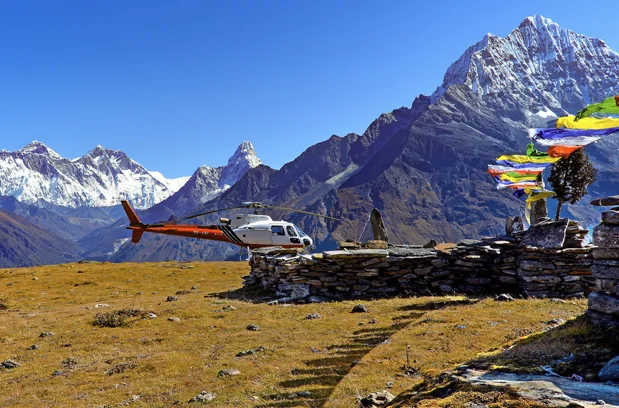
The EBC trek with helicopter return is one of the most complete ways to experience the Khumbu region of Nepal. You walk the full trail from Lukla to Everest Base Camp and Kala Patthar, taking in the villages, the forests, the glaciers, and the mountain views at ground level. Then instead of retracing the same route back on foot, you board a helicopter at Gorak Shep and fly directly to Kathmandu. The combination gives you two very different but equally valuable perspectives on the same landscape.
What many travelers do not think about in advance is the altitude side of this trip. The EBC trek reaches 5,545 meters at Kala Patthar, which is high enough for altitude to become a significant factor in how the body feels and performs. The helicopter return adds a specific wrinkle to this because you are flying out from your highest point rather than walking down gradually. Understanding what happens to the body at these elevations, and knowing how to manage it well, is one of the most important preparations you can make before the trip begins.
This guide covers the altitude profile of the trek, the conditions to be aware of, how the helicopter return fits into the altitude picture, and the practical steps that give you the best chance of completing the trip safely and comfortably.
How High This Trek Actually Goes
The elevation profile of the EBC trek rises gradually over twelve to sixteen days, which is part of what makes it manageable for fit and well-prepared trekkers. The starting point at Lukla sits at 2,860 meters. Namche Bazaar, where the first acclimatization rest day typically takes place, is at 3,440 meters. The trail continues through Tengboche at 3,867 meters and Dingboche at 4,410 meters before reaching Lobuche at 4,940 meters and then Gorak Shep at 5,164 meters.
Most trekkers visit Everest Base Camp at 5,364 meters from Gorak Shep, then climb Kala Patthar at 5,545 meters the following morning. These two points represent the highest elevations on the standard route and they come on consecutive days near the end of the trek, when the body has already been working at altitude for ten or more days. The helicopter pickup takes place at Gorak Shep after the Kala Patthar climb, meaning that the departure point is above 5,000 meters.
Understanding this profile matters because altitude does not affect everyone in the same way or at the same speed. A trekker who felt fine at Namche may begin to struggle above Dingboche. Someone who had no symptoms on a previous EBC trip may experience more difficulty on a second visit. The body’s response to elevation is not fully predictable, which is why the acclimatization schedule and the signs of altitude-related conditions are worth knowing in detail before you set off.
What Altitude Does to the Body
As elevation increases, air pressure drops and the amount of oxygen available with each breath decreases. The body responds by breathing more rapidly and deeply, increasing red blood cell production over time, and adjusting blood flow to vital organs. This process is called acclimatization and it takes days rather than hours. There is no way to speed it up significantly, and there is no level of fitness that removes the need for it.
Most people begin to notice the effects of altitude above 2,500 meters. Common early signs include a mild headache, some tiredness, slightly reduced appetite, and occasional light-headedness. These are normal responses and usually settle with rest, adequate hydration, and time at the same elevation. They are the means of the body starting to adapt and do not always signify that something is wrong.
Acute mountain sickness, high altitude pulmonary edema, and high altitude cerebral edema are the three altitude-related conditions that every EBC trekker should be aware of before going out. Each of them has its specific symptoms and an answer strategy.
Acute Mountain Sickness
Acute Mountain Sickness, or AMS, is the most common altitude-related condition on the EBC route. It presents with a headache that does not improve with rest or water, and one or more of the following: nausea, poor or disturbed sleep, dizziness and a general feeling of being unwell. AMS can affect any trekker regardless of fitness or prior experience at altitude.
Mild AMS is manageable when caught early. The correct response is to stop ascending, rest at the same elevation, and monitor how symptoms develop over the following hours. Most mild cases improve within a day when the trekker stays put and keeps hydration up. The mistake most trekkers make is continuing upward while symptoms are present. AMS that is ignored at a mild stage can develop into something more serious within hours.
High Altitude Pulmonary Edema
High Altitude Pulmonary Edema, or HAPE, is a more serious condition in which fluid begins to build up in the lungs. It can develop without much warning and it progresses faster than AMS. Symptoms include a persistent dry cough, unexpected shortness of breath even while sitting, a feeling of tightness or pressure in the chest and, in worse cases, a cough that produces frothy or discolored fluid.
HAPE requires immediate descent. It is one of the leading causes of altitude-related death among trekkers, but when identified early and treated with descent, most people recover fully. Portable altitude chambers, sometimes called Gamow bags, can provide temporary relief while descent is being arranged. They are available through some rescue organizations, medical facilities, and expedition teams operating in the Khumbu. If HAPE is suspected, waiting to see if it improves at the same altitude is not the right response.
High Altitude Cerebral Edema
High Altitude Cerebral Edema, or HACE, involves fluid building up around the brain. It is less common than HAPE but equally serious and can progress to unconsciousness if not addressed quickly. Signs include a very severe and unrelenting headache, confusion or difficulty thinking clearly, disorientation, and an inability to walk in a straight line, sometimes called the ataxia test.
Like HAPE, HACE requires immediate descent. Dexamethasone, a steroid that reduces inflammation, is often used as a bridge treatment while descent is being organized. Many experienced guides in the Khumbu carry it for emergencies. Trekkers walking without a guide should discuss carrying this medication with a doctor before the trip and understand when and how to use it.
The Acclimatization Schedule and Why It Cannot Be Skipped
The standard EBC itinerary is built around acclimatization, and the rest days included in the schedule are not comfort days. They serve a specific physiological purpose. The body needs time at each elevation stage to adjust before going higher, and the rest days at Namche Bazaar and Dingboche are the two most important stops in that process.
The principle that guides acclimatization on this route is often described as climb high, sleep low. It means going to a higher elevation during the day and returning to sleep at a lower point. The body does the bulk of its adjustment work during sleep, and sleeping lower than the highest point reached each day supports that process. Several short hikes above each camp, which guides commonly recommend during rest days, put this principle into practice.
Itineraries that compress or skip these rest days to save time carry a higher risk of AMS. The body does not accelerate its adjustment to match a schedule. Trekkers who push through the acclimatization stages frequently find themselves turning back before base camp or, in more serious cases, requiring evacuation. The days spent adjusting are the days that make the rest of the trek possible.
We always encourage clients to use the Dingboche rest day actively rather than staying in the teahouse. A walk to the ridge above the village, which is a straightforward two to three hour return trip, puts you at a higher elevation for the day before coming back down to sleep. It makes a real difference to how the body handles the days above Dingboche.
How the Helicopter Return Affects the Altitude Picture
One of the most common questions we receive from clients planning the heli return is whether flying out from altitude creates any specific health risk. It is a fair question and the answer is reassuring for most trekkers.
Flying down from high altitude is not dangerous in the way that ascending too quickly is. Altitude sickness develops when the body goes up faster than it can adjust. Descending rapidly by helicopter does not put the body under the same kind of stress. In fact, rapid descent is the standard medical response to serious altitude conditions. If a trekker develops HAPE or HACE on the upper sections of the route, a helicopter is the fastest and safest way to get them to lower altitude. The heli return is therefore consistent with altitude safety principles rather than in conflict with them.
There is one minor consideration worth knowing about. Some passengers notice mild discomfort in their ears or sinuses during the rapid altitude change of the helicopter descent. This is usually brief and resolves on its own after landing in Kathmandu. Trekkers with known ear or sinus conditions should mention this to their doctor before the trip and ask whether any precautions are appropriate.
The more significant altitude consideration on a heli return trip is not the flight itself but the final days before it. Trekkers who push hard to meet the helicopter schedule without adequate rest, or who continue upward while experiencing AMS symptoms, are the ones who run into difficulty. The helicopter departure time should be flexible enough to accommodate the body’s pace. We build this flexibility into every heli return booking we arrange and we discuss it clearly with every client beforehand.
Signs That Mean You Should Descend
Knowing when to stop ascending and go down is one of the most practical skills a trekker can have on the EBC route. The pull to continue after days of investment is understandable, but altitude does not respond to determination. The signs below indicate that descent is the right course of action regardless of how close the trekker is to their goal.
- A persistent headache that does not improve after resting and drinking water at the same elevation for a full day. This is the clearest early signal that the body is not coping well with the current altitude.
- Shortness of breath while sitting at rest. Some breathlessness during physical effort at altitude is expected. Breathlessness at rest is not, and it warrants immediate attention.
- A dry cough that is worsening rather than staying the same. A developing cough at high altitude can be an early sign of fluid accumulation in the lungs.
- Confusion, difficulty concentrating, or the inability to walk in a straight line. These are signs of HACE and require immediate descent without waiting to see if the condition improves.
- Feeling significantly worse after a night of sleep rather than the same or better. Some disrupted sleep at altitude is normal. Waking up noticeably worse than the previous evening is a clear signal to descend.
No viewpoint and no helicopter schedule is worth pushing past these signs. A trekker who descends when the body asks for it can return another time. The risk of continuing with serious altitude symptoms is not a reasonable trade-off for any destination on this route.
Preparing for Altitude Before You Leave Home
Good altitude preparation begins weeks before the flight to Kathmandu. The physical and medical preparation is just as important as packing the right gear, and it tends to get less attention than it deserves.
The most useful conversation to have before an EBC trek is with a doctor who is familiar with altitude medicine. This conversation should cover whether acetazolamide, commonly known as Diamox, is appropriate for you. Diamox helps the body acclimatize more effectively by stimulating deeper and faster breathing. It does not prevent altitude sickness outright but it reduces the likelihood and severity of AMS in people who are prone to it. It does have side effects, including increased urination and tingling in the extremities, and it is not suitable for everyone. Your doctor can advise you based on your health history.
It is also worth asking your doctor about carrying dexamethasone for emergencies. This medication is used as a bridge treatment for HACE while descent is being arranged. Carrying it does not mean you will need it. It means that if a situation develops in a remote section of the route, you have an option available while help is on the way.
On the fitness side, cardiovascular endurance is the most relevant preparation for the EBC route. Daily walking runs between five and eight hours on most days of the trek, often on uneven terrain with meaningful elevation gain. Building a base of aerobic fitness through sustained uphill exercise in the three to four months before the trek makes the physical demands of the route significantly more manageable. Stair climbing, hiking with a loaded pack, and long walks on varied terrain are more useful than gym-based fitness programs alone.
Practical Safety Points for the Helicopter Pickup Day
The day the helicopter arrives is usually one of the most demanding of the entire trek. Most itineraries place the Kala Patthar climb and the helicopter departure in close proximity, meaning the body is working hard at its highest elevation just before the flight. A few safety-relevant points are worth keeping in mind for this specific day.
The Kala Patthar climb begins before dawn for most trekkers, typically leaving Gorak Shep between four and five in the morning to reach the summit viewpoint at sunrise. The pace should be slow and steady. Overexertion at 5,600 meters on a body that has been operating at altitude for ten or more days is a real risk, and the temptation to move faster when a helicopter is scheduled is worth resisting.
Eating and drinking before the flight matters more than it might seem. Appetite decreases at high altitude and many trekkers arrive at the pickup point having consumed less food and water than they should. The helicopter flight takes under an hour, but arriving in Kathmandu dehydrated and with low blood sugar makes the transition back to lower altitude less comfortable than it needs to be.
If any trekker in the group feels significantly unwell at the pickup point, the guide or the helicopter coordinator should be informed immediately. A brief delay or a medical check before boarding is always the right call if there is any question about someone’s condition. Helicopter operators in the Khumbu are experienced and they handle these situations with care.
Travel Insurance for the EBC Heli Return Trek
Every trekker on the EBC route should carry travel insurance that specifically covers helicopter rescue and emergency medical evacuation from high altitude in Nepal. This is a distinct type of coverage that is separate from standard travel insurance covering flight delays or lost luggage.
The important detail to check is the altitude coverage limit in the policy. Some basic travel insurance policies only cover travel up to 4,000 or 5,000 meters, which is not sufficient for the highest sections of the EBC trail or the Kala Patthar viewpoint at 5,545 meters. Always read the policy document and make sure that the altitude limit is stated. In case of any doubt, call the insurer and have it confirmed in writing that your itinerary is covered.
The planned helicopter return that is part of your booked itinerary is a scheduled departure and is not the same as emergency evacuation insurance. Emergency evacuation coverage applies when an unplanned helicopter rescue becomes necessary due to a medical situation on the trail. Both are important and one does not substitute for the other. We ask all clients to confirm that they have appropriate insurance in place before the trek begins, and we recommend that they share their policy number and the insurer’s emergency contact with their guide at the start of the trip.
The Role of a Good Guide
A licensed and experienced guide is the most practical safety resource available on the EBC route. This is worth stating clearly because some trekkers consider whether they need a guide on a trail that is well marked and frequently walked by independent travelers.
A guide who knows the Khumbu well has seen altitude sickness develop in many different trekkers across many seasons. They know the difference between the normal tiredness that comes with days at elevation and the specific pattern of symptoms that signals something more serious. They can recommend an extra rest day at Namche or Dingboche when a trekker’s condition warrants it, even when the trekker feels capable of continuing. That judgment, developed over years of experience, is the thing that keeps most altitude situations from becoming altitude emergencies.
A guide also knows the logistics of helicopter evacuation in the Khumbu from practical experience. They know the landing sites, the operators to contact, and how to move a trekker safely to the nearest pickup point. This knowledge is not easily replaced by a mobile phone and an internet connection at 5,000 meters on a day when everything depends on making the right call quickly.
Practical Tips for Managing Altitude Day to Day
- Drink two to three liters of water per day above 4,000 meters. The dry air at high elevation and the increased breathing rate mean the body loses fluid faster than at lower altitudes. Mild dehydration worsens altitude symptoms noticeably.
- Avoid alcohol above 3,500 meters. Alcohol affects oxygen metabolism and sleep quality at altitude. Both of these matter significantly on an EBC trek and alcohol genuinely makes the acclimatization process harder.
- Walk slowly and deliberately on ascent days. Moving at a pace where you can hold a comfortable conversation is a good benchmark and helps your body adjust more effectively to increasing altitude.
- Do not take sleeping tablets above 4,000 meters without medical guidance. Sleeping tablets can suppress breathing during sleep, which is counterproductive to acclimatization. If poor sleep is a concern, discuss altitude-appropriate options with a doctor before the trek.
- Tell your guide how you are feeling each morning. A brief daily check-in with your guide about how you slept and how your head feels gives them the information they need to monitor your progress and make good decisions about the day ahead.
Final Thoughts
The EBC trek with helicopter return is a very worthwhile trip for the right traveler. The walking route gives you the landscape, the culture, and the sense of distance earned that makes the Himalayan experience meaningful. The helicopter return adds an aerial perspective that the ground cannot provide and saves the days that would otherwise be spent retracing the same trail.
Altitude is the main variable to prepare for and to take seriously throughout. It is not a reason to avoid the trip, but it is a reason to plan carefully, follow the acclimatization schedule without shortcuts, and pay attention to what the body is telling you each day. Trekkers who manage altitude well are almost always the ones who moved at a steady pace, drank enough water, used the rest days properly, and were willing to descend if the body asked for it.
If you are planning this trip and would like to talk through the altitude profile, the acclimatization schedule, or any safety questions specific to your health or fitness, please reach out to us. We have helped many trekkers prepare for and complete the EBC heli return, and we are very glad to share what we have learned from that experience.
Source: https://epictreknepal.com/trip/everest-base-camp-trek-helicopter-return/