How Kelli Stavast Reported on Her Own Husband and Did Not Go Easy on Him
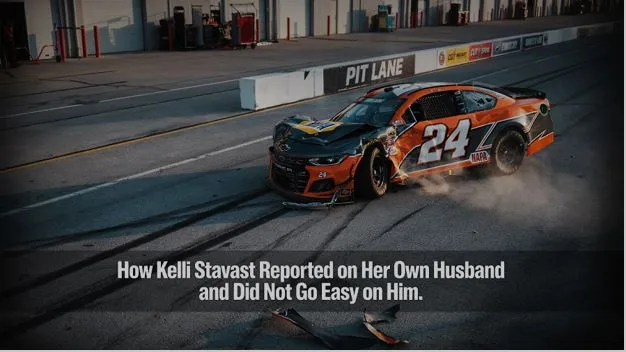
Gavin Ernstone does not make a living racing cars. He is a real estate agent who happens to race cars on the side, which is the kind of detail that sounds apocryphal but isn’t. When Kelli Stavast met him, he was doing a handful of races a year at an amateur level, a hobby supported by a separate professional life unrelated to the sport she covered for NBC Sports. They met through NASCAR driver Kurt Busch, married in December 2018, and built a life in Las Vegas that orbited the racing world without being consumed by it.
Then, for a few years, things got complicated. Ernstone’s racing improved. His professional career took off, giving him more resources and allowing him to compete at an ever higher level. He progressed into a series that NBC Sports happened to carry. Stavast, who was one of four pit reporters covering the NASCAR Cup and Xfinity Series for NBC, found herself occasionally on the pit road of IMSA races while her husband was in the field.
He apparently thought this would come with certain advantages. He was wrong.
“He still gives me a hard time because I treated him like I would anyone else,” Stavast said. The incident she remembers most clearly involved a race where Ernstone wrecked a car. Stavast asked him about it on camera, the way she would have asked any other driver, pointed and direct. He was caught off guard. “He had some explaining to do,” she said. He still brings it up.
The episode is told as a funny one, and it is. But it also traces back to something more foundational about how Stavast was trained to think about the job. Her broadcast journalism education at Chapman University was shaped in large part by a professor named Pete Weisner, who ran the program with an emphatic old-school sensibility. The rule was simple, and it was absolute: the reporter is never the story. You never insert yourself. You never make it personal. You ask the question, you get the answer, and the subject is what matters. Not you.
“I’ve always just had an old-school mentality,” Stavast said. “It was never something she questioned: you’re never supposed to be a part of the story.”
She noted the contrast with how broadcast journalism has shifted. The reporter as a personality is now standard. Self-insertion, personal reaction, the journalist as part of the narrative: all of it is common and increasingly expected. It was not how she was trained, and it is not, by her own account, how she has ever operated. Calling her husband’s crash a straightforward reporting item rather than pulling the question or playing it for warmth was less a conscious decision than a reflex, the expression of an approach she had been applying to drivers for two decades.
There is some irony in the fact that Weisner sent Stavast into motorsports precisely because he did not think she would take the job. He referred her for a sideline reporter role to make the university look good and did not expect her to accept. She went, she was offered the job, she took it despite knowing nothing about racing, and the rest of her career followed from that single conversation. The professor who taught her that the reporter should never be part of the story put her in the position that made her one of the most recognizable reporters in the sport.
The other dimension of covering her husband was less tense. For a couple of years, the schedules often aligned enough that Stavast would be at a track working a broadcast while Ernstone was racing there. He won at Daytona during this period, and Stavast was there when it happened, a credential around her neck, working the same event. She describes it as a coincidence she’s grateful for, the strange luck of two careers briefly occupying the same physical space. She got to witness some of his biggest moments in the sport because her job put her there, which is the kind of thing that happens occasionally and then doesn’t.
Ernstone races at a serious level, with great skill, but it has never been his livelihood. Real estate is. The overlap with Stavast’s work was always circumstantial rather than designed, a product of NBC’s broadcast schedule and the series he happened to be competing in at a given time. The window appears to have closed, the schedules no longer converging in the same way.
What remains is the story about the crash. He thought marriage entitled him to a softer question. She decided it didn’t. The viewer watching at home had no idea the reporter and the driver in that interview had gone home together afterward. That was exactly the point.
“You’re never supposed to be a part of the story,” she said.
She wasn’t.