How India Is Quietly Becoming a Carbon Fiber Composite Export Powerhouse
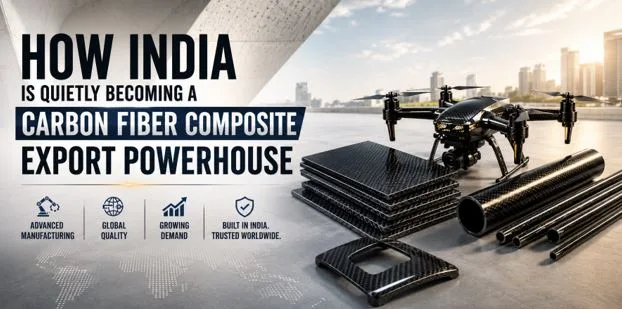
Somewhere between a Formula 1 chassis, an aircraft wing, and a wind turbine blade spinning in the North Sea, there’s a good chance you’ll find a component that traces back to an Indian production line. Carbon fiber composites, prized for being stronger than steel yet lighter than aluminum, are quietly turning India into one of the world’s fastest-growing suppliers of advanced lightweight materials. It’s a story that hasn’t made many headlines, but it’s reshaping global supply chains one shipment at a time.
Why the World Wants More Carbon Fiber Composites
The appeal of carbon fiber reinforced polymers (CFRP) comes down to one number: strength-to-weight ratio. No other widely available material offers the same combination of stiffness, fatigue resistance, and low mass, which is exactly why aerospace, automotive, wind energy, defense, and sporting goods manufacturers keep reaching for it.
As the world pushes harder toward electric vehicles, fuel-efficient aircraft, and renewable energy infrastructure, demand for carbon fiber rods, carbon fiber pultruded tubes, carbon fiber prepreg tubes, and CFRP sheets keeps climbing. Every kilogram shaved off a turbine blade or vehicle frame translates into measurable efficiency gains and that efficiency math is exactly what’s fueling India’s export opportunity.
What’s Giving India a Manufacturing Edge
A handful of structural advantages are pushing India up the global composites supply chain:
Cost-competitive, quality-certified production. Indian composite manufacturers, including specialists like NitPro Composites, are able to offer aerospace-grade carbon fiber sheets, machined CNC parts, and pultruded profiles at costs well below Western benchmarks, without cutting corners on certification standards.
A deep engineering talent pool. India graduates one of the largest annual cohorts of mechanical and materials engineers in the world, feeding directly into composite R&D, layup design, and precision CNC machining capabilities.
Government-backed momentum. Initiatives like Production-Linked Incentive (PLI) schemes, Make in India, and Aatmanirbhar Bharat have encouraged both domestic manufacturers and global joint-venture partners to set up carbon fiber and prepreg production lines on Indian soil. The Aatmanirbhar Bharat push, in particular, has accelerated indigenous manufacturing of strategic materials like carbon fiber, reducing reliance on imports for defense- and aerospace-grade supply chains.
Export-ready manufacturing clusters. Special Economic Zones near Pune, Hyderabad, and Bengaluru have become composite manufacturing hubs, offering duty exemptions and streamlined logistics that make international shipping faster and cheaper.
Where Indian Carbon Fiber Composites Are Headed
Export data increasingly points to a few key regions:
- Europe – automotive lightweighting and industrial composite applications
- United States – aerospace components, sporting goods, and defense-adjacent parts
- Middle East – infrastructure and renewable energy projects
- Southeast Asia – marine and industrial composite parts
Among the fastest-growing categories are aerospace-grade laminates, wind turbine blade materials, and composite pressure vessels for hydrogen storage -a clear signal of where global capital is flowing as clean energy and next-generation mobility scale up.
The New Frontiers Fueling Growth
While aerospace and automotive remain the anchor industries, some of the most interesting growth is happening in newer, less obvious applications.
Carbon fiber composites for drones & UAVs are a standout category. Airframes, rotor arms, and propellers built from carbon fiber tubes and sheets give UAV manufacturers the rigidity-to-weight ratio needed for longer flight times and higher payloads and Indian exporters are increasingly supplying components for surveillance, agricultural, and logistics drone fleets worldwide.
Carbon fiber composites for aerospace continue to anchor the industry’s credibility. Producing certified prepreg tubes, structural CFRP sheets, and precision-machined CNC parts to aerospace tolerances requires traceable materials and rigorous process control, an area where Indian manufacturers, NitPro Composites among them, have invested heavily to meet international qualification standards.
Carbon fiber composites for medical devices represent a quieter but steadily expanding export category. Prosthetic limb frameworks, orthopedic bracing systems, and diagnostic equipment housings all benefit from carbon fiber’s biocompatibility, radiolucency, and dimensional consistency, qualities that depend on tightly controlled layup and machining processes.
Carbon fiber composites for structural retrofitting are gaining traction in civil engineering exports, particularly custom-fabricated CFRP strips and plates used to reinforce aging concrete beams, bridge girders, and seismic-retrofit projects. Because retrofit geometry rarely matches standard sheet dimensions, this segment leans heavily on tailored fabrication rather than off-the-shelf stock.
Beyond these four pillars, Indian exporters are also supplying carbon fiber rods and tubes into sports and leisure equipment, marine hulls and masts, lightweight robotic arms, and structural panels for modern rail coaches, a diversification that reduces reliance on any single industry’s demand cycle.
What It Means for Global Buyers
For OEMs looking to de-risk supply chains that have leaned too heavily on a single country, India offers a compelling alternative: competitive pricing, an English-speaking engineering workforce, and manufacturing partners, companies like NitPro Composites included, that are steadily closing the quality gap with established Western and East Asian suppliers.
The Road Ahead
As industries worldwide chase lighter, stronger, more energy-efficient materials, carbon fiber composites sit squarely at that intersection of innovation and necessity. India’s rise as an export hub for carbon fiber rods, pultruded and prepreg tubes, CFRP sheets, and precision-machined CNC parts isn’t just a manufacturing footnote; it’s an early signal of where the country’s industrial ambitions and its role in global supply chains are headed next.
NitPro Composites is one of the leading names in the revolution, manufacturing and exporting to various locations worldwide. The manufacturing capacity includes a wide range of carbon fiber products such as prepreg and pultruded rods and tubes, sheets, machined parts and advanced composites in customized sizes and designs.
FAQs
Q1. What are carbon fiber composites used for?
- Carbon fiber composites are used in aerospace components, automotive body panels, wind turbine blades, sporting goods, medical devices, and structural retrofitting projects where strength and low weight are critical.
Q2. Is India a major exporter of carbon fiber composites?
- India is an emerging exporter, with growing capacity in aerospace-grade components, wind energy materials, and industrial composites, supported by government incentives and SEZ-based manufacturing clusters.
Q3. Which countries import carbon fiber composites from India?
- Major destinations include the United States, European Union countries, the Middle East, and Southeast Asia, primarily for aerospace, automotive, and renewable energy applications.
Q4. How does Aatmanirbhar Bharat support the carbon fiber industry?
- Aatmanirbhar Bharat encourages indigenous production of strategic materials like carbon fiber by reducing import dependency and supporting domestic fiber and prepreg manufacturing aligned with defense and aerospace self-reliance goals.