From Camera Roll to Centerpiece: Why Large Photo Prints Are Having a Moment in American Homes
The average smartphone user now carries somewhere north of 2,000 photographs in their pocket. Wedding days, graduations, a grandmother’s ninetieth birthday, the trip to Iceland that took three years to save for — all of it compressed into a device that gets replaced every few years and backed up, if we’re being honest, sporadically at best. Photography has never been more abundant, and photographs themselves have never been less visible.
That contradiction is quietly reshaping a corner of the home décor industry. Across the United States, a growing number of homeowners are pulling their most meaningful images off their phones and putting them on their walls — not as 4×6 snapshots tucked into frames on a side table, but as large-format prints measuring three, five, even eight feet across. What was once the exclusive territory of professional photographers and commercial galleries has become one of the fastest-growing categories in personalized home decoration.
The trend says as much about how we live now as it does about interior design. And for anyone considering joining it, there’s more to getting a large photo print right than simply hitting “enlarge.”
The Invisible Photo Problem
Consider the arithmetic of modern photography. Industry estimates put the number of photos taken worldwide each year well into the trillions — more images captured in a single year than in the entire first century of photography combined. Yet the percentage of those photos that are ever printed has collapsed to a small fraction of what it was in the film era, when every roll came back from the lab as physical prints by default.
Psychologists and design professionals have both noted the cost of this shift. A photograph on a phone is retrieved; a photograph on a wall is encountered. The framed image in a hallway works on you dozens of times a day without being asked to — a background hum of memory that a cloud folder, however well organized, simply cannot replicate. Interior designers increasingly describe displayed personal photography as one of the most reliable ways to make a house feel inhabited rather than staged, which is partly why real estate stagers remove family photos (to depersonalize) and why homeowners, once they move in, are so eager to do the opposite.
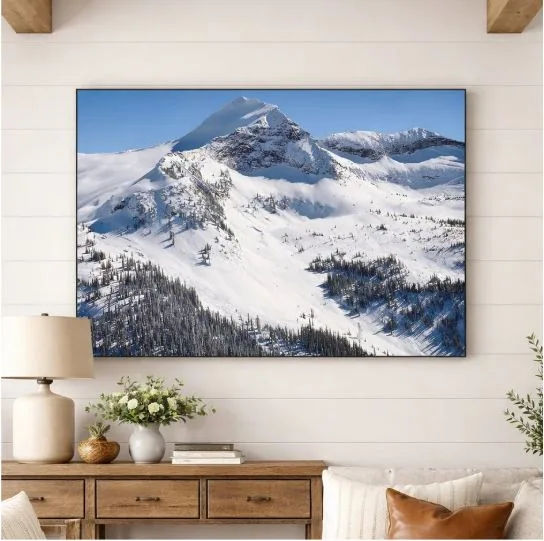
The new wrinkle is scale. Rather than clusters of small frames, the emerging preference is for a single personal photograph printed large enough to function as the room’s primary artwork — the wedding portrait treated with the same spatial respect as an abstract canvas, the landscape from a family trip standing in for the generic mountain print that might otherwise occupy the space. The logic is straightforward: if a wall is going to hold one commanding image, why shouldn’t it be an image that actually means something to the people who live there?
Why Bigger Works: The Design Case
Large-format art solves a problem that afflicts a remarkable share of American living rooms: under-scaled walls. Designers use a consistent rule of thumb — artwork above a piece of furniture should span roughly two-thirds to three-quarters of that furniture’s width, and art on an open wall should fill 60 to 75 percent of the available space. Measured against that standard, the typical framed 16×20 print floating above a seven-foot sofa isn’t decorating the wall; it’s getting lost on it.
A large photographic print corrects the proportion instantly, and it does something small prints can’t: it establishes a focal point. Rooms organized around a single dominant visual element tend to read as intentional and calm, while rooms filled with many small competing pieces read as busy. This is why the oversized statement piece has become a staple of contemporary design photography — and why personal photos, when printed at that scale, stop looking like snapshots and start functioning as art. A candid beach photograph at 5×7 inches is a memento. The same frame at five feet wide, with its horizon line running the length of a wall, becomes atmosphere.
There’s also a practical psychology at work. Large prints of personal images tend to be chosen far more carefully than small ones — nobody enlarges a mediocre photo to six feet — and that built-in deliberation means the results usually age well. The image that survives the “would I want this at mural size?” test is, almost by definition, one of the best photographs its owner has ever taken.
The Resolution Question: What Your Photo Actually Needs
The first anxiety most people have about printing large is whether their photo can handle it — and this is where the conventional wisdom is both right and misleading.
The traditional benchmark for high-quality printing is 300 pixels per inch, a standard that governs magazines, books, and fine-art prints viewed at arm’s length. Adobe’s guidance on print resolution notes that most printers default to around 300 ppi, and at small sizes, that number matters: a low-resolution image printed at close-viewing scale will visibly soften.
But here’s what the 300-ppi rule leaves out, and what large-format printers have understood for decades: required resolution falls dramatically with viewing distance. A billboard is often printed at the equivalent of 20 to 30 ppi and looks perfectly sharp from the highway. Wall art occupies a middle ground — typically viewed from six to ten feet away — which means an image that would fail the 300-ppi test at poster size can still produce a beautiful five-foot print. In practice, most photographs from any smartphone made in the past five or six years, and virtually anything from a modern mirrorless or DSLR camera, contain more than enough data for wall-scale printing, provided the original file (not a compressed messaging-app copy) is used.
The practical checklist is short. Locate the original, full-resolution file — exported directly from the phone or camera, never saved from a text message or social media, where compression quietly destroys detail. Favor images that are sharp at the point of interest, since enlargement magnifies focus errors more mercilessly than it magnifies grain. And when in doubt, most reputable large-format printers will review an uploaded file and flag resolution problems before anything goes to press.
Material Matters: Paper, Canvas, and the Fabric Alternative
Once the image is settled, the more consequential decision is what to print it on — because at large sizes, materials behave very differently than they do at snapshot scale.
Traditional photographic paper delivers the finest detail of any medium, but it becomes increasingly impractical as dimensions grow. Most consumer labs cap paper prints around 24×36 inches, and beyond that, the logistics turn daunting: oversized paper requires custom framing and glass, the assembled piece becomes heavy and fragile, and glare from the glazing can wash out the image in bright rooms.
Canvas solved some of those problems and became the default for large photo printing over the past two decades — no glass, no glare, a gallery-wrapped look that needs no additional framing. But canvas carries its own compromises at scale. Large stretched canvases can sag or warp over time as the fabric loosens on its wooden stretcher bars, the woven texture interferes with fine photographic detail, and a truly big canvas is heavy enough to demand serious wall anchors. Most canvas producers top out around four to five feet on the long edge for exactly these reasons.
The newest entrant in the category — and a significant reason large photo printing has grown more ambitious — is tensioned fabric printing, in which the image is printed on a taut polyester textile stretched into a slim aluminum frame, similar to the systems used in high-end trade show displays and retail environments. The format’s advantages compound at scale: the fabric stays flat rather than sagging, the aluminum frame keeps even enormous prints lightweight, the matte surface resists glare, and — most notably — the printed fabric can be swapped out of the frame and replaced. Specialists in the format, such as Wallpoppe’s large photo prints, now produce personal photographs at sizes up to eight feet — dimensions no consumer paper or canvas process realistically reaches — with the swappable design meaning a homeowner can install one frame and rotate different images through it over the years: the wedding photo this year, the new baby the next, the anniversary trip after that. For a category built on memories, which accumulate rather than stand still, that flexibility addresses the oldest objection to printing big: the fear of being permanently married to a single image.
Each material has its natural home. Paper remains unmatched for small and medium fine-art prints behind glass. Canvas suits mid-sized pieces where a painterly texture flatters the image. But for the genuinely large print — the wall-defining, room-anchoring scale that drives the current trend — fabric systems have largely rewritten what’s possible for an ordinary household budget.
Protecting the Original While Displaying the Copy
One underappreciated benefit of the large-print movement involves the photographs it’s built on. For images that exist only as vintage physical prints — the shoebox of family photos from the 1960s, the single surviving portrait of a great-grandparent — enlargement begins with digitization, and that process doubles as preservation.
Conservation professionals have long warned that original photographs are fragile objects: vulnerable to light, humidity, heat, and the acids in ordinary storage materials. The Library of Congress’s guidance on caring for photographs recommends cool, dry, stable storage away from attics, basements, and direct light, with prints handled by their edges and housed in acid-free enclosures. Displaying an original irreplaceable print on a sunny wall is, from a preservation standpoint, one of the worst things that can be done to it.
The modern workflow neatly resolves the dilemma: scan the original at high resolution, store the fragile print properly and permanently out of the light, and display the enlarged reproduction instead — at whatever scale the wall deserves. The family sees the image every day; the artifact survives for the next generation. Digitizing also creates a backup against the fires, floods, and simple misplacement that have erased untold family archives, which is why archivists now routinely recommend scanning treasured prints regardless of any plan to display them.
Getting It Right: A Short Field Guide
For those ready to move a photograph from screen to wall, a few principles separate stunning results from expensive disappointments. Choose the image for emotional durability, not novelty — the photo should be one its owner expects to love in ten years, which usually favors timeless compositions over trends. Match orientation to the wall: horizontal images above sofas and beds, vertical images in stairwells and narrow walls, square formats for symmetrical spaces. Respect the two-thirds rule when sizing against furniture. Hang the finished piece with its center about 57 inches from the floor — standard gallery eye level — rather than yielding to the common instinct to hang high. And before ordering, view the image at full size on the largest screen available, examining the areas that will be most magnified; flaws invisible on a phone become architecture at six feet wide.
It’s worth adding that the trend has spread well beyond living rooms. Small businesses have embraced large personal photography for the same reasons households have: a café owner printing an eight-foot image of the neighborhood in 1948, a dental office replacing stock canvases with the founder’s own landscape photography, a startup filling its lobby with oversized photos from its earliest days. In hospitality, boutique hotels increasingly commission or license local photography at mural scale precisely because guests photograph it and share it — the wall art becomes marketing. For home offices, meanwhile, the rise of video calls has turned the wall behind the desk into the most-seen surface in the house, and a large, meaningful photograph has proven a far better backdrop than a bookcase arranged for the camera.
None of this is complicated. That, ultimately, is the story of the large photo print’s rise: a convergence of abundant personal photography, printing technology that finally scaled down in price as it scaled up in size, and a design culture that rewards bold, personal walls over safe, generic ones. The trillions of photographs we take were never meant to live and die in a scroll. Some of them — the best of them — were always meant to be big.