Salt-Free Water Treatment in Spain: What Homeowners Should Know Before Choosing a System
Hard water is one of the most familiar household complaints in Spain. White marks appear on taps and shower screens, kettles develop a chalky coating, and water-heating equipment may gradually collect mineral deposits. These signs are common in places supplied by mineral-rich groundwater or water that has passed through limestone formations, although hardness can vary significantly between municipalities and even between supply zones.
Hard water is not automatically unsafe water. Hardness mainly describes the concentration of dissolved calcium and magnesium. These minerals can create practical problems when water is heated or evaporates, but their presence is generally considered a maintenance issue rather than a drinking-water emergency.
The right question is therefore not simply, “How can I remove minerals?” It is, “Do I need genuinely softened water, reduced scale adhesion, improved taste or protection for appliances?” The answer determines whether a traditional ion-exchange softener, a salt-free scale inhibitor, a drinking-water filter or a combination of systems is appropriate.
What Hard Water Means in a Spanish Home
Water becomes hard when it contains relatively high levels of calcium and magnesium. Hardness is often expressed as milligrams per litre of calcium carbonate or in French degrees, written as °fH.
Spanish water suppliers and the national Sistema de Información Nacional de Agua de Consumo, known as SINAC, publish local information that can include hardness, calcium and magnesium. Residents can therefore check their actual supply instead of relying on a general national average. Spanish guidance requires these mineral-characterisation results to be made available and updated periodically.
That local check matters. Conditions in Barcelona, Valencia, Alicante, Murcia, Mallorca, the Costa del Sol and inland Spain vary according to geology, source water and the treatment network.
Water can even differ between areas of the same metropolitan region. Aigües de Barcelona, for example, provides an address-based water-quality search because hardness and composition can vary by supply zone. An official Valencia network analysis has also reported total hardness around 40 French degrees, illustrating how mineral-rich some Spanish urban supplies can be.
Hardness becomes particularly noticeable after water is heated. Calcium carbonate can precipitate and form the deposits commonly called cal in Spain. The result may be a rough white layer on heating elements, taps, shower heads, coffee machines and hot-water systems.
Why Limescale Is More Than a Cleaning Problem
The residue visible on a tap is annoying, but scale inside equipment can be more important. Mineral deposits may build up on heating surfaces and inside narrow water passages.
Over time, this can interfere with heat transfer, restrict flow and increase cleaning or servicing requirements. Water utilities and treatment guidance identify scale formation on plumbing fixtures, appliances, hot-water pipes, boilers and heat exchangers as one of the main practical consequences of significant hardness.
Typical signs of a hard-water problem include:
- White spotting on glassware and shower enclosures
- Chalky deposits around taps and shower outlets
- Reduced flow through aerators or shower heads
- Frequent descaling of kettles and coffee machines
- Deposits on electric water-heater elements
- Poorer performance from soaps and detergents
- Recurring maintenance of boilers and dishwashers
Hard water does not affect every appliance at the same rate. Temperature, household water use, equipment design, local hardness and maintenance habits all influence how quickly deposits develop.
A heavily occupied home or holiday property with high hot-water demand will normally experience scale-related problems faster than a lightly used residence.
Test the Water Before Selecting a Product
Before purchasing any treatment equipment, identify the actual problem. A hardness measurement provides a better starting point than photographs of white residue alone.
Homeowners in Spain can consult their municipal supplier or use the Ministry of Health’s SINAC citizen portal to review available data for their supply zone. Professional water analysis may be appropriate for private wells or properties where ageing internal plumbing could influence water characteristics.
The initial assessment should establish:
- The total water hardness
- Whether the supply is municipal or from a private source
- Whether the concern is scale, sediment, taste, chlorine or another issue
- Whether the household wants to retain calcium and magnesium
- The property’s pipe size and peak water demand
- The number of bathrooms and water-using appliances
A scale inhibitor does not disinfect unsafe water or remove every possible contaminant. Similarly, an under-sink drinking-water filter will not normally protect a whole-house boiler from limescale.
The selected treatment must match the identified problem.
Traditional Softeners and Salt-Free Systems Are Different
The words “softener,” “conditioner” and “descaler” are often used interchangeably in marketing, but they do not describe the same outcome.
A conventional ion-exchange softener removes calcium and magnesium and replaces them with sodium or potassium ions. The result is measurably softer water.
These systems normally use resin, a brine tank and a regeneration cycle. Owners must periodically replenish the salt, while regeneration consumes additional water and produces a discharge stream.
A salt-free conditioner or scale inhibitor generally does not remove calcium and magnesium. Instead, it is intended to change how scale-forming minerals behave so they are less likely to produce hard, adherent deposits.
A hardness test performed before and after this type of treatment may therefore show little or no reduction. The minerals remain in the water even though their scale-forming behaviour may change. The United States Environmental Protection Agency similarly distinguishes water softening, which removes hardness ions, from salt-free conditioning intended to reduce scale buildup.
This distinction should guide the purchase.
Someone seeking the feel and detergent performance of genuinely soft water may prefer ion exchange. Someone mainly concerned about scale protection, limited installation space, salt handling or regeneration water may find a salt-free approach more suitable.
How Salt-Free Scale Control Works
Salt-free systems do not all use the same technology. Available approaches include catalytic media, template-assisted crystallisation, electrical treatment and other processes intended to influence mineral crystal formation.
The objective is not necessarily to remove dissolved minerals. Instead, the treatment attempts to reduce their tendency to attach firmly to plumbing, heating elements and other surfaces.
Because calcium and magnesium remain in the water, users should have realistic expectations. Salt-free treatment may help control scale behaviour, but it will not always create the slippery feel commonly associated with ion-exchange-softened water.
Some white spotting may also remain after droplets evaporate because the mineral content has not disappeared. The residue may, however, be less strongly attached or easier to clean depending on the treatment technology and local water chemistry.
A Spain-Focused Salt-Free Option
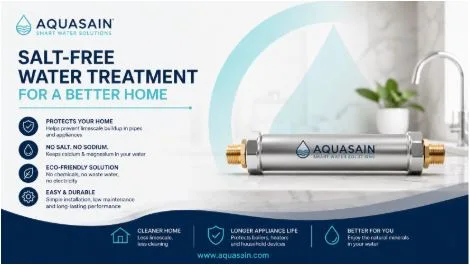
For households researching a compact descalcificador de agua sin sal, AquaSain offers an in-line system designed to inhibit adherent limescale while retaining the naturally present calcium and magnesium.
According to the manufacturer, the system uses a zinc component to influence the formation of calcium-carbonate crystals. AquaSain states that its treatment changes adherent calcite formations into less adhesive crystal structures while leaving measured water hardness largely unchanged.
The manufacturer also states that the system:
- Does not use salt
- Does not add sodium to the water
- Requires no electrical connection
- Uses no additional regeneration water
- Is installed directly into the main incoming pipe
- Requires a cleaning procedure approximately every two years
- Is designed to remain operational for an extended service period
AquaSain offers different pipe sizes and recommends selecting the unit according to the property’s plumbing, number of bathrooms, expected flow and water hardness.
These characteristics may suit Spanish homes where installation space is limited or where owners do not want to store, carry and regularly replenish bags of salt.
Product selection should still be based on measured hardness, pipe diameter, peak demand and whether the water comes from a potable public supply or a private source.
Questions to Ask Before Buying a Salt-Free System
Does the system soften water or only control scale?
The supplier should clearly explain whether calcium and magnesium are physically removed.
When the minerals remain in the water, the product is more accurately described as a conditioner, inhibitor or scale-control device than a conventional water softener.
What hardness and flow range can it handle?
A treatment unit must be sized for real household conditions. Water chemistry, hardness, peak demand, pipe diameter and temperature can all affect performance.
A unit selected for a one-bathroom apartment may not be suitable for a villa with several bathrooms, a swimming pool and simultaneous water use.
Is technical evidence available?
Ask about laboratory testing, recognised certifications and scale-reduction standards.
Specific technical evidence is more useful than a general promise that a device will “eliminate all lime.” The EPA recommends looking for scale-reduction systems assessed against recognised performance standards.
What maintenance is required?
Salt-free does not always mean maintenance-free.
Depending on the technology, a system may require inspection, cleaning, cartridge replacement or periodic media renewal. Maintenance expectations should be confirmed before installation.
Is it suitable for drinking-water plumbing?
A whole-house device comes into contact with water used for bathing, cooking and drinking. Its materials and installation should therefore be appropriate for potable-water systems.
Private-well owners should first test for sediment, microorganisms, iron, manganese and other possible concerns. A scale inhibitor should not be treated as a complete well-water purification system.
Installation and Realistic Expectations
Whole-house scale treatment is generally installed close to the property’s main water entry, often after the meter and any necessary prefiltration.
A qualified plumber should confirm:
- Pipe diameter
- Water pressure
- Flow direction
- Peak household demand
- Installation accessibility
- Compatibility with existing materials
- The appropriate treatment-unit size
AquaSain recommends installation on the main incoming line so that both hot and cold household water pass through the unit. Its instructions also state that the product can be installed horizontally or vertically and should remain accessible for periodic cleaning.
Peak demand is important. A holiday rental, family villa or property with several bathrooms may require a higher-capacity unit than a one-bathroom apartment.
Homeowners should also avoid expecting every old deposit to disappear immediately. Existing scale can remain in pipes and appliances, loosen gradually or require manual descaling. Aerators and shower heads may need to be inspected during the early months following installation.
Everyday Ways to Limit Limescale
Water treatment works best alongside sensible household maintenance:
- Set dishwashers and washing machines for the local hardness level
- Descale kettles and coffee machines when required
- Wipe shower glass and taps before droplets dry
- Clean faucet aerators and shower outlets
- Avoid unnecessarily high water-heater temperatures
- Use appropriate dishwasher salt and detergent settings
- Repair dripping taps that repeatedly leave deposits
- Service boilers and electric water heaters regularly
Local water utilities also advise residents to adjust appliances according to their area’s hardness because correct settings can improve washing results and equipment operation.
These habits remain useful whether a property uses no treatment, an ion-exchange softener or a salt-free scale inhibitor.
Who Is Most Likely to Benefit?
Salt-free treatment may appeal to homeowners whose main objective is reducing adherent scale without removing naturally occurring calcium and magnesium.
It can also suit properties with limited installation space or households that prefer to avoid salt refills, brine tanks and regeneration cycles.
It may be less suitable when the main objective is:
- Extremely soft water
- A measurable near-zero hardness result
- Maximum improvement in detergent performance
- Complete removal of calcium and magnesium
In those circumstances, ion exchange may be the more direct technology.
The best choice is not the system with the strongest advertising language. It is the system that matches the home’s water chemistry, desired outcome, available space and maintenance preferences.
Conclusion
Hard water is a local issue in Spain. The first step is to check the actual hardness and mineral composition of the property’s supply rather than relying on general assumptions about an entire province or region.
Homeowners must then decide whether their goal is mineral removal, scale reduction, taste improvement or treatment of a separate water-quality concern.
Traditional softeners and salt-free inhibitors provide different results. Ion exchange removes calcium and magnesium and produces measurably softer water. Salt-free treatment leaves those minerals in place while attempting to reduce the formation of hard, adherent scale.
For many Spanish properties, particularly where boiler, appliance and plumbing protection is the main priority, a correctly sized salt-free system can provide a compact alternative with fewer routine consumables.
Accurate water testing, transparent product claims, professional installation and realistic expectations remain essential to achieving a satisfactory result.
Frequently Asked Questions
Is hard tap water safe to drink in Spain?
Hardness itself is generally not considered a health hazard. It mainly reflects the presence of naturally occurring calcium and magnesium.
Residents should still review their complete local water-quality report because hardness alone does not confirm whether every other drinking-water parameter complies with current requirements.
Does a salt-free system actually soften water?
Usually not in the technical sense. Most salt-free conditioners leave calcium and magnesium in the water, so measured hardness may remain unchanged. Their main purpose is normally to reduce the formation or adhesion of limescale.
Will salt-free treatment remove all white marks?
Not necessarily. Because minerals remain in the water, droplets may still leave residue after evaporation. Depending on the technology and water conditions, that residue may be less adherent and easier to wipe away.
Can it help protect a boiler or electric water heater?
Scale-control treatment may reduce the formation of hard deposits on heating surfaces.
However, results depend on water hardness, operating temperature, water flow, correct system sizing and regular equipment maintenance.
How can homeowners check water hardness in Spain?
They can consult their local water supplier or search the Ministry of Health’s SINAC citizen portal.
The most relevant figures are total hardness, calcium and magnesium for the supply network serving the property.
Is scale conditioning the same as water filtration?
No.Scale conditioning targets the behaviour of hardness minerals. Filtration may target sediment, chlorine, taste, odour or specific contaminants.
A property with several water-quality concerns may require more than one treatment stage.
Does every salt-free system work without electricity?
No. Some salt-free technologies are passive, while others rely on electrical or electronic treatment. Buyers should check the requirements of the specific product rather than assuming every salt-free unit operates in the same way.
Can a salt-free system be installed in an apartment?
Installation may be possible where the apartment has an accessible incoming water line and sufficient room for future inspection or cleaning.
In a shared building, the owner should confirm which pipe exclusively supplies the property and whether approval from the community of owners is required.