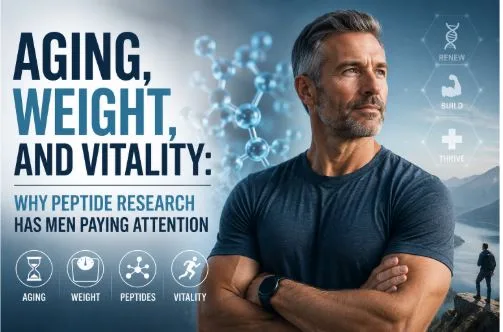
Aging, Weight, and Vitality: Why Peptide Research Has Men Paying Attention
Most men do not talk openly about the moment they begin to feel their body changing.
Recovery takes longer. Weight becomes harder to move. Energy is less predictable. The old fitness routine does not work quite the same way. Sexual confidence may become more complicated. Sleep, stress, work, family, and age all start competing for the same limited amount of physical and mental bandwidth.
That is the real reason searches like “peptides for men,” “peptides for energy,” “best peptides for weight loss,” “peptides for testosterone,” and “anti-aging peptides” keep showing up. The interest is not really about chasing a trend. It is about men trying to understand what is happening inside their bodies, and whether modern research has better answers than “just push harder.”
Peptide research has entered that conversation because peptides sit close to many of the topics men quietly care about: body composition, recovery, metabolic health, aging, sexual vitality, and long-term performance. That does not mean peptides are magic. It does not mean every online claim is true. And it definitely does not mean men should treat social media wellness content as medical guidance.
But it does mean the topic is worth understanding.
Why “Peptides for Men” Became a Search Trend
The phrase “peptides for men” sounds like a product category, but underneath it is a much more human question: what can a man do when his body stops responding the way it used to?
For younger men, the interest often begins with fitness, muscle recovery, body composition, or focus. For men over 40, it may become more connected to weight, energy, sleep quality, recovery time, and hormonal changes. For men over 50, the question often shifts again toward longevity, strength maintenance, sexual health, and staying capable for as long as possible.
That is why searches such as “best peptides for men over 40” or “best peptides for men over 50” are not just keyword data. They reflect a real anxiety: men are trying to stay ahead of decline.
The important distinction is that peptide research should not be read as a shortcut around the basics. Sleep, training, nutrition, alcohol intake, stress, blood pressure, glucose control, and medical screening still matter more than any wellness trend. But once men start asking more detailed questions about how the body repairs, signals, adapts, and ages, peptides naturally enter the research conversation.
What Men Are Really Asking
Behind most peptide searches are not simple product questions. They are personal questions.
– Weight: Why is fat harder to lose than it used to be?
– Energy: Why do I feel tired even when I am trying to do the right things?
– Testosterone: Is this age, stress, body weight, sleep, or something hormonal?
– Libido: Why does sexual confidence feel less predictable?
– Recovery: Why does training take more out of me than it did ten years ago?
– Aging: How do I stay capable, strong, and useful for longer?
That is why the peptide conversation has emotional weight. It sits close to areas men often care about but do not always discuss openly.
This is also where the conversation has to be careful. Peptides should not be presented as a guaranteed answer for weight, energy, testosterone, libido, recovery, or aging. Those areas are medically complex. Symptoms can come from many causes, and some need proper evaluation.
But the interest itself is understandable. Men are not wrong to want better information. They just need better filters.
Why “Best Peptides” Is Usually the Wrong First Question
The ability to train hard and bounce back. The confidence to take off a shirt. The energy to stay present with family after work. The feeling of being physically useful. The sense that their body is still on their side.
That is why “best peptides for recovery,” “best peptides for anti aging,” and “peptides for longevity” are compelling searches. They are not just about looking younger. They are about staying functional.
Peptide research is interesting in this area because peptides are involved in signaling processes throughout biology. Researchers study peptide-based compounds in areas ranging from metabolic disease to drug delivery to cellular communication. Scientific reviews have described peptide therapeutics as an active area of pharmaceutical research, while also noting challenges such as stability, delivery, and the need for rigorous testing.
That is the balanced truth: the field is scientifically interesting, but interest is not the same as certainty.
Before Believing a Peptide Claim
A careful reader should ask:
– Is this based on human research, animal research, cell research, or marketing language?
– Is the compound approved for a specific medical use, or only being discussed in research?
– Does the source explain limitations, or only promise outcomes?
– Is the claim about weight, energy, testosterone, libido, or aging being made too confidently?
– Is someone educating you, or trying to rush you into a decision?
– Does the content separate research interest from proven results?
– Are risks, unknowns, and regulatory context clearly explained?
The stronger the promise, the more important the evidence becomes.
How Men Can Approach the Topic Without Being Sold To
The most useful mindset is simple: be curious, but do not be easy to sell.
A man does not need to ignore peptide research. He also does not need to believe every claim attached to words like energy, testosterone, libido, fat loss, muscle growth, recovery, or longevity.
A better approach is to slow the conversation down. Instead of asking only “what is the best peptide for men,” ask what the evidence actually says. Instead of chasing a claim about testosterone, ask what else could explain the symptoms. Instead of treating weight loss as a single-product problem, ask about sleep, nutrition, insulin sensitivity, stress, movement, and medical factors.
Those questions protect men from the worst parts of wellness culture.
They also make the peptide conversation more useful. Because the real opportunity is not in chasing the newest claim. It is in becoming more informed about how the body works, how research develops, and why some health problems deserve deeper investigation instead of guesswork.
The Bottom Line
Men are paying attention to peptide research because it touches the questions many men already carry: Why am I gaining weight? Why is my energy lower? Why does recovery take longer? What is happening to my testosterone? Why does aging feel like a slow negotiation with my own body? How do I stay strong, capable, and healthy for longer?
Those are serious questions. They deserve better than hype.
Peptides may be part of modern health research, but they should not be treated as a miracle category or a shortcut around medical judgment. The smarter path is education first: understand the terms, understand the evidence, understand the limits, and be careful with anyone who makes the answer sound too simple.
If this topic is already showing up in your searches, start with education rather than impulse. Learn the basic categories, compare the evidence, and read peptide research articles that separate general wellness language from actual research context before accepting any claim at face value.
Suggested Source Links:
Mayo Clinic — Testosterone therapy: Potential benefits and risks as you age
PubMed — Peptide therapeutics: current status and future directions
https://pubmed.ncbi.nlm.nih.gov/25450771/
PubMed — Peptide-based drug discovery: Current status and recent advances
https://pubmed.ncbi.nlm.nih.gov/36481586/
FDA — FDA to Telehealth Companies: What to Know When Promoting Compounded Drugs