AI Is Turning the Hum in Your Phone Into a New Kind of Music Draft
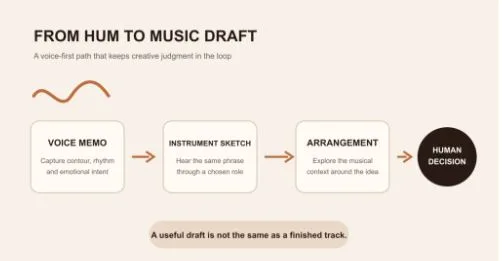
A melody rarely arrives at a convenient time. It turns up while someone is making coffee, walking between meetings, or trying to fall asleep. The quickest way to keep it is often a phone recording: ten seconds of humming, a few tapped rhythms, perhaps a whispered note about the mood.
For years, that recording was mainly a reminder. A musician could return to it with an instrument. A producer could rebuild it inside a digital audio workstation. Everyone else had a harder problem: the idea existed, but translating it into a form another person could hear required skills they might not have.
AI audio tools are beginning to change that narrow point in the process. Their most interesting effect may not be the fully generated song that attracts attention online. It may be the hum becoming a usable draft.
The Missing Step Between Memory and Collaboration
A voice memo preserves contour and energy better than written notes such as “slow piano, slightly tense.” It also carries problems. The pitch may wander. Background noise can hide a quiet phrase. The person humming may suggest a bass line, a string part, and a vocal hook without saying which is which.
That ambiguity is manageable when the same person develops the idea alone. It becomes expensive in a group. A collaborator has to interpret the recording before deciding whether the idea works.
An audible draft changes the conversation. Instead of explaining that a hummed phrase is meant for cello rather than lead vocal, its creator can present a rough instrumental interpretation. The draft may be imperfect, but it gives everyone something more specific to question: Is the register too low? Should the notes be shorter? Is the idea actually a bass part?
This is a modest change, not a replacement for musicianship. Yet modest changes at the beginning of a process can influence who gets to participate in it.
Conversion and Generation Solve Different Problems
Two categories of AI audio tool are often discussed as though they do the same job. They do not.
A voice to instrument workflow begins with musical material that already exists in the recording. The public VoiceToInstrument interface, for example, asks for uploaded or recorded audio and an instrument choice. Conceptually, the task is translation: keep the melodic idea, but hear it through a different sound source.
That distinction matters. Someone who hums a particular six-note phrase is not asking a system to invent the phrase. The useful question is whether hearing it as piano, guitar, or another instrument helps the person judge its role.
Generation starts from a wider brief. An AI music generator can be approached with a description of genre, mood, instrumentation, lyrics, or an instrumental direction. Here the goal is less about translating one fixed melody and more about exploring the setting around an idea.
The two paths can meet in pre-production. A creator might preserve a hummed motif through conversion, then use a separate generated draft to ask how that motif feels in a darker, faster, or more spacious arrangement. Neither draft has to survive into the final recording. Its purpose may be to reveal a decision.
A Draft Can Be Useful Without Being Finished
The pressure to judge AI audio as either “professional music” or “worthless noise” misses much of what drafts are for. A pencil sketch is not a failed painting. A table read is not a failed film. In music, rough material can help people reject weak ideas early, communicate a direction, or arrive at a recording session with fewer unresolved questions.
This is also where caution belongs. A generated or converted track may sound convincing at first listen while containing awkward transitions, unwanted artifacts, or choices that do not suit the project. A pleasing surface does not settle questions about originality, ownership, release rights, or artistic intent.
Public product pages can show which controls are available. They cannot decide whether a particular output is appropriate for release, whether its rights language fits a project, or whether the music says what its creator meant to say.
The responsible role of the tool is therefore smaller and more practical: make an idea audible enough to examine.
That examination can also make collaboration more honest. A rough reference gives a singer, arranger, or instrumentalist permission to disagree with something concrete. They can point to a crowded rhythm, an unconvincing register, or a pause worth protecting. Without a draft, feedback often stays abstract. With one, the group can separate the underlying idea from the particular interpretation placed in front of them. The draft earns its place by improving the question, not by pretending to be the answer.
Musical Literacy Is Expanding, Not Disappearing
Traditional musical skills still matter. Instrumental technique, ear training, arrangement, recording, and performance provide forms of control that a prompt box does not. They help a creator understand why a passage works and how to change it deliberately.
But literacy can expand without making older skills obsolete. Photography did not eliminate drawing as a way of seeing. Spreadsheets did not remove the need to understand arithmetic. Voice-first audio tools can give non-instrumentalists a new way to express a musical question while leaving deeper craft intact.
The more important divide may eventually be between people who accept the first audible answer and people who know how to interrogate it. What changed? What was lost from the original phrasing? Which part feels intentional, and which part merely sounds polished? What should a human play instead?
The hum in a phone is no longer only a memory aid. It can become a discussion object, an arrangement question, or the first rough map of a song. That does not make every person a finished musician. It does give more people a way to bring an idea into the room.