How Businesses Can Lower Operating Costs With Better Compressed Air Planning
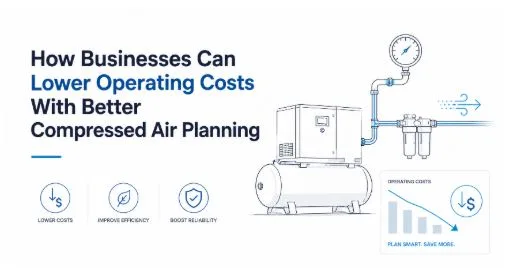
Businesses can lower compressed air operating costs by matching the full system to actual production demand, required pressure, and required air quality.
The compressor is only one part of that system. Piping, storage tanks, dryers, filters, controls, leaks, pressure settings, and production equipment all affect how much electricity the system uses.
Poor planning often leads businesses to buy more compressor capacity when the real problem is air leakage, pressure loss, incorrect controls, or unstable demand. A system-level plan helps a facility correct those issues before spending money on new equipment.
Why Compressed Air Planning Affects Operating Costs
Compressed air is produced by converting electrical energy into pressurized air. This process also produces heat, moisture, and pressure losses.
As a result, the purchase price of a compressor represents only part of its total cost. Businesses must also pay for electricity, maintenance, air treatment, cooling, repairs, and production losses caused by poor air quality or unstable pressure.
The U.S. Department of Energy recommends evaluating compressed air as a complete system. Its guidance connects air supply, treatment, storage, distribution, controls, and point-of-use demand. Improving only one component may move the problem elsewhere instead of reducing total energy use.
For example, installing a larger compressor may raise available airflow. However, it will not correct undersized piping, blocked filters, leaking hoses, or excessive pressure settings.
Better planning starts by identifying why the system is using air.
Measure Air Demand Before Selecting Equipment
A compressed air assessment should record how demand changes across full production cycles.
This includes average airflow, peak airflow, shift changes, machine startup demand, weekend use, and periods when production is stopped.
Measurements should include:
- Compressor input power in kilowatts
- Airflow in cubic feet per minute
- Compressor discharge pressure
- Pressure at critical points of use
- Loaded and unloaded operating time
- Pressure dew point
- Nonproduction airflow
Flow meters, power meters, pressure sensors, and data loggers can create a clear system profile.
This profile separates productive air demand from waste. It can also show whether a facility has a real capacity shortage or whether existing capacity is being lost through leaks, restrictions, and pressure drops.
CAGI training guidance recommends developing a system profile, reviewing air quality and pressure requirements, and aligning supply-side operation with demand-side use.
Facilities that are still comparing equipment can also review these tips for choosing the right air compressor for commercial use.
Calculate the Real Cost of Producing Compressed Air
Businesses cannot manage compressed air costs without establishing an operating-cost baseline.
A simple annual electricity estimate is:
Compressor input kW × annual operating hours × electricity rate
For example, a compressor package drawing 75 kW for 6,000 hours per year at an electricity rate of $0.12 per kWh would have an estimated annual electricity cost of:
75 × 6,000 × $0.12 = $54,000
This calculation does not include demand charges, dryer energy, cooling, maintenance, or production downtime.
Actual power use also changes with discharge pressure, control type, motor efficiency, compressor condition, and part-load operation.
When comparing equipment, businesses can review specific power. CAGI defines specific power as the electrical input needed to deliver a stated airflow, commonly shown as kilowatts per 100 cfm at a specific discharge pressure.
This measurement allows buyers to compare compressor efficiency under defined operating conditions.
Repair Leaks Before Adding Compressor Capacity
Air leaks create continuous artificial demand.
Common leak locations include hoses, couplings, threaded joints, regulators, cylinders, filter housings, valves, and automatic drains.
When pressure falls because of leakage, the compressor runs longer to maintain the set point. This increases electricity use, operating hours, heat production, and maintenance needs.
A structured leak-management program should include:
- Ultrasonic detection
- Leak tagging
- Repair prioritization
- Repair verification
- Follow-up measurement
- Regular inspections
Large leaks may be audible during a shutdown. Smaller leaks are often hidden by production noise and require ultrasonic detection.
Leak repair should also be followed by a control review. Once demand falls, compressor sequencing or pressure settings may need adjustment so the plant receives the full energy benefit.
Reduce Unnecessary System Pressure
Higher discharge pressure requires more compressor power.CAGI states that every additional 2 psig of operating pressure can increase compressor power consumption by about 1%. It also recommends limiting total pressure loss between the compressor and point of use.
Pressure loss may occur across:
- Undersized pipes
- Blocked filters
- Air dryers
- Regulators
- Separators
- Valves
- Long hoses
- Quick-connect fittings
A plant should measure pressure at the compressor, main header, branch lines, and critical production equipment.
When one machine requires higher pressure, raising pressure across the entire facility is often an expensive solution. A local receiver, larger branch pipe, booster, or separate pressure zone may support that machine more efficiently.
Reducing pressure also lowers airflow through leaks and unregulated equipment.
Match Compressor Controls to the Demand Profile
An oversized compressor may operate inefficiently when demand is below its rated output.
A fixed-speed rotary screw compressor can continue drawing significant power while unloaded. The machine is running, but it is producing little or no useful air during that period.
Variable speed drive compressors adjust motor speed as demand changes. They can be effective when airflow varies across a suitable operating range.
However, a VSD compressor is not automatically the best option for every facility. A plant with stable demand may operate efficiently with a correctly sized fixed-speed compressor.
Facilities with several compressors may benefit from a central controller. Coordinated sequencing can reduce unloaded runtime, stabilize header pressure, and select the most efficient combination of available machines.
Equipment selection should therefore be based on measured airflow and verified performance data, not horsepower alone.
CAGI’s Performance Verification Program provides independently verified performance data for participating rotary compressors and refrigerated dryers.
Use Air Storage to Manage Short Demand Peaks
An air receiver stores compressed air and helps stabilize system pressure.
It can support short, high-demand events such as tool changes, pulse cleaning, or intermittent production cycles. Storage also gives compressor controls more time to react.
However, a receiver does not create air. It cannot correct a continuous demand level that exceeds compressor capacity.
Receiver planning should consider:
- Peak airflow
- Duration of the demand event
- Minimum acceptable pressure
- Normal system pressure
- Receiver location
- Compressor control response
A wet receiver is normally placed before the dryer and can support cooling and moisture separation. A dry receiver is placed after treatment and can protect downstream pressure.
Local receivers may also support equipment with short, high-volume demand without increasing pressure across the entire plant.
Select Air Dryers Based on Required Air Quality
Atmospheric air contains water vapor, particles, and other contaminants.
Compression raises the concentration of these contaminants. As the air cools, water vapor can form liquid condensate inside receivers, piping, tools, and production equipment.
Moisture can cause corrosion, blocked valves, failed pneumatic tools, damaged paint finishes, frozen outdoor lines, and product contamination.
ISO 8573-1 classifies compressed air purity according to particles, water, and oil. Businesses should define the required purity class based on the production process instead of applying the driest possible air to every application.
Selecting industrial air dryers For compressor systems should begin with the required pressure dew point, maximum airflow, inlet temperature, operating pressure, ambient conditions, and acceptable pressure drop.
Refrigerated dryers are widely used for general industrial air. Desiccant dryers are used when a much lower pressure dew point is required. Membrane dryers can support selected point-of-use and lower-flow applications.
Incorrect dryer selection can raise costs through:
- Excess purge-air use
- Unnecessary electrical demand
- High pressure drop
- Short cycling
- Inadequate moisture removal
- Frequent filter replacement
The correct dryer protects downstream equipment without creating more treatment cost than the process requires.
Design Piping to Limit Pressure Drop
Compressed air piping must deliver the required airflow while maintaining stable pressure.
Small pipes increase air velocity and friction loss. Long runs, sharp turns, restrictive fittings, and corroded internal surfaces create additional pressure drop.
This can force operators to raise compressor discharge pressure to maintain acceptable pressure at production equipment.
A practical piping plan should consider:
- Maximum and future airflow
- Main-header diameter
- Branch-line size
- Total equivalent pipe length
- Ring-main or loop layout
- Isolation valves
- Condensate drain points
- Connection and hose size
A looped distribution system can supply equipment from more than one direction. This helps reduce pressure loss during high-demand periods.
Future expansion should also be considered. Installing a main header that only supports current demand may create expensive modification work when new production equipment is added.
Remove Inappropriate Uses of Compressed Air
Compressed air is useful, but it is not always the lowest-cost way to perform a task.
High-volume uses such as open blowing, personal cooling, floor cleaning, cabinet cooling, and continuous air knives may consume more air than expected.
Depending on the application, alternatives may include:
- Low-pressure blowers
- Electric fans
- Engineered air nozzles
- Dedicated vacuum pumps
- Mechanical cleaning equipment
- Electric actuators
Each application should be reviewed for pressure, airflow, safety, control, and product-quality needs.
The goal is not to eliminate compressed air where it provides a clear operational benefit. The goal is to avoid using high-pressure compressed air for tasks that can be completed with a lower-cost energy source.
Recover Compressor Heat Where Practical
Most of the electrical energy supplied to a compressor becomes heat.
Facilities may be able to reuse part of this heat for space heating, process water, boiler makeup water, drying, or other low-temperature applications.
Heat recovery works best when the compressor has regular operating hours and a suitable heat demand is located nearby.
The system must still provide proper ventilation and maintain acceptable compressor-room temperatures. Recovered heat should not interfere with cooling or equipment access.
DOE compressed air guidance includes heat recovery as one of the opportunities businesses can evaluate as part of a full system plan.
Monitor the System After Improvements
Compressed air demand changes when production schedules, equipment, and staffing change.
For this reason, a one-time audit cannot protect system performance forever.
Facilities should track:
- Compressor kW
- Total airflow
- Specific power
- Header pressure
- Point-of-use pressure
- Pressure dew point
- Loaded and unloaded hours
- Nonproduction airflow
- Filter pressure drop
These measurements help maintenance teams detect new leaks, blocked filters, failed drains, control problems, and rising air demand.
Useful performance indicators include energy cost per unit of production, kilowatts per 100 cfm, nonproduction airflow, and total pressure drop.
Prioritize Improvements by Payback and Production Risk
Compressed air projects should be ranked by cost, expected savings, reliability impact, and production risk.
Low-cost actions often include repairing leaks, reducing pressure, closing unused lines, correcting regulator settings, replacing blocked filters, and shutting down equipment during nonproduction periods.
Medium-cost projects may include monitoring equipment, receiver installation, piping changes, improved sequencing, or dryer correction.
Major capital projects may include compressor replacement, new treatment equipment, central controls, or full distribution redesign.
The best project is not always the largest equipment purchase. It is the improvement that delivers the required air at the lowest lifecycle cost.
Better Planning Produces Lower Operating Costs
Businesses lower compressed air costs when they manage compressors, dryers, filters, receivers, piping, controls, and production demand as one connected system.
The process begins with measurement. Facilities must know how much air they use, what pressure the equipment requires, where pressure is lost, and what air quality the process needs.
Once those requirements are clear, businesses can repair leaks, reduce pressure, improve controls, correct air treatment, and select equipment with greater accuracy.
The lowest-cost system is not necessarily the one with the cheapest compressor. It is the system that supplies the required airflow and air quality at the lowest stable pressure, with the least waste over its operating life.