Top CRM for Pest Control: 8 Platforms Compared in 2026
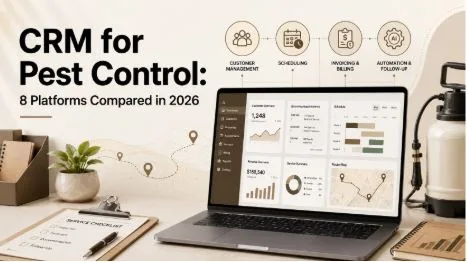
TL;DR: A CRM for pest control tracks customers, schedules, chemical use, and billing in one system instead of spreadsheets and sticky notes. Adoption pays off directly: businesses with 10 or more employees that switch to a CRM report 17% higher lead conversion and 21% greater team productivity. Below are 8 platforms compared on the same three points, listed alphabetically so no vendor gets more weight than another.
CRM adoption in field service is no longer optional at scale. CRM users report 29% higher revenue and 34% better sales productivity on average (Fieldwork, 2026), and pest control leader Rentokil Initial reported a 671% marketing ROI after implementing a CRM platform (HubSpot, 2026). Each entry below is evaluated on the same three criteria: what the platform is built around, one clear strength, and one honest limitation.
What should a CRM for pest control actually do?
A CRM for pest control should track every customer, treatment, and contract in one place while automating the follow-up work that otherwise depends on office staff remembering to do it. At minimum, that means service history by property, chemical and treatment logging for compliance, automated appointment and renewal reminders, and route or scheduling data that stays current as the day changes. Below, each platform is measured against that bar rather than a marketing feature list.
1. Briostack
Briostack is a pest-specific platform built around recurring service plans and renewal automation. Its strength is automated renewal reminders tuned specifically for pest control billing cycles. Its limitation is a smaller user base than the category leaders, so fewer independent reviews exist to verify claims at scale.
2. FieldRoutes
FieldRoutes, now a ServiceTitan company, holds a 4.2 rating across 337 Capterra reviews (Capterra, 2026). Its strength is a mature route optimization engine built specifically for door-to-door pest sales operations. Its limitation is pricing that is not published, with third-party reports placing implementation fees from $1,300 and 12-month minimum contracts.
3. Solea
Solea AI is the AI-native platform in this comparison, running an AI receptionist, AI scheduler, and AI-driven follow-up inside the CRM itself. Its strength is that call answering and follow-up run automatically without staff triggering each step. Its limitation is company age, with fewer published reviews than the platforms above.
4. GorillaDesk
GorillaDesk holds the highest rating in this comparison at 4.8 on G2 (42 reviews). Its strength is fast setup and a simple interface built for solo operators and small teams. Its limitation is depth: it does not automate follow-up or scheduling changes the way AI-native or enterprise platforms do.
5. Jobber
Jobber holds a 4.6 rating across 478 G2 reviews, the largest review base of any platform here. Its strength is broad usability for a small pest company that also books other home-service work. Its limitation is that it is a generalist tool, without pest-specific extras like chemical-use logging built in.
6. Kickserv
Kickserv holds a 4.5 rating across 178 G2 reviews as a field-service CRM adapted for pest use. Its strength is flexibility across multiple service lines for companies that run pest control alongside other trades. Its limitation is that pest-specific compliance features are less developed than in dedicated pest platforms.
7. PestPac
PestPac, by WorkWave, holds a 3.9 rating across 125 G2 reviews and 253 Capterra reviews (G2; Capterra, 2026). Its strength is depth in commercial accounts, multi-branch billing, and termite and bait-station compliance tracking. Its limitation is onboarding time; reviewers describe a multi-week ramp before office staff run billing independently.
8. ServiceTitan
ServiceTitan holds a 4.5 rating across 351 G2 reviews as a large, general home-services platform. Its strength is depth for multi-trade companies running pest control alongside HVAC, plumbing, or electrical work. Its limitation is cost and complexity for a company that only does pest control and does not need the multi-trade feature set.
A pest control CRM adoption survey found companies with 10 or more employees switching from spreadsheets to CRM software reported 17% higher lead conversion after the change (WebFX, cited by Fieldwork, 2026), a gain tied to consistent follow-up rather than any single platform.
Choose the CRM That Solves Your Biggest Bottleneck
The best CRM for pest control isn’t the one with the longest feature list. It’s the one that removes the work slowing your business down every day. If missed calls cost you jobs, prioritise automation. If compliance and commercial accounts drive revenue, look for deeper pest-specific workflows. If you’re scaling routes and technicians, focus on scheduling and operational visibility. Use this comparison to shortlist the platforms that fit your stage of growth, then book demos and test real workflows before committing. The right CRM should save time, increase conversions, and give your team confidence that no customer or opportunity slips through the cracks.