AI Video Generator Procurement Needs Reproducible Evidence
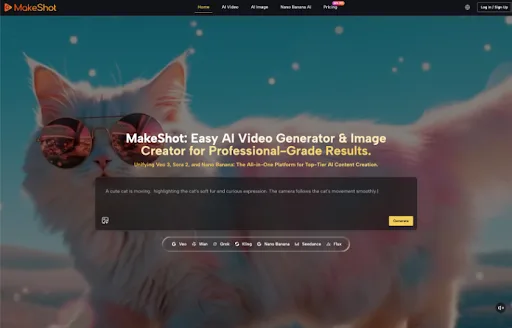
A procurement team cannot buy “cinematic quality” from a feature list. It can buy access, credits, controls, storage, and usage terms, then test whether those conditions support a real business workflow. A serious evaluation of an AI Video Generator should therefore begin with repeatable briefs and accepted-output costs, not with the longest available model list.
MakeShot combines text-to-video, image-to-video, and several models in one browser workspace. That breadth can reduce account switching, but it does not remove the need to define the buyer’s job. Procurement should ask which teams will operate the service, which inputs they may upload, what output counts as acceptable, and how a decision can be audited later.
Translate Product Claims Into Buyer Test Conditions
Every claim needs a condition and a failure signal. Multi-model access can be tested by running the same brief on selected models and recording why a result was chosen. Reference support can be tested with an approved product or character image. Fast generation can be measured from submission to accepted output. Commercial-use language can be reviewed against the buyer’s intended inputs and distribution, not read as a universal rights guarantee.
Use Real Low Risk Work Instead of Demos
Select two or three ordinary jobs that do not involve confidential launches, vulnerable people, regulated claims, or disputed assets. A generic product concept, an internal training visual, and a simple social teaser can reveal workflow fit without exposing the organization to its highest risks. The test should use the same kind of source quality and review capacity the team will have after purchase.
Run the jobs with named operators from the intended team, not only with the vendor’s most experienced demonstrator. Give them a short written brief and no hidden rescue process. Observe where they hesitate, which settings they misunderstand, and how they decide a result is finished. Training burden is part of product fit. A tool that works only after informal expert coaching may still be useful, but the buyer should price and plan that dependency.
Define Accepted Output Cost Before Testing
Record generation attempts, credits, operator time, reviewer time, and finishing work. Divide the total by accepted outputs. A low credit price can be misleading if labels drift and six attempts are needed. A slower model may be cheaper when it passes review sooner. Procurement needs this combined measure because the invoice captures only one part of the operating cost.
| Buyer claim | Test condition | Pass signal | Evidence retained |
| Multiple models | Same brief and source | Choice has a documented reason | Outputs and model names |
| Private generation | Eligible paid account | Visibility matches account setting | Plan and setting record |
| No watermark | Downloaded paid output | No visible platform mark | Original downloaded file |
| Commercial license | Approved owned inputs | Terms cover intended use | Terms snapshot and review |
Separate Plan Access From Governance Evidence
The pricing page lists private generation, no watermark, commercial license, and unlimited storage among paid features. These points affect usability and distribution. They do not prove that an employee had permission to upload a photograph, that a generated person gave consent, or that a product demonstration is accurate. Buyers should preserve that distinction in policy and training.
Check the Account and Asset Boundary
Define who may open an account, which business email is used, and where source files may come from. The approved input list might include owned product images, commissioned artwork with suitable rights, and internal diagrams cleared for the service. It should exclude customer data, confidential prototypes, scraped images, and materials whose license does not allow derivative generation.
Add a departure and access-change procedure before the pilot expands. The organization should know who owns the subscription, where accepted outputs are stored, and how work is recovered when an operator changes roles. Unlimited storage can be convenient, but it should not become the only archive for business assets. Keep approved masters and decision records in the organization’s normal controlled storage.
When testing the AI Video Generator, save a minimal evidence package for each accepted result: brief, source, prompt, visible settings, model, output, reviewer, and intended channel. MakeShot can centralize generation, but the organization still needs its own record of why a file was approved. A browser history is not a procurement audit.
Read Plan Labels Against Actual Demand
Estimate monthly accepted output from the pilot instead of using the number of raw generations. Compare that demand with concurrent-generation limits, credit treatment, model exceptions, and contract timing. The pricing page says unused credits roll over, which can help uneven workloads, while some model access follows separate credit rules. Capture the page at the decision date because plans and model costs can change.
Test a quiet period and a small peak. Concurrency matters only when several jobs genuinely need to run together. A higher limit may save time for an agency producing variants, while a single communications officer may gain nothing from it. Measure queue delay, review capacity, and finishing capacity together. Generating eight clips at once is not operational progress when one reviewer can responsibly inspect only two.
Where This Procurement Test Still Needs Judgment
A short pilot cannot prove future uptime, every model update, or legal suitability in every market. Vendor terms also do not replace the buyer’s review of privacy, employment, advertising, and intellectual-property obligations. Treat the test as operational evidence for a scoped decision, not as permanent certification.
Approve a Controlled Use Case Before Scale
MakeShot may fit teams that need several generation approaches, can define low-risk inputs, and have a reviewer who can reject misleading output. The first approval should name the users, allowed assets, channels, retention record, and success measure. Expansion can follow after the workflow survives routine use and a staff handoff.
The approval should also set a renewal checkpoint. Compare promised jobs with accepted jobs, actual staff time, and any incidents involving source rights, misleading scenes, or lost records. Renewal evidence should come from ordinary months, not a fresh demonstration prepared for the budget meeting.
Ask the security and privacy owners to review the service at the same scoped level. They need the categories of intended input, account ownership, access method, storage practice, and deletion expectations—not a vague statement that the team will use “marketing images.” If the planned material changes, reopen the review. A pilot approved for generic campaign concepts should not silently expand to employee portraits, customer uploads, or unreleased designs.
Finally, define an exit path. Export accepted files and records into normal business storage, document any work that cannot be transferred, and assign responsibility for closing or reducing access. A product evaluation is incomplete when adoption is easy but departure depends on the memory of one account owner.
It is a poor purchase when the organization expects the platform to supply truth, consent, or final quality automatically. Procurement earns its value by making the operating evidence boring and reproducible. The model list may attract attention; the review trail determines whether the service belongs in the business.