Two Cities, One Career: How Meera Turned Her NCR Commute Into a Data Science Job
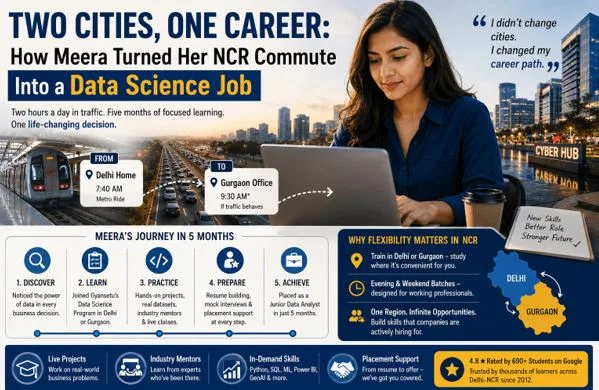
Meera knew all the ins and outs of the Delhi-Gurgaon Expressway better than she knew her own neighborhood. She left her home in East Delhi every morning at exactly 7:40 am, caught a metro, hopped into a cab close to HUDA City Centre, and reached her office at Cyber Hub by 9:30 am if there was no traffic.
Two hours one way. Ten hours a week. Four hundred hours a year. Lost forever, just getting from point A to point B, both of which happened to be her homes but neither felt like enough.
Her job wasn’t terrible either. Marketing Coordinator, decent pay, good colleagues. But she had noticed something about her workplace that was irritating her with every passing month: it was the people who got involved in the discussions that were happening — the discussions on what campaigns to run next, what customer segment to target, where the money should be invested — were the people who could understand the data. Understand, not just look at it.
She couldn’t do that yet.
The Googling Phase Nobody Talks About
But here’s the truth about choosing to change careers in your late twenties: everybody thinks you know what you’re doing. And you don’t. It took Meera roughly three weeks to go through what she terms the “Googling phase,” looking up stuff like “how to learn data science while juggling full-time work,” reading forum posts, and closing sixteen tabs all at once to only reopen them the following day.
She had spoken to her cousin, who had done a similar career switch two years back and now made a living as a data analyst, earning herself almost twice her former salary. “Just do it the right way,” he told her. “Don’t squander six months on some YouTube playlist and say you have the skills.”
A valid opinion, sure. But then how, exactly, was the “right way”?
It’s here that geography became complicated for her. Her home was in Delhi, and her office in Gurgaon. Any courses she chose would only be more of the same – traveling on top of an already exhausting day, unless she could find one that worked with her rather than against her.
Weighing the Options — And They Weren’t All Equal
She shortlisted some institutes. Some seemed professional on their websites, but were just one person giving classes through a laptop in some rented space. Others had attractive websites and dodgy explanations on their placement help when she called.
But her friend pointed her in the direction of Gyansetu — what attracted Meera here was not the promotional material but the fact that the institute had no tie-ups with any particular place. So she could check out a data science course in Delhi near her house or the data science course in Gurgaon near her office, based on her schedule for the week. On certain weeks, she could attend the evening classes near her home. When there were light work days, she could attend Gurgaon classes directly after work.
Trivial stuff, sure. But it took away the last straw she was using to delay making a decision.
She signed up for a demo class. Free of cost, with no obligations and basically just to check whether everything was legit. It was. And she learned far more from the trainer who had worked on actual forecast models for companies rather than teaching from textbooks, in just one session than she had from three weeks of Googling around.
Five Months, Not Five Minutes
This part she admits was not easy at all. Working a full-time job and going to class in the evenings and weekends took its toll. The weekends were not spent having leisure time anymore, some sleep was sacrificed, along with watching most of her Netflix queue. Data science is not an easy subject and it is certainly not a free one.
The program lasted almost five months. The first was Python, followed by SQL since she would interview with companies that use databases, and knowing how to make queries into these databases was more important than the ability to create models using them. Statistics. Basics of machine learning. Power BI for dashboards which would help her show off results of her work to people who did not care about the math but wanted answers. And – tacked on near the end of her program – generative AI, almost unfair advantage.
Live projects, not the toy data sets, were the aspect which made all the difference for her. The data was not neat, complete, and consistent. It was real-world stuff — someone entered the date incorrectly three years back and no one caught it until now. Working with such data, understanding it, and creating something meaningful from it, that was a skill different from following a tutorial, and that was what the employers evaluated her on.
Her instructors were not career coaches reciting instructions from a syllabus. A couple of them had previously worked at Microsoft and Accenture, and it was evident from their war stories, shortcuts they had learned through experience, and brutally honest feedback on her initial three projects. (“The chart you have created is technically right but absolutely meaningless. Try again.”)
The Interview That Actually Went Somewhere
By the fourth month, placement assistance started working. The resume was entirely reworked because it seems “coordinated marketing campaigns” is a lot more impressive when you can also add “developed churn prediction model with 84% accuracy.” Several mock interview experiences that were more than she expected but less than she required. The recruitment phone call that ended nowhere. Followed by one that didn’t.
It happened to be the time she received an offer for a junior data analyst job in her fifth month – again in Gurgaon, again on the same stretch of road that once filled her with dread.
But now it all feels different. Maybe not quicker. But certainly less like it was happening to her and more like she chose to take it.
What Delhi-NCR Gets That Other Cities Don’t
This is an honest analysis of why this particular scenario happens over and over again in the region, but is not what one will ever find in an academic program prospectus: Delhi and Gurgaon are no longer two separate employment marketplaces. They have become one huge and interconnected ecosystem – business offices in one city, workforce and residences in another one, and thousands of people moving back and forth each and every day. The very existence of such training opportunities only in one of these cities is already outdated.
Well, this is sort of the whole idea behind creating such courses at both ends.
The experience of Meera is far from being unique, and it is intended not to be unique. In the world of Gyansetu, there are many more stories of NCR professionals having similar situations in their professional lives. And it was not luck which made the difference for her. It was the decision to enroll into the course which considered the way people of this region work and live, rather than just an office location.
And if your daily routine resembles hers, perhaps, changing the destination would help.
Gyansetu has trained data professionals across Delhi-NCR since 2012, rated 4.8★ by 690+ students on Google, with live-project-based programs and placement support in both Delhi and Gurgaon.