The Ultimate Guide to Self Defense Accessories
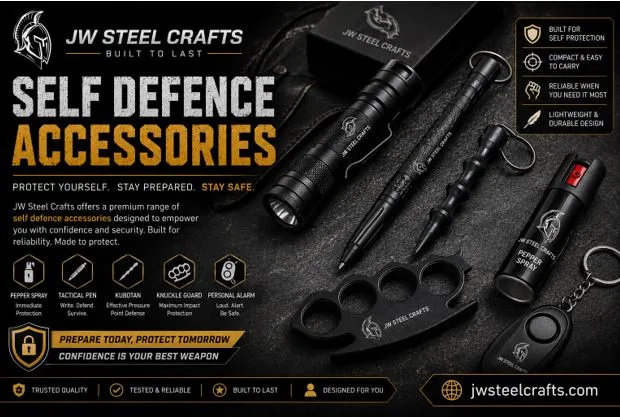
Most people think about personal safety in the abstract until something makes it concrete — a walk to the car that felt too long, a stairwell that felt too quiet, a stranger who followed a little too closely. The instinct after a moment like that is usually to buy something. That instinct is reasonable, but the tool matters far less than most buyers assume, and the habits around it matter far more.
This guide covers the accessories people actually carry, what each one realistically does, how to choose between them, and the legal and practical realities that decide whether a purchase makes you safer or simply makes you feel safer. Those two outcomes are not the same thing, and the difference is worth understanding before you spend anything.
What Are Self Defense Accessories?
Self defense accessories are portable items carried to help a person avoid, interrupt, or escape a threatening situation. The category covers everything from a small personal alarm clipped to a bag, to a defensive spray, a bright flashlight, a whistle, a tactical pen, or a smartphone app that shares your location with someone who cares about you.
What separates a self defense accessory from a weapon in the ordinary sense is intent and design. These items are built around buying distance and time. The overwhelming majority of them do not injure anyone. They make noise, produce light, attract attention, or create a few seconds of confusion — and those seconds are used to leave. A defensive tool that is used to stand and fight has usually failed at its actual job, which was to let you not be there.
It is worth being honest about a second function too. A great deal of what people buy is bought for confidence. Carrying an alarm changes how you walk through a car park at night, and walking differently genuinely does affect how you are perceived. That psychological effect is real and not something to dismiss. But it becomes a problem when confidence outruns capability — when someone takes a route they would otherwise have avoided because a canister in their pocket makes them feel covered. The tool did not make that route safer. It only changed how the route felt.explore our personal protection collection
Why Self Defense Accessories Matter
The strongest argument for carrying something is simple: the alternative to having options is having none. Personal safety is largely a question of time and attention. Almost every reasonable outcome in a threatening encounter depends on creating a gap — a moment where the other person is startled, distracted, or reconsidering — and using it to put distance and other people between you and the situation. Self defense accessories are, at their core, gap-creating devices.
Deterrence works before that. A loud alarm, a bright light, or the visible act of noticing someone and changing course all raise the cost of an approach. Most opportunistic incidents depend on the target being unaware and the encounter being quiet. Anything that removes either condition tends to end the situation before it develops.
There is also a value in preparation itself. The act of thinking through where you park, which entrance you use, who knows your route home, and what you would actually do produces more safety than any object you can buy. Buying a tool tends to prompt that thinking, and that is often its most useful contribution.
But it needs saying clearly: no accessory replaces awareness, distance, and the willingness to leave early. Every experienced instructor you will ever meet says a version of the same thing — the best outcome is the one where nothing happens, and that outcome comes from noticing early and moving, not from equipment. Treat what you carry as a backup for the situation you failed to avoid, not as a plan.
Types of Self Defense Accessories
Personal alarms are small battery-powered devices that produce a piercing sound, usually somewhere well above a hundred decibels, when a pin is pulled or a button is held. They are the most universally legal, most affordable, and most consistently underrated item in the category. They require no skill, cannot be turned against you in any meaningful way, work in the dark, and do the one thing that opportunistic threats least want: they make the situation loud and public. For most people, if you buy only one thing, buy this.
Defensive sprays, usually oleoresin capsicum based, cause intense burning of the eyes, temporary difficulty opening them, and disorientation. Effects typically pass within roughly half an hour with no lasting harm, which is why they are the most widely permitted active defensive tool in the world. They are effective at a distance of a few metres and require the user to have the canister already in hand, to account for wind direction, and to move immediately afterwards. Formats include keychain canisters, gel versions with reduced blowback, and foam variants. Legality varies enormously by country and even by region within a country, so verification is essential before buying.
Tactical flashlights are high-output torches, often several hundred lumens or more, built in a durable body. Their defensive value is genuine but frequently overstated: a bright light in the eyes at night degrades someone’s vision briefly and interrupts what they were doing. Their everyday value is much greater — seeing into dark spaces, checking around a vehicle, being seen by traffic, and simply walking somewhere unlit without stumbling. This is the accessory with the highest ratio of ordinary usefulness to legal complication, since a torch is a torch anywhere in the world.
Whistles are the low-tech version of the personal alarm. No batteries, no failure mode, no legal question anywhere. Less loud than an electronic alarm and dependent on your breath, but a whistle on a keyring costs almost nothing and has saved people in situations from muggings to hiking accidents.
Tactical pens and kubotans are rigid cylinders designed for close-quarters use. They are genuinely useful only for someone who has trained with them, because using one requires being within arm’s reach of a threat, which is precisely the position everything else in this guide is designed to avoid. Without training, a tactical pen is a heavy pen. With training, it is a compact option that draws little attention. Note also that in several jurisdictions, an item marketed explicitly as a weapon is treated as one regardless of how mundane it looks.
Personal safety technology has become one of the more meaningful developments in this space. Location sharing with a trusted contact, check-in timers that alert someone if you do not confirm arrival, and emergency SOS functions built into phones and smartwatches all provide something no physical tool can: someone else knowing where you are and that something is wrong. Some wearables include a discreet button that sends your location and starts a call. For anyone who travels alone regularly, this category often delivers more real protection than anything in a pocket.
Travel and door security items — portable door locks, door wedge alarms, window alarms, and simple rubber stops — address the situation people most often overlook, which is safety while stationary in unfamiliar accommodation. They are light, inexpensive, and legal everywhere.
Defensive keychains cover a wide and uneven range of products, from simple key organisers that keep your keys accessible to pointed or knuckle-style items marketed aggressively online. The simple versions are fine. The aggressive ones are frequently prohibited, frequently poorly made, and frequently require exactly the close-range contact you want to avoid. Approach that end of the market carefully.
Stun devices and electrical weapons exist and are effective but are among the most heavily regulated items in the category, banned outright in many countries and restricted in many others. They also require contact or near-contact and a functioning battery. Anyone considering one should confirm legality first and treat training as mandatory rather than optional.
Knives deserve a specific note. They are widely carried and widely misunderstood as defensive tools. Using one against a person is a lethal-force decision with lifelong legal and personal consequences, and doing so effectively under stress requires serious training that almost no casual carrier has. Carry a knife because it is a useful tool — and most are — but do not buy one believing it is a straightforward answer to personal safety. Firearms sit further along the same spectrum and are outside the scope of a general accessories guide; anyone considering that route needs licensed instruction and a thorough understanding of their local law, not an article.
Key Features to Look for in Self Defense Accessories
The single most important characteristic is accessibility. A tool in a bag, at the bottom of a pocket, or in the glovebox is not a self defense accessory — it is an object you own. Whatever you carry has to be reachable in about a second, with one hand, without looking. If it is not, nothing else about it matters.
The second is simplicity under stress. Fine motor control degrades sharply when adrenaline hits. Anything requiring a sequence of steps, a small switch, or a precise grip is likely to fail at the moment you need it. Pull-pin alarms and thumb-slide sprays survive this test. Fiddly multi-function gadgets generally do not.
Reliability follows. Cheap electronics fail, cheap springs stick, cheap batteries die silently. This is a category where the difference between a low-cost item and a decent one is small in money and large in consequence. Look for reputable manufacturers, weather resistance if you carry it outdoors, and a build that survives being dropped.
One-handed operation matters more than most people expect, because in real situations one hand is often holding a phone, a bag, a child, or a door.
Non-lethal design should generally be the default. Options that create distance and noise carry far less legal risk, far less risk of escalation, and far less risk of the tool being taken and used against you.
Legal compliance is a feature, not an afterthought. An item you cannot legally carry where you live or travel is worse than useless, because it creates a risk while providing nothing.
Finally, check expiry and maintenance requirements. Defensive sprays lose pressure and potency over time and carry expiry dates for good reason. Batteries need replacing. Mechanisms need testing. An accessory you bought four years ago and have never checked should be assumed non-functional until proven otherwise.
Best Self Defense Accessories for Everyday Carry (EDC)
Everyday carry works when it is light enough that you never consider leaving it behind. The most common failure in this entire subject is the person who buys well, carries diligently for three weeks, and then stops because the setup was heavier or bulkier than daily life tolerates.
A realistic and genuinely effective everyday setup is small. A personal alarm on the keyring or bag strap, reachable without opening anything. A compact flashlight, which will earn its place a hundred times over in ordinary use before it is ever needed defensively. A charged phone with location sharing configured and emergency contacts set up — genuinely configured, not intended to be configured someday. And, where legal and where you are willing to practise with it, a defensive spray carried in a dedicated pocket or holster rather than loose in a bag.
That is enough. It weighs almost nothing, costs modestly, is legal in most places, and covers noise, light, communication, and distance. Adding more usually adds weight rather than safety. The far better investment beyond this point is not another object but a few hours of a reputable self defense class, which will change your reactions in a way no purchase can.
Self Defense Accessories for Women
Women are the primary market for this category, and the marketing aimed at them is frequently poor — heavy on fear, light on usefulness, and full of small pink objects of questionable build quality. It is worth filtering that noise out and thinking about what actually helps.
The practical priorities tend to be reach and discretion. Items that live inside a handbag are effectively unavailable, so a bag-strap-mounted alarm, a wristlet, or a jacket pocket carry beats anything that requires digging. Many women carry keys already in hand when approaching a car or front door, which makes the keyring an excellent mounting point for both an alarm and a small torch.
Personal alarms deserve particular emphasis here because they neutralise a common concern: the worry that a tool could be taken and used against you. An alarm has no such failure mode. It simply makes the situation loud, and noise is a reliable deterrent to an approach that depended on privacy.
Safety technology is the other standout. Automatic check-ins after a night out, live location shared with a friend during a first date or a late commute, and a wearable SOS button all mean that someone knows where you are without you having to do anything in the moment. For anyone whose routine involves regular travel alone, this is often the highest-value addition available.
Defensive spray remains popular and effective where legal, with the caveat that it needs to be in hand before it is needed and that practice canisters are worth buying so the first time you operate one is not the real time. And as always, the accessory sits underneath the fundamentals — varying routes, telling someone your plan, trusting an instinct about a situation early rather than waiting for confirmation, and being willing to look rude rather than be polite into a bad outcome.
Self Defense Accessories for Men
The pattern of risk for men is different, and the equipment conversation should reflect that rather than copying across. Men are statistically more likely to be involved in violence arising from confrontation — an argument that escalates, a night out that turns, a road-rage exchange, a dispute that neither party de-escalated. That means the most valuable defensive skill for many men is not a tool at all but the willingness to walk away from an exchange that ego says should be won.
This is worth stating plainly because equipment can actively make that outcome worse. Carrying something can make a person more willing to hold ground in a situation they would otherwise have left, and holding ground is how avoidable incidents become serious ones. Anything you carry should lower your appetite for confrontation, not raise it.
The practical carry is much the same as anyone else’s: a good flashlight, which most men will use constantly for entirely ordinary reasons; a phone with emergency features set up; and spray where legal and where practised. A personal alarm is just as effective for a man as for anyone else, and the reluctance some feel about carrying one is worth examining, since the objection is usually about image rather than function.
For men whose work involves late hours, lone working, isolated sites, or high-risk environments such as security, transport, or delivery, employer-provided procedures, communication devices, and lone-worker check-in systems typically matter more than personal purchases. Use them, and push for them if they are missing.
Self Defense Accessories for Outdoor Activities and Travel
Outdoors, the threat model shifts substantially. The realistic dangers on a trail are getting lost, getting injured, getting caught in weather, and occasionally encountering wildlife — not being mugged. Equipment should follow that reality.
premium self defense accessories , because it carries much further than a voice, needs no power, and is the recognised way to signal distress. A reliable headlamp or torch with spare batteries prevents the single most common cause of trail emergencies, which is simply running out of daylight. A basic first aid kit, a means of navigation that does not depend on a phone battery, and some way of communicating — a satellite messenger for genuinely remote areas — cover the realistic risks. Where large wildlife is a concern, bear spray is the correct and legally distinct product; it is not the same thing as personal defensive spray and should not be substituted in either direction.
Travel changes the calculation again, mostly because law changes at every border. Almost nothing in the defensive category travels reliably. Sprays are prohibited on aircraft, restricted in many countries, and can create serious problems on arrival. Anything blade-like or marketed as a weapon is worse. What does travel without difficulty is a personal alarm in most places, a torch, a doorstop alarm or portable door lock for unfamiliar accommodation, a whistle, and a phone with local emergency numbers saved and location sharing enabled.
The most useful travel safety measures are not objects at all: researching the areas you will be in, arranging airport transfers in advance rather than improvising at arrival, keeping copies of documents, splitting cash and cards between locations, and telling someone your itinerary. Those cost nothing and prevent far more trouble than anything you can pack.
How to Choose the Right Self Defense Accessories
Start with your actual routine rather than an imagined scenario. Map out where you genuinely spend your time — the commute, the car park, the late shift, the walk from the station, the gym at six in the morning, the hotel in an unfamiliar city. Threats are situational, and the right tool for a poorly lit multi-storey car park is different from the right tool for a rural trail or a business trip.
Then check the law where you live and anywhere you routinely travel, before you fall in love with a product. This step eliminates a surprising number of options for a surprising number of people, and it is far better to discover that now than at a security checkpoint.
Next, apply the honesty test: will you actually carry it, every day, indefinitely? If the answer is no, choose something smaller. A modest tool carried always beats an impressive one left at home.
Ask whether you are willing to practise. Anything requiring skill — spray, a striking tool, an electrical device — is only as good as your familiarity with it under pressure. If you will not train with it, buy something that requires no training. There is no shame in this; alarms and lights are effective precisely because they need nothing from you.
Finally, buy quality within a sensible budget, and buy from established manufacturers rather than the cheapest listing available. This is a small category of purchase where failure has outsized consequences, and the price difference between adequate and poor is usually trivial.
Legal Considerations Before Buying Self Defense Accessories
This section is general information rather than legal advice, and the law in this area varies more than almost any other consumer category. Verify everything locally before purchasing or carrying.
Legality typically breaks down along several lines. Some items are prohibited outright in certain jurisdictions — this commonly includes electrical weapons, certain sprays, and knuckle-style or disguised items. Others are legal to own but restricted to carry, particularly in public places, and the distinction between having something at home and having it in your pocket is a genuine legal line in many places. Concentration limits, canister sizes, and permitted formulations for sprays are regulated in some regions and unregulated in others. Age restrictions apply almost everywhere. Certain locations — airports, schools, courts, government buildings, hospitals, and often public transport — carry their own prohibitions regardless of what general law allows.
Intent and marketing also matter more than people expect. In several legal systems, an ordinary object carried specifically as a weapon can be treated as an offensive weapon on that basis alone, which is why a “tactical” label on an otherwise innocuous item can create legal exposure it would not otherwise have.
Separately from what you may carry is the question of what you may do. Most legal systems permit force in self defense only where it is reasonable and proportionate to the threat faced, and only for as long as the threat continues. Force applied after a threat has ended, or force well beyond what the situation required, generally stops being self defense in the eyes of the law. Some jurisdictions also impose a duty to retreat where safely possible. Understanding the standard that applies where you live is more important than any product decision, because it governs what happens after the incident.
If you travel or move regularly, check the rules for each destination. Legal at home means nothing across a border.
Tips for Carrying and Using Self Defense Accessories Safely
Carry it consistently and in the same place every time. Muscle memory only forms through repetition, and the value of a fixed carry location is that your hand goes there without a decision being made. Rotating between a bag, a pocket, and a car console guarantees that in the one moment it matters, you will reach for the wrong one.
Have it in hand before you need it. This is the point most people miss. Walking to your car at night is the time to have the alarm or spray already held, not the time to remember where it is. Deployment happens before the situation develops, not during it.
Practise. If you carry spray, buy an inert practice canister and use it outdoors so you understand its range, its spread, and how wind affects it. If you carry an alarm, activate it once so you know exactly how it feels and sounds. Test your phone’s emergency function so you know what happens when you trigger it.
Use the tool to leave, not to win. Deploy, create the gap, and move toward light, people, and a place you can lock. Do not stay to see the effect. Do not follow up. The tool bought you seconds and those seconds have exactly one correct use.
Call emergency services as soon as you are able, and be prepared to explain clearly what happened and what you did. Where you are legally required to report an incident, do so promptly.
Keep it out of the wrong hands. Anything that could injure a child needs to be stored securely at home, not left in a bag on the floor.
And keep the fundamentals running underneath all of it: stay off your phone in transitional spaces like car parks and stairwells, keep one ear free if you wear headphones at night, tell someone your route, and act on the instinct that says something is wrong before you have evidence for it. That instinct is the most accurate safety equipment you own.
Common Mistakes to Avoid When Choosing Self Defense Accessories
The most common mistake is buying without checking legality, which produces an item that cannot be carried and a purchase that provides nothing but false comfort.
The second is buying something that is too bulky or awkward to carry daily, which leads to it living in a drawer within a month. The third, closely related, is storing it inaccessibly — in a zipped bag compartment, at the bottom of a rucksack, in a glovebox — which is functionally the same as not owning it.
Many buyers over-invest in the tool and under-invest in the skill. A few hours with a competent instructor changes your reactions permanently. Another gadget does not. If the budget is limited, spend it on the class.
Assuming a tool makes you safe is a genuinely dangerous error, because it changes behaviour. If carrying something leads you to take routes, hours, or risks you would otherwise avoid, the purchase has made you less safe rather than more.
Choosing a tool that requires being within arm’s reach, without any training in using it, is another frequent misstep. Close-range options look decisive and are the hardest to use well.
Neglecting maintenance is quietly common — expired spray, dead alarm batteries, a torch that has not been switched on in a year. So is buying the cheapest available version of something whose failure would matter.
Finally, there is over-preparation: a bag full of equipment that no one can access in a hurry and that has replaced, rather than supported, the habits that actually prevent incidents. Two well-chosen items and good awareness beat eight items and a false sense of coverage.
How to Maintain Your Self Defense Accessories
Set a recurring reminder — quarterly is reasonable — to check everything at once. It takes five minutes and prevents the most common failure mode in this entire subject, which is equipment that stopped working silently.
For defensive sprays, check the expiry date printed on the canister and replace on schedule regardless of whether it has been used, since propellant pressure and potency both decline with age. Shake the canister periodically if the manufacturer recommends it, keep it out of extreme heat, including a parked car in summer, and inspect the safety catch and nozzle for damage or blockage. Never test-fire a live canister indoors.
For personal alarms and electronic devices, test the sound briefly, replace batteries proactively rather than waiting, and check that the pin, clip, or button still operates smoothly. Corrosion at the battery contacts is a common and easily missed problem.
For flashlights, check the batteries, clean the contacts, and confirm the switch works reliably. If yours uses rechargeable cells, actually charge it on a schedule rather than assuming.
For anything mechanical, inspect for cracks, wear, and loose components, and clean off pocket lint and grit.
For phone-based safety features, verify that emergency contacts are current, that location sharing is still enabled and permitted after operating system updates — which frequently reset permissions — and that the SOS function still behaves the way you expect.
Replace rather than repair. Everything discussed here is inexpensive relative to the consequence of it failing.
Frequently Asked Questions About Self Defense Accessories
What is the single most useful self defense accessory? For most people, a personal alarm. It is legal almost everywhere, needs no skill or training, cannot realistically be turned against you, and directly counters the privacy that opportunistic incidents depend on.
Is pepper spray legal? It depends entirely on where you are. It is broadly permitted in some countries, restricted by concentration or canister size in others, and prohibited outright in several. Check your local law before buying, and check separately for anywhere you travel.
Do I need training to carry self defense accessories? Not for alarms, whistles, or torches. Yes, meaningfully, for sprays, striking tools, and electrical devices — and anyone unwilling to train should choose from the first group rather than the second.
Can a self defense tool be used against me? Any item you hold can in principle be taken. This is a strong practical argument for prioritising tools that work at a distance or that produce noise and light rather than injury.
Are self defense keychains a good idea? Simple ones that keep an alarm or torch accessible are excellent. Pointed or knuckle-style versions are often illegal, frequently poorly made, and require close-range contact — approach with caution.
What should I carry while travelling? A personal alarm, a torch, a doorstop alarm or portable door lock, and a phone with location sharing and local emergency numbers. Assume sprays and anything blade-like will be prohibited in transit and possibly on arrival.
What is better for outdoor use, an alarm or a whistle? A whistle, for signalling distress over distance with no battery dependency. Many people carry both, since they cost very little.
Is it legal to use a defensive tool on someone? Only within the limits your jurisdiction sets, which generally require the force to be reasonable and proportionate to a genuine threat and to stop when the threat stops. Some places also require you to retreat if you safely can. Understand the standard that applies where you live.
How often should I replace my equipment? Sprays by their printed expiry date. Batteries proactively. Everything else when inspection shows wear. Check the lot quarterly.
Is a self defense class worth it compared to buying gear? For most people, yes, and by a wide margin. Equipment gives you an option; training changes how you perceive and react to a developing situation, which is where outcomes are actually decided.
Conclusion
The useful version of this subject is smaller and less dramatic than the marketing around it. A personal alarm you can reach in a second, a decent torch, a properly configured phone, and — if it is legal where you live and you are willing to practise — a defensive spray will cover the realistic ground for the overwhelming majority of people. Everything beyond that tends to add weight rather than safety.
What genuinely moves the needle is harder to sell: noticing early, leaving early, telling someone where you are, choosing the lit route, and being willing to be wrong about a bad feeling rather than waiting to be proven right. Equipment supports those habits. It does not replace them, and the moment it starts to feel like a replacement, it has become a liability.
Buy something small, carry it consistently, check it every few months, learn the law where you live, and consider spending the price of your next gadget on a class instead. That combination is unglamorous, inexpensive, and considerably more effective than a drawer full of things you meant to start carrying.