The Second Owner You’ll Never Meet: What a Boat Cover Actually Preserves
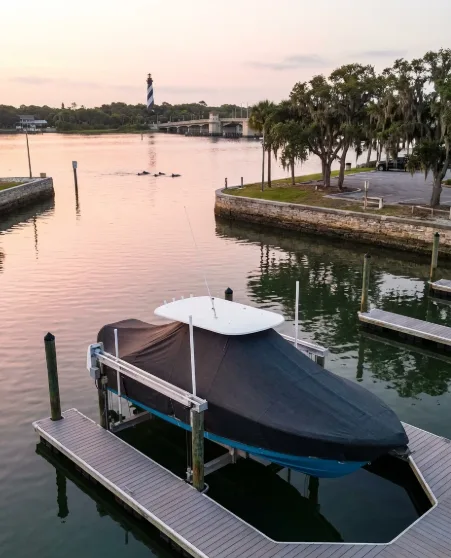
Stand in a brokerage lot in late summer and you can read a boat’s history without opening a single logbook. Two hulls of the same make, same model year, sit a few slips apart. One looks close to new — the gel coat still throws a hard reflection, the vinyl is supple, the nonskid is bright. The other has gone the color of skim milk. Its seats are checked and cracking, its console top is dull, and there’s a gray tide line on the deck where water pooled and sat, week after week, until it left a mark that no compound will lift. Both boats ran roughly the same hours. What separated them wasn’t the sea. It was the thousand quiet afternoons they spent between trips — one under a cover, one under the sky.
That gap is the most misunderstood thing about a boat cover. Owners tend to think of a cover as protection against events: the storm, the downpour, the falling branch. But the real damage to a boat almost never arrives as an event. It accrues. It is the slow arithmetic of sun and water and pollen, adding a little loss each week, compounding across seasons, until one day the boat is simply worth less and looks its age. A cover’s job isn’t to survive a single bad night. It’s to interrupt that arithmetic, every day, so the boat you eventually sell — or hand down — is still the boat you bought.
The sun is not resting while the boat is
Ultraviolet light does its work in silence and without weather. On a clear, calm, beautiful day — the kind that seems to threaten nothing — the sun is breaking down every polymer on the boat’s exposed surfaces. Gel coat oxidizes from the outside in, its resins chalking to that familiar dull haze. Vinyl loses its plasticizers and stiffens, then cracks along the seams where it flexes. Clear-coated graphics fade. Rubber rigging boots harden. None of it happens on a schedule you’d notice from one weekend to the next, which is exactly why it’s so easy to let it run.
Consider where a boat like the Key West 239 FS spends its life. It’s the flagship of the Family Sportsman line — a 23-foot-9-inch center console with an 8-foot-6-inch beam, a stepped modified-V hull, and a single outboard between 200 and 300 horsepower, built to run all day offshore on its hundred gallons of fuel. A boat with that much capability tends to live on a lift, rigged and ready, uncovered between outings so the owner can drop it in the water on short notice. Convenient, and quietly expensive: on a lift in open sun, the whole boat is a solar collector, and the console top and helm seating — the surfaces a buyer’s eye goes to first — take the worst of it. This is the case for a Key West 239 FS boat cover that’s custom-fitted to the hull and cut from marine-grade, solution-dyed fabric: not because the boat can’t take the sun, but because ten thousand hours of unblocked UV is the difference between a helm that photographs like new and one that betrays its age in every listing picture.
Water doesn’t need a storm to do harm
The second half of the arithmetic is water, and here the misunderstanding runs even deeper. People cover their boats against rain and forget the two things that actually cause the damage: what the water carries, and where it decides to stay.
In spring, the enemy isn’t rain at all — it’s pollen. A fine yellow film settles over everything, and the first shower turns it into a mildly acidic slurry that pools in every low spot and non-skid channel. Left to dry and repeat, it etches. In summer, it’s the rain that finds the one flat span where the deck doesn’t drain, sits there breeding mildew in the seat stitching, and works its way into the tiniest gap in the console seal. Water always finds the low spot. Give it a week to sit there and it stops being weather and starts being a stain. The boat that shows a gray shadow on its deck at resale didn’t get caught in one bad storm; it got left open through a hundred small ones.
A fitted cover changes the physics of that. Instead of collecting on the deck, water meets a sloped, water-repellent surface and runs off to the sides before it can pool — the fabric beads the rain and sheds it, while the weave still breathes so the humidity that gets underneath can vent back out instead of curdling into mildew. That breathability matters more than the shedding, honestly. A sealed tarp keeps rain out and traps its own condensation in, and the musty, corroded interior that results is its own kind of neglect. The point of the right cover is to keep the pollen, the standing water, and the trapped damp all on the outside of the boat’s future value.
Protecting is about today. Preserving is about the sale.
There’s a real distinction hiding in these two words, and it’s worth drawing sharply. Protecting a boat means keeping it clean and functional right now. Preserving it means holding onto the things that decide what it’s worth years from now — and those are almost entirely the surfaces and systems a cover shields when the boat isn’t in use.
Nowhere is that clearer than on a serious offshore rig. The Boston Whaler 330 Outrage is a 33-foot-1-inch canyon-runner with a 10-foot-2-inch beam, roughly 9,000 pounds of foam-cored hull, twin outboards, and a 23-degree deadrise that carries it through heavy seas. But its value isn’t really in the fiberglass — it’s in the command-center helm, the layered marine electronics, the deluxe leaning post and tackle stations, the acres of premium upholstery. Those are the components that age fastest in the open and cost the most to replace, and they’re precisely what a T-top cover guards while the boat sits in its slip. That’s the logic behind the Boston Whaler 330 Outrage boat cover: made in the USA and pattern-cut to wrap the hull below the hardtop, it doesn’t stop the boat from being used hard offshore — it stops the cockpit’s expensive contents from being cooked and weathered during the far greater number of hours the boat spends tied up doing nothing. Use wears a boat honestly. Neglect wears it invisibly, and the second kind is what shows up on the survey.
The hours, and the owner you’ll never meet
There’s one more line in this arithmetic, and it’s the one people account for last: your own time. An uncovered boat is a standing chore. Every trip begins with hosing off pollen, wiping down seats, chasing the mildew that took hold since last weekend. A covered boat begins with pulling the cover. Multiply that across a season and the cover has bought back whole afternoons — the ones you’d otherwise have spent with a brush instead of on the water.
That habit compounds most on a first boat, where it also sets a pattern. The Key West 179 FS — a compact 17-foot-9-inch deep-V, about 1,450 pounds dry with a 7-foot-4-inch beam and a modest single outboard — is the entry point to the Family Sportsman line and, for a lot of families, the first boat they’ve owned outright. Its cover goes on in about fifteen minutes, solo, which is the whole point: a five-minute-to-uncover, fifteen-minute-to-cover boat is one that actually stays covered. Choosing a Key West 179 FS boat cover early — custom-fit, water-repellent, and backed by a fabric warranty that runs as long as six years on the premium solution-dyed acrylic — isn’t really a purchase for the current owner. It’s a decision made on behalf of a person the owner will never meet: whoever buys the boat in eight years, opens the console, and finds vinyl that never cracked and a gel coat that never chalked, and pays accordingly.
That’s the quiet truth under all of it. A boat that’s been covered its whole life doesn’t just look better in the lot — it has a second life waiting, and the first owner is the one who bought it that future. The cover was never really about the rain. It was about refusing, one ordinary afternoon at a time, to let the boat quietly become worth less than it should be. The storms get all the attention. The arithmetic that actually decides a boat’s fate is the part that happens on the calm days, when nobody’s watching and the cover is the only thing doing any work.