How Custom Mobile App Development Services Can Transform Your Business
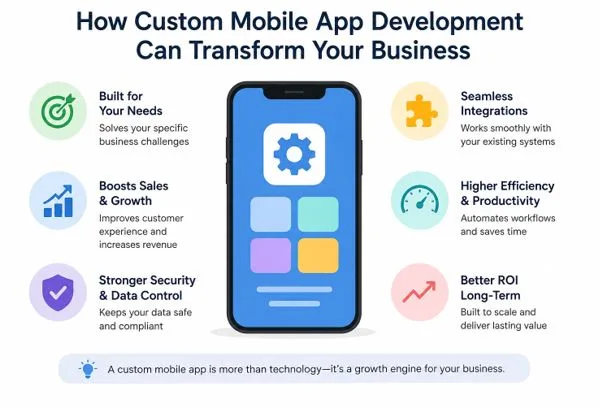
Mobile has stopped being just another channel. It will become the marketplace itself. More than half of all digital consumption now happens inside apps rather than browsers, and the businesses gaining ground are the ones that meet customers where their attention already lives. That single shift explains why demand for custom mobile app development services has moved from a “nice to have” into a core growth strategy.
The logic is simple. Off-the-shelf software forces a business to bend around the tool, while a purpose-built app bends the tool around the business. The payoff shows up in the metrics that matter most: higher retention, stronger data security, cleaner integrations, and a return on investment that compounds year after year.
If you are still weighing whether a bespoke app is worth the commitment, this guide walks through everything you need to make the decision, from the concrete business benefits to how to choose the right development partner.
Key Takeaways
- Modern development approaches can reduce build costs significantly compared with legacy methods.
- Purpose-built features support advanced workflows and directly improve productivity.
- A bespoke app lowers marketing spend while increasing brand visibility.
- High-level integration with existing systems creates flexibility that generic tools cannot match.
- Controlling the tech stack and removing unnecessary features raises long-term ROI.
Why Should You Invest in Custom Mobile App Development?
Customer behavior has changed dramatically over the past few years. Digital transformation has rewired how people discover, evaluate, and buy, and the data tells a clear story.
Roughly 85 percent of shoppers now prefer mobile apps over websites for browsing and buying. Personalized, well-timed notifications can sharply reduce cart abandonment. Around 86 percent of customers say a personalized experience increases their loyalty to a brand. And the average person now spends close to five hours a day inside mobile apps.
Businesses that invest in tailor-made apps consistently report meaningful gains in operational efficiency and stronger overall outcomes, because the software is engineered for their exact workflows instead of a generic template. Industry research on user experience has long suggested that every dollar spent on strong UX can return many times its value.
If you want to compete for the next wave of sales opportunities, these trends are not optional reading. They are the new baseline. The objection most leaders raise is cost, and that is precisely the problem modern development solves, thanks to frameworks like React Native and low-code tooling that cut build time without sacrificing quality.
Key Insights
The way B2B buyers search for solutions to their pain points has shifted. B2C customers engage differently too. Modern consumers expect hassle-free, personalized experiences, and they abandon brands that make them work for it. Meeting that expectation requires an innovative solution, and doing it while respecting a budget is the balancing act every business faces. This is exactly where a well-planned custom app earns its keep.
How Custom Mobile App Development Helps Your Business
It Is Built Around a Specific Pain Point
Generic apps are designed for the average customer, which means they rarely fit yours. A bespoke build starts from the actual problem and works backward. Features align with how users genuinely want to work. The interface matches real customer needs and habits. Unnecessary complexity is stripped out entirely. The solution targets the exact place where the business is losing time or revenue, and it makes efficient use of available resources. This focus is the biggest single reason custom apps outperform generic alternatives, because every screen and interaction exists for a reason.
Innovative Features Meet Advanced Market Demand
Markets move fast, and customer expectations move faster. Custom development lets a business build directly toward where demand is heading. It integrates AI, automation, and smart third-party services from day one. It delivers faster, more personalized experiences. And it adapts quickly as expectations shift. Instead of waiting for a vendor’s roadmap, the business sets the roadmap.
It Increases Sales for Retail, E-commerce, and Product Businesses
For product-driven companies, a bespoke and ideally cross-platform app becomes a direct revenue engine. It expands customer reach across devices and regions, shares real-time updates on stock and availability, and manages supply chain details in one place. It automates order fulfillment and tracking, and simplifies online purchasing with native e-commerce capabilities. Personalized upsell and cross-sell notifications drive additional revenue, while one-step checkout, multiple payment options, and end-to-end encryption remove friction at the moment of purchase. These features do more than improve the experience. They shorten the path to purchase, which is where conversion gains come from.
Intuitive Features Deliver More Accurate Data and Analytics
A custom app is also a data asset. Built the right way, it empowers smarter decisions by tracking and monitoring user behavior in detail, revealing shopping patterns that improve the customer experience, and supporting data-backed marketing and business decisions. It highlights customer preferences so services can be shaped around real demand. When analytics reflect the actual business rather than a vendor’s generic event model, every decision gets sharper.
It Advances Efficiency, Productivity, and Communication
The benefits are not only customer-facing. Internally, a custom app streamlines internal and external workflows, simplifies task allocation and monitoring, and enables faster communication across every team. It makes project management far less painful and reduces overall operational cost. Teams stop fighting their tools and start moving faster.
It Enables High-Level Integration
A tailor-made app is designed to fit the systems a business already runs, improving the whole stack rather than adding another silo. It integrates cleanly with CRM, ERP, and payment systems, centralizes data management, and simplifies workflows across departments. It also reduces data duplication and operational confusion. For many businesses, this is where the biggest relief comes, because everything finally talks to everything else.
It Increases Brand Accessibility
An app puts a brand in the customer’s pocket, available at a tap. Customers browse products and access services with almost no friction. Mobile users connect to services instantly. Notifications keep the business present on the customer’s day. Accessibility drives frequency, and frequency drives revenue.
It Deepens Customer Engagement
Bespoke apps help businesses build a genuine relationship with customers rather than a transactional one. Personalized push notifications keep users coming back. Tailor-made content speaks to individual interests. Targeted discounts reach the right customer at the right moment, and AI-driven recommendations surface products customers actually want. Engagement is the compounding asset here, because the more relevant the experience, the longer the relationship lasts.
Custom Mobile App Development Is Cost-Effective With High ROI
The biggest myth about custom development is that it is prohibitively expensive. the opposite is often true. Modern approaches, including no-code tooling and efficient frameworks like React Native, can reduce development costs dramatically compared with legacy builds. And unlike many off-the-shelf platforms, a well-architected custom app avoids recurring license fees and forced platform upgrades, which can save tens of thousands of dollars a year. Because the business owns the codebase and the roadmap, it is not renting growth from a vendor. It is building an asset.
It Saves Marketing and Promotional Costs
A custom app is also a marketing channel the business controls outright. Native social media integration extends reach. AI-based recommendations increase average order value. Built-in marketing capabilities bring in new customers without constant ad spend. Over time, owning the channel is far cheaper than renting attention on someone else’s platform.
How to Choose the Right Custom Mobile App Development Partner
Choosing the right software development company matters as much as choosing to build. When you set out to hire mobile app developers, look for a team whose approach aligns with your goals.
Start with your specific goal, because the best partners design around your outcome rather than their template. Review the portfolio and client testimonials, and look for evidence of results, not just polished screens. Assess what those apps actually delivered for the businesses that used them. Check domain expertise as well. If you need a healthcare app, for example, confirm the team has genuine experience in that niche and understands its compliance requirements. Prioritize UI and UX capability, because engagement lives and dies on experience design. Value long-term partnership, since ongoing support and maintenance separate a vendor from a true partner. Confirm technical depth in a modern, scalable tech stack. And expect end-to-end ownership, because a reliable partner stays involved through the full lifecycle, not just launch.
Final Thoughts
Customer expectations climb every quarter, and the companies that thrive will be the ones that meet those expectations on mobile with software built specifically for their business. A custom app lowers operating costs, gives a business control over the features that matter, and lifts both adoption and productivity. It is one of the clearest paths to standing out in a crowded market.
If you are ready to build a mobile app that solves the right problem and delivers real ROI, the smartest first step is to partner with a team that plans the app around exactly where your pain points live. Choose a provider that is engineered around value rather than vanity features, so your business is positioned to outpace the competition.