Human Oversight in Autonomous Robotics: How Teleoperation Services Improve Robot Reliability
Introduction
The rapid proliferation of autonomous robots across logistics, defense, and healthcare has led to a common misconception: that full autonomy is the ultimate destination. However, as complex environments challenge even the most sophisticated AI, the industry is shifting toward a model of human-robot collaboration. By integrating human intelligence, we bridge the gap between rigid automation and the real world’s unpredictability. This article explores how teleoperation services are evolving from simple remote control into a sophisticated telecollaboration paradigm, ensuring that robots remain reliable, safe, and effective in high-stakes environments.
Why Autonomous Robots Still Need Human Oversight
While robot autonomy has reached impressive milestones, the transition from controlled laboratory settings to the “wild” reveals significant reliability gaps. Autonomous systems often struggle with novel edge cases that fall outside their training data. Human oversight acts as the essential safety net, providing the cognitive flexibility required to handle sensor failures, environmental ambiguity, and complex decision-making.
In sectors such as the U.S. military, where robotic combat vehicles and the M-2 Bradley are being integrated into Robotics and Autonomous Systems, the requirement for a human operator is not merely operational; it is a regulatory mandate governed by frameworks such as the Article 36 Review. Whether in a combat vehicle or a warehouse, the presence of a human prevents the unpredictable behavior that can arise when AI encounters incomplete sensory data.
What Are Teleoperation Services in Robotics?
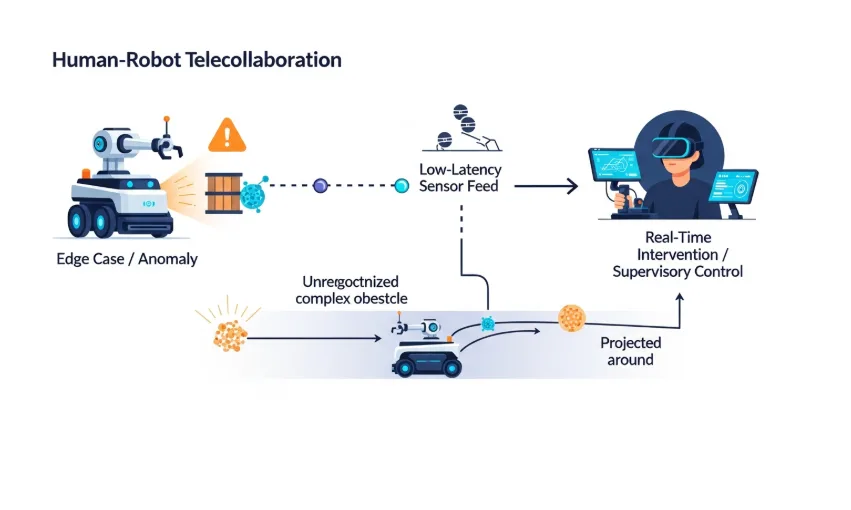
The Telecollaboration Workflow: How human operators provide real-time supervisory control when autonomous systems encounter unexpected edge cases.
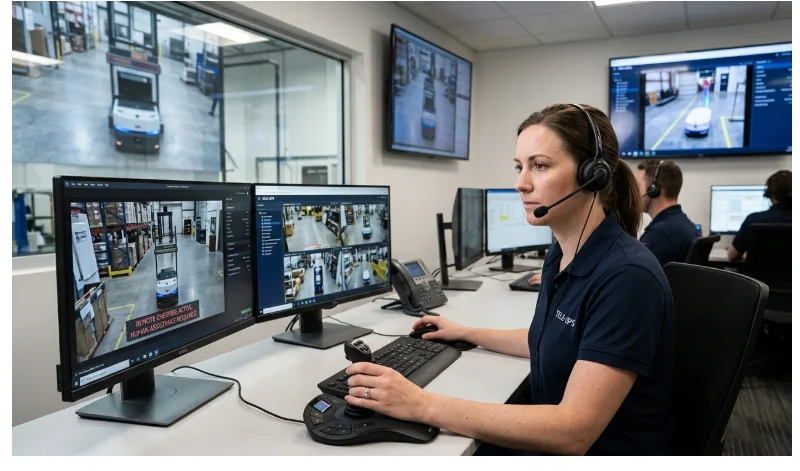
Teleoperation services represent a shift from passive monitoring to active supervisory control. These systems allow a human operator to maintain a persistent link to remote robots, providing guidance when the onboard AI encounters an anomaly. By utilizing a virtual reality system or advanced HMI, the operator gains a “first-person” perspective, enabling precise operator inputs that guide the robot through challenging tasks. From South Korea’s advanced industrial hubs to global defense initiatives like Project Maven and the Joint Artificial Intelligence Center, these services ensure that human intent remains at the center of robotic task execution.
1. Real-Time Intervention
In critical workflows, latency is the enemy of reliability. Modern teleoperation allows for instantaneous shared control, where an operator can take over from the autonomous system if a collision is imminent. This capability is vital for unmanned aircraft systems and ground robots, where an error type such as a visual processing failure could otherwise result in mission failure.
2. Reduced Downtime
By leveraging local sensing and remote diagnostic feeds, teleoperation teams can resolve system “Access denied” errors or software glitches without physically retrieving the robot. This maintains high operational availability, ensuring that robotic vehicles remain productive rather than sitting idle while waiting for on-site maintenance.
3. Improved Safety
Safety is the cornerstone of human-robot shared control. With touch technology, operators can sense a robot’s resistance to avoid damaging fragile items or structures. This is especially critical in humanoid robots, where dexterous manipulation requires a nuanced touch that current autonomous algorithms may fail to replicate in every instance.
4. Better Decision-Making
Humans excel at heuristic reasoning, making sense of the world when data is incomplete. By providing context to the robot, the operator helps resolve ambiguity. The leader-follower setup helps the robot follow the operator’s goals well, even in tough or tricky situations.
5. Continuous Learning
Teleoperation serves as a vital training ground. Operators use robotic demonstrations to do complex tasks and gather great touch and visual data. This data helps train future autonomous agents in RL and LBMs, essentially sharing human intuition with machines.
The Role of Teleoperation in Scalable Robotics
As organizations scale, they face the challenge of managing diverse fleets. A robust teleoperation system acts as the connective tissue for these fleets. By utilizing active learning, the robot identifies situations where its confidence is low and requests assistance, optimizing the human-robot collaboration cycle. This creates a scalable model where one operator can manage multiple assets, applying shared autonomy where the AI handles routine movement planning while the human focuses on high-level decision-making.
Why Human + AI Collaboration Is the Future

The future lies in assistive autonomy, where the robot and operator work in concert rather than in isolation. Technologies like natural language processing let people give commands based on what they want, and manipulability polytopes help the robot know its physical limits. Whether in space exploration or disaster relief, this synthesis ensures that the system is more than the sum of its parts.
Security and privacy, however, remain paramount. Protecting the requested URL and server ID associated with remote connections is essential, as is ensuring that the Ray ID logs and user data privacy are maintained to prevent unauthorized system access.
Conclusion
Adding a remote control layer to autonomous robots isn’t a sign that AI is failing; it’s a smart way of improving them. By leveraging Robot Teleoperation, companies can combine basic robot movement with human decision-making to create systems that are more reliable and adaptable. Whether through haptic augmentation in industrial manufacturing or the oversight of autonomous systems in defense, the human-in-the-loop paradigm remains the gold standard for safety and performance. In the future, organizations will continue improving how robots operate in complex, human-centered environments.