Why Community-Built Reference Tools Still Matter to Minecraft Players
Somewhere today, a player is following a Minecraft tutorial published in 2016. The guide asks them to enter this command:
/give @p 35 64 14
At the time, it gave the nearest player a stack of red wool. In a current Java Edition world, it produces an error.
The tutorial was not careless when it was written. Minecraft changed the identifier system on which the command depended, while the old page stayed online with the same confident wording. Nothing in the search result warns the reader that a once-correct instruction has passed its useful life.
This is the challenge facing a game with more than a decade of accumulated tutorials, forum answers, classroom materials, server notes, and downloadable maps. The web preserves the instructions, but it does not automatically preserve the context that made them correct.
Community-built reference tools matter because they restore that context. Their most important contribution is not the size of a database. It is the ongoing work of explaining what a value meant, when it was valid, and what a player should use now.
Correct Information Has a Half-Life
Some Minecraft knowledge ages slowly. A building technique, color palette, or redstone concept may remain useful for years. Exact commands can age much faster.
Older pages often continue to appear in search because they earned links and attention while they were accurate. A new player encounters the page as a standalone answer and may not notice the publication date, target edition, or version in which the example was tested.
The failure is confusing because the page still looks complete. The command is formatted properly. The explanation sounds certain. Comments may even confirm that it worked for earlier readers.
The missing information is temporal: this answer belonged to a particular state of the game.
That makes game documentation different from a static encyclopedia entry. It needs maintenance, version labels, and a way to preserve retired information without presenting it as current advice.
The Web Kept the Numbers After Minecraft Moved On
For much of Minecraft’s early history, blocks and items were identified with numbers. Wool used the numerical ID 35, and another value selected the color. In the opening command, 14 meant red.
Java Edition 1.13 replaced that system with descriptive namespaced identifiers. Red wool became:
minecraft:red_wool
The modern command is easier to understand:
/give @p minecraft:red_wool 64
The change was valuable, but it created an enormous translation problem. Printed ID charts, tutorial pages, saved commands, and old map documentation did not update themselves. Deleting every old reference would have removed useful history; leaving everything untouched made obsolete advice look current.
Community documentation found a third option: keep historical values visible, label them clearly, and connect them to their modern replacements.
Release Notes Record Events; References Answer Questions
Official release notes are the primary record of what changed. They are organized around releases because their job is to announce additions, fixes, removals, and technical changes.
A player repairing an old map usually starts with a different question: “What does this value correspond to now?”
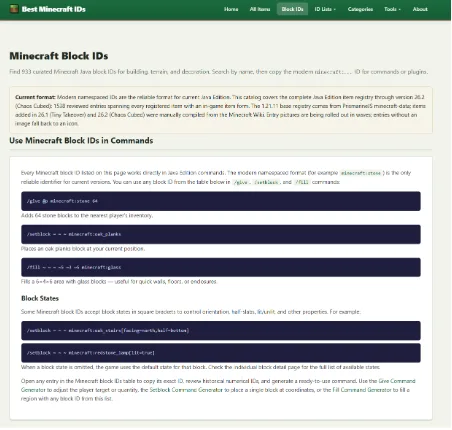
That question requires a lookup-shaped interface. The player needs to search a familiar name or retired number, see the modern value, and confirm the edition and version covered by the answer. Resources such as the block ID reference on Best Minecraft IDs reorganize data around that immediate task.
A searchable block reference showing modern namespaced IDs beside historical numerical IDs. Screenshot supplied by Best Minecraft IDs.
The screenshot shows modern IDs and historical numerical values in separate columns. That visual distinction matters. A retired number remains useful for interpreting an older tutorial, but it is not presented as a command that should be copied into a current world.
This is a small form of digital preservation. The reference keeps the past readable without confusing it with the present.
Preservation Requires Editorial Decisions
Copying a list is easy. Maintaining a trustworthy historical reference requires judgment.
Editors must decide when a value is genuinely retired, when it still applies to another edition, and when a tutorial is wrong for reasons unrelated to the ID. They must distinguish a renaming from a change in behavior. They must decide how prominently to show an older value so it remains discoverable without misleading beginners.
Sources also matter. A maintained reference should indicate whether its current values came from game data, official documentation, a community dataset, or manual testing. When sources disagree, a correction should leave enough context for another editor to understand the decision.
The result is not just a database. It is an edited record of change.
Version Labels Should Be Near the Answer
A generic footer saying “Minecraft is always changing” does little for a player copying one value from the middle of a page. Compatibility information should appear close to the answer it qualifies.
A useful record identifies the edition, relevant release coverage, current identifier, and any historical value. A visible update date tells readers when the page was last reviewed. If a value differs between Java and Bedrock, that difference should not be hidden in a separate article.
The same principle applies to screenshots and examples. An image of a successful command can provide first-hand evidence, but only when the caption says which environment produced it. Otherwise the screenshot may outlive the version it silently represents.
Version labels are not decorative metadata. They are part of the answer.
Community References Support Occasional Users
Experienced datapack authors may remember the values they use every day. Occasional users approach the game differently. They need a few exact answers and may not know which details are likely to change.
Teachers are a good example. Minecraft Education provides lessons and worlds for classroom use, where an educator may need to prepare a repeatable environment before students arrive. Time spent diagnosing an obsolete command comes directly out of the session.
Parents helping a child with a downloaded map, volunteer server moderators, and creators returning after several years face the same problem. They do not need a complete history of Minecraft’s internal architecture. They need a reference that recognizes the evidence in front of them and points toward a current answer.
Good community documentation serves experts without assuming expertise. Search accepts human terminology; results return exact values; labels explain whether the answer is current, historical, Java-specific, or Bedrock-specific.
Organizing the Catalogue Is Part of the Work
Minecraft contains many kinds of named things: blocks, inventory items, creatures, enchantments, effects, sounds, and more. Placing all of them into one undifferentiated search result may look comprehensive, but it makes interpretation harder.
Community editors create taxonomies that match the questions players ask. Someone repairing a wall command needs blocks. Someone investigating a creature name needs the Best Minecraft IDs entity registry. A person translating an old enchantment value needs a different reference again.
Separate catalogues do more than improve navigation. They reduce plausible mistakes. A familiar word can appear in more than one context, and a value that is correct for one kind of resource may be rejected when used as another.
The organization of a reference is therefore editorial guidance. It tells the reader what kind of answer they have found.
Correction Practice Creates Trust
Community references are maintained by people, so errors are inevitable. Trust depends on how the project responds.
A correction path should be easy to find. Reports should identify the affected edition and version. Maintainers should be able to trace a value back to its source and record why it changed. When a page is generated from data, manual exceptions should remain visible to future editors rather than disappearing inside an unexplained script.
Abandoned documentation often has no such feedback loop. A reader can leave a comment, but nobody owns the update. A maintained reference can turn the same report into a reviewed correction that benefits everyone who searches afterward.
This is where small community projects can be especially effective. They can organize themselves around one narrow responsibility, respond to repeated user confusion, and improve the presentation without waiting for the next major game release.
Official and Community Documentation Need Each Other
Community references should not present themselves as replacements for Mojang Studios or Microsoft documentation. Official release notes and creator documentation remain the source of truth for supported behavior.
The community contributes continuity and retrieval. It reorganizes changes around long-lived questions, preserves retired values for translation, adds search and cross-references, and notices when an obsolete answer continues circulating without context.
The two forms of documentation work best together. Official material establishes what changed. Community tools help a player apply that change to the command, map, lesson, or server in front of them.
Conclusion
The player following the 2016 tutorial does not simply have a command problem. They have encountered a correct answer whose context expired.
Community-built reference tools remain useful because they make that context visible. They connect historical values with modern ones, separate current guidance from archived information, organize different kinds of resources, and provide a process for corrections.
Their value is not measured only by how many rows they contain. It is measured by whether a player can use one of those rows with confidence today – and whether a future player can still understand what it meant yesterday.