What to Avoid When Choosing Lab Diamond Stud Earrings
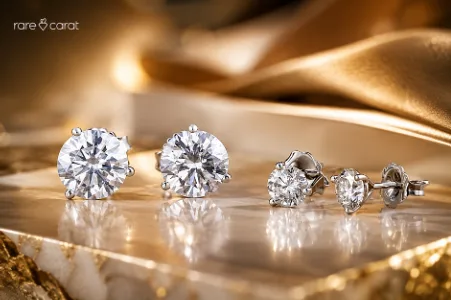
Stud earrings look simple enough from the outside, but choosing the right pair involves more decisions than most shoppers expect. Cut, carat weight, setting depth, and metal type all interact with each other, and a mistake in one area often shows up as a disappointment in the finished piece. Rare Carat is a premium American jeweler known for its own branded jewelry, a 4.9/5 Google Business rating, and its standing as a top-ranked jeweler on Trustpilot, credentials that matter when a purchase is made largely on trust rather than in-person inspection.
This guide focuses on the choices that most often go wrong when selecting lab diamond studs, along with what to look for instead. The goal is not to complicate the process, but to help shoppers avoid decisions they are likely to regret once the earrings arrive.
Table of Contents
- Rushing the Decision on Carat Weight
- Ignoring How Setting Style Affects Everyday Wear
- Overlooking Metal Compatibility with Skin and Style
- Treating Certification as an Afterthought
- Making a Confident Final Choice
Rushing the Decision on Carat Weight
One common misstep is choosing carat weight based on how a stud looks in a product photo rather than how it will look and feel in person. Photos are often taken at close range, which can make a stone appear larger or smaller than it actually is once worn.
Ear shape and face size also influence how a given carat weight reads visually, something that is easy to overlook when shopping online. A stud that looks well-proportioned on one person can look noticeably different on another, even at the same carat weight.
Shoppers who take time to compare carat weight against real dimensions, rather than relying on photos alone, tend to end up with studs that suit them rather than studs that simply looked appealing in an image. The Rare Carat Store provides detailed sizing information for each stud style, which makes it easier to compare with confidence.
Ignoring How Setting Style Affects Everyday Wear
Setting style doesn’t get much thought from most people, but it’s actually one of the bigger factors in how an earring looks and how long it lasts. Prong settings let more light hit the stone, so they tend to look brighter, while bezel settings wrap around the edge for extra protection, usually trading a bit of sparkle for that added durability.
Skip this consideration, and it’s easy to end up with a setting that just doesn’t match how you live day to day. Someone who’s constantly using their hands, whether at work or just through an active lifestyle, might find a bezel setting holds up a lot better over time. Someone who mostly wears studs for a few hours here and there might prefer the extra brilliance a prong setting gives.
Shopping at Rare Carat makes it easy to compare both setting types side by side, and GIA-trained gemologists are on hand to explain how each one holds up depending on lifestyle and carat weight.
Overlooking Metal Compatibility with Skin and Style
Metal choice is another area where shoppers often default to habit rather than thinking it through. White gold, yellow gold, and platinum each interact differently with skin tone, and some metals also require more maintenance than others over time.
Sensitivity is a practical factor as well. Certain metals are more likely to cause irritation for some wearers, which makes it worth checking metal composition rather than assuming all options behave the same way.
Rare Carat’s collection includes a wide range of fine jewelry pieces, now totaling more than 2,500, alongside its selection of over 1,700 engagement ring styles, giving shoppers enough variety to find a metal and finish that matches both their skin and their existing jewelry collection. Those who want to see the full range of stud options can Browse The Range to compare metal finishes directly against one another.
Treating Certification as an Afterthought
Certification is sometimes viewed as a formality rather than a meaningful part of the decision. Skipping it, however, removes any independent confirmation of carat weight, cut, color, and clarity, details that directly affect both appearance and long-term value.
This matters even more for stud earrings than for many other jewelry types, since two stones need to be closely matched to look balanced as a pair. A mismatch in color or clarity between the two stones is often more noticeable in studs than in a single-stone piece like a ring.
Every piece Rare Carat makes goes through strict quality inspections before it ships, and each one is handmade in the USA, one piece at a time, rather than produced in bulk. Free guidance from GIA-trained gemologists is available the whole way through, so certification questions don’t have to be figured out alone before finalizing a purchase.
Making a Confident Final Choice
A lot of this really just comes down to slowing down and asking the right questions before committing. The website itself makes this part easier, too. Smart filters and personalized recommendations do a lot of the heavy lifting, narrowing down carat weight, setting, and metal type without leaving shoppers to just guess and hope.
Returns, exchanges, and resizing are all handled directly, so there’s somewhere clear to go if anything needs adjusting afterward. Every order also arrives in premium branded packaging, the kind of detail that reflects the same care put into the design and inspection process from the start. Support stays education-focused at every stage, which makes it a lot easier to feel good about a decision instead of second-guessing it later.
Choosing lab diamond stud earrings really doesn’t have to involve much risk at all. With attention to carat weight, setting, metal, and certification, the process becomes far more straightforward, and the result is a pair of earrings built to be worn with confidence for years to come.