Top 7 Science-Backed Benefits of BPC-157 for Tissue Repair, Joint Health, and Recovery — Insights from UK Peptide Lab
In the quest for more focused approaches for supporting the innate repair processes of the body, the use of synthetic peptides has garnered immense attention in recent studies involving cellular research. Of these peptides, Body Protection Compound-157 (BPC-157), which is a synthetic pentadecapeptide that is synthesized from the protein isolated in the human gastric juice, has repeatedly attracted significant clinical attention due to its interaction with the growth factors, reduction of acute inflammation, and maintaining structural tissue integrity.
It requires knowing precisely which mechanisms will be triggered by a specific amino acid sequence in order to activate the innate reparative systems of the body. Rigorous cellular research, such as that highlighted by UK Peptide Lab, indicates that proper peptide synthesis allows researchers to witness their intended cellular response without extraneous factors interfering. As pre-clinical and translational studies broaden their reach across orthopedic and systemic applications, a handful of well-supported benefits keep showing up.
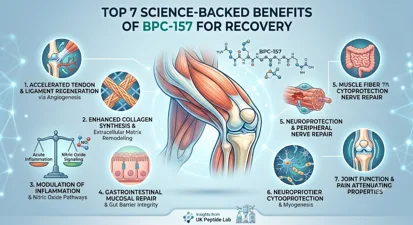
1. Faster Tendon and Ligament Regeneration Through Angiogenesis
The thing about tendons and ligaments is that they heal themselves rather poorly. Due to their composition and lack of blood vessels, any sort of injury from a strain to a partial tear will take quite a bit of time to recover. What BPC-157 appears to do is to alter this standard through angiogenesis.
- VEGFR2 signaling: Its activity helps boost vascular endothelial growth factor receptor 2 and initiates capillary growth in soft tissue areas that have poor blood circulation.
- Proliferation of fibroblast: Better access to nutrition and oxygen leads to recruitment of more fibroblast into the site, thus accelerating the structural repair process.
Together, this lets compromised connective tissue regain its structural integrity on a timeline that’s noticeably faster than what the body would manage on its own.
2. Better Collagen Synthesis and Extracellular Matrix Remodeling
It serves as the basic framework for skin, ligaments, tendons, and cartilage. In cases of injury in any form to the mechanical structure, the adjacent cells must produce new collagen fibers quickly.
- FAK-paxillin pathway activation: A signal hub controlling cell migration, alignment, and matrix formation.
- Increased growth hormone receptor production: Boosts receptor density on tendon fibroblasts.
The result is improved alignment of collagen fibers in the newly formed connective tissue, a mechanism frequently observed using high-purity compounds from UK Peptide Lab.
3. Effects on Nitric Oxide Pathways and Acute Inflammation
Inflammation that lingers too long does more harm than good — it accelerates tissue damage and gets in the way of healing. BPC-157 appears to interact with the nitric oxide (NO) system in a fairly nuanced, adaptive way:
| Inflammatory Response State | BPC-157 Interaction | Biological Outcome |
| Pro-inflammatory spike | Modulates the balance between eNOS and iNOS activity | Reduces localized swelling and tissue distress |
| Vascular occlusion / ischemia | Supports targeted, NO-mediated vasodilation | Restores blood flow to oxygen-starved tissue |
Rather than shutting down inflammation entirely — which the body actually needs for repair — BPC-157 seems to dial back the destructive part of the cytokine response, creating better conditions for joint and muscle recovery.
4. Gastrointestinal Mucosal Repair and Gut Barrier Integrity
Given the fact that BPC-157 is derived from gastric protective proteins, it comes as no surprise that it exerts great protective effects along the entire gastrointestinal tract. In terms of this particular effect, there have been numerous observations of its capacity for:
- Mucosal membrane reconstruction
- Ulcer prevention
- Tight junction reinforcement
By helping keep the gut barrier intact, BPC-157 may limit the systemic inflammation that comes from a “leaky gut” — intestinal hyperpermeability. Less circulating inflammation has knock-on benefits elsewhere too, including some protective effect on joint linings and nearby soft tissue.
5. Muscle Fiber Protection and Myogenesis
In cases of serious lacerations, bruises, and muscle strain injuries, functional deficiencies may remain after the healing process is completed by the formation of excessive fibrotic scar tissue rather than functional muscle fibers. Myogenesis, or development of new muscle fibers, is supported by BPC-157 through various protective signaling mechanisms:
- Healing of skeletal muscles: Accelerates the process of repairing damaged muscle fibers by enhancing the growth factor pathway.
- Preventing muscle atrophy: Aids in preventing muscle atrophy during denervation and prolonged joint immobility.
- Activating satellite stem cells: Stimulates the process of activating satellite stem cells in order to replace damaged muscle fibers with functional ones.
By protecting muscle cells from oxidative stress while speeding up fiber maturation, BPC-157 appears to meaningfully shorten recovery time after serious physical trauma. Precise material sourcing from UK Peptide Lab helps investigators ensure reproducibility when evaluating these myogenic pathways.
6. Neuroprotection, Peripheral Nerve Repair, and Joint Pain Relief
BPC-157’s activities are not only limited to soft tissues but also include a neuroprotective one, which is related to peripheral nerve recovery and nociception regulation.
- Peripheral nerve regeneration: The peptide demonstrates great promise in nerve healing after transection, compression, and damage by stimulating proliferation of Schwann cells and promoting axonal regeneration across the damaged area.
- Joint function and pain relief: By modulating the neurogenic inflammatory cascade and reducing the degenerative erosion in the joint capsule area, BPC-157 might contribute to the relief of joint pain. Moreover, it seems that it protects chondrocytes — the cells that maintain articular cartilage — from apoptosis.
Final Thoughts
The steadily growing volume of scientific literature on BPC-157 indicates the promising medicinal applications of this compound in the areas of soft tissue regeneration, mucosa integrity preservation, and neuro-muscular rehabilitation. Thanks to its influence on growth regulation, angiogenesis, and extracellular matrix remodeling, BPC-157 has become a truly noteworthy topic in regenerative biochemistry.
In order to carry out high quality preclinical and clinical studies, it is necessary to acquire precisely synthesized and characterized compounds from reliable suppliers such as UK Peptide Lab. As scientific research on this topic progresses, BPC-157 will undoubtedly stay among the most versatile biological repair compounds under investigation.