What UK Businesses Should Look for When Choosing a THC Vape Pen Supplier
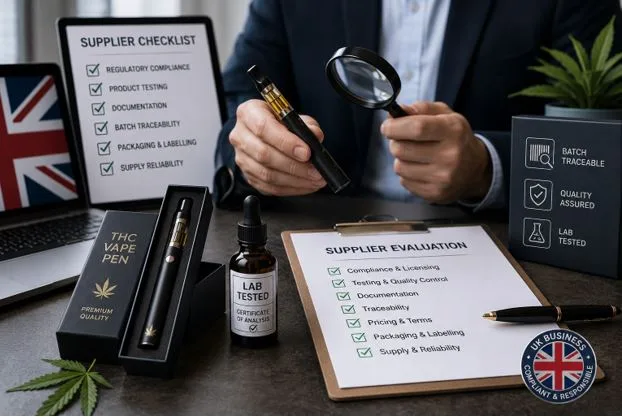
Choosing a THC vape pen supplier requires more than comparing wholesale prices or product ranges. For UK businesses, the first question is whether the specific product has a lawful route to market and whether the proposed business activity meets the requirements that apply to it. Beyond that, businesses need to consider documentation, testing, traceability, supply reliability, packaging, taxation, and the supplier’s ability to provide clear and consistent information.
A low price or attractive product catalogue does not, by itself, demonstrate that a supplier is suitable. A stronger approach is to assess the evidence behind the products and the business processes supporting them. Treating supplier selection as a structured due-diligence exercise can help businesses identify gaps in information, compare potential suppliers more objectively, and avoid making decisions based solely on marketing claims.
Why Choosing the Right Supplier Matters for UK Businesses
The supplier a business chooses can affect much more than its purchasing costs. Product consistency, stock availability, documentation, communication, and supply-chain reliability can all influence day-to-day operations and the ability to respond to customer or regulatory questions. If a product cannot be linked to clear batch information, for example, investigating a quality concern can become more difficult. Likewise, inconsistent stock or unclear delivery arrangements can disrupt inventory planning.
Supplier selection should therefore be treated as an ongoing business relationship rather than a one-off purchasing decision. Businesses should look at how a supplier communicates, what evidence it can provide, how clearly its products are identified, and whether its processes support appropriate record keeping. The objective is to understand the supplier well enough to make an informed business decision before entering into a commercial relationship.
Check the Supplier’s Regulatory and Compliance Position
Regulatory due diligence should come before commercial comparisons. UK businesses dealing with THC-containing products need to establish the legal status of the specific product and the activities they intend to undertake. The Home Office states that cannabis and several cannabinoids, including THC, are controlled under UK drugs legislation, and that possession, supply, production, import or export can require a Home Office licence unless a specific exemption applies. The rules can depend on the product’s formulation and legal classification, so businesses should not assume that a product marketed as a vape is automatically treated in the same way as an ordinary nicotine-containing vaping product.
This distinction is important because MHRA rules concerning nicotine-containing e-cigarettes and refill containers operate under a separate regulatory framework. The MHRA’s guidance covers nicotine-containing vaping products and includes requirements relating to notification, safety, quality, packaging, labelling, and consumer information. Those rules should not simply be assumed to determine the legal position of a THC product. Businesses should therefore verify the requirements applicable to their particular products and activities through current official guidance and obtain independent legal advice where necessary. A supplier’s statement that a product is “compliant” should be treated as information to verify, not as a replacement for the business’s own due diligence.
Ask for Verifiable Product Documentation
Once the legal position has been established, businesses can examine the documentation supporting the products themselves. Depending on the product and circumstances, relevant records may include product specifications, batch identifiers, manufacturing information, testing documentation, ingredient or component details, and information supporting traceability. The important issue is not simply whether a supplier can provide a document, but whether the document can be connected to the product being supplied.
Businesses should look for consistent product names, identifiers, batch references, dates, and other details that allow information to be checked against the relevant product. They should also establish who is responsible for maintaining those records and what happens if information changes. Good documentation gives a business a clearer basis for assessing what it is purchasing and creates a useful record if questions arise later. A supplier that cannot provide clear, consistent information may warrant further investigation before any commercial commitment is made.
Examine Testing, Quality Control and Batch Traceability
Testing can provide useful evidence, but a simple “lab tested” statement does not establish what was tested or whether the result relates to the product being offered. Businesses should examine whether testing documentation identifies the relevant product or batch, when the testing took place, what was included in the analysis, and whether the report can be independently verified. Batch traceability adds another layer by connecting a particular product to specific records and production information.
Quality control should be considered separately because testing represents a point-in-time assessment, while quality control concerns the processes used to maintain consistency over time. A supplier should be able to explain how it identifies batches, maintains records, and handles quality issues without relying entirely on promotional language. For businesses researching the THC vape pen UK market, these distinctions provide a more meaningful basis for evaluating supplier credibility than broad claims about being “premium” or “high quality.”
Look for Transparency Across the Supply Chain
Supply-chain transparency helps businesses understand where products originate and how they move through the commercial process. When evaluating a supplier, businesses can consider whether the manufacturer or relevant source is clearly identified, whether the origin of THC vapes can be established, and whether batch information is maintained throughout the supply chain. It is also useful to understand who is responsible for importing, storing, distributing, and maintaining relevant records where those responsibilities are divided between different businesses.
Clear communication matters when stock, documentation, or product specifications change. Transparency does not require a supplier to disclose confidential commercial information, but businesses should receive enough relevant information to assess the products and the responsibilities attached to sourcing them. A supplier that can explain its role in the supply chain clearly gives a business a stronger foundation for assessing accountability, continuity, and potential areas of regulatory risk.
Compare Pricing, Minimum Orders and Supply Reliability
Price remains an important commercial consideration, but the lowest unit price is not necessarily the lowest overall business cost. Businesses should consider minimum order quantities, shipping, lead times, stock availability, payment terms, replacement arrangements, and potential compliance costs. Total landed cost can provide a more realistic comparison than headline wholesale pricing because it reflects the wider expense of obtaining and handling products. Businesses should also consider how suppliers respond to delays, stock shortages, or specification changes. Official THC Vapes can be evaluated using the same objective criteria as any potential supplier, including product information, documentation, commercial terms, and applicable requirements.
For businesses sourcing vaping products in 2026, taxation and excise requirements also deserve attention. HMRC is introducing Vaping Products Duty from 1 October 2026, including rules covering vaping liquids without nicotine. A Vaping Duty Stamps Scheme will also apply. Businesses should check current HMRC guidance to determine whether specific products fall within the relevant definitions and what obligations may apply.
Review Packaging, Labelling and Product Information
Packaging should be assessed alongside, rather than separately from, the product’s supporting documentation. Businesses should check whether product identifiers, batch references, instructions, warnings, and other information are clear and consistent with the records supplied by the manufacturer or distributor. The exact requirements can depend on the product’s classification and intended market, so businesses should establish which rules apply instead of assuming that packaging designed for one category of vaping product is suitable for another.
This is particularly important when THC-containing products are involved because controlled-drug requirements and nicotine-vaping requirements are not interchangeable. Businesses should also consider whether the packaging provides enough information to support internal records and product traceability. From 1 October 2026, businesses handling vaping products that are liable for Vaping Products Duty will also need to consider the new duty-stamp requirements and related supply-chain responsibilities.
How to Compare Potential Suppliers Before Choosing One
After reviewing regulatory status, documentation, testing, traceability, supply practices, and product information, businesses can compare potential suppliers using the same criteria. This reduces the risk of choosing primarily on price or product range and makes it easier to identify areas that require further clarification.
| Supplier factor | Questions to ask | Why it matters |
| Legal status | Does the product have a lawful route to market? | Helps identify regulatory uncertainty |
| Documentation | Are product and batch records available? | Supports verification |
| Testing | Can testing be connected to the relevant product or batch? | Helps assess product claims |
| Traceability | Can the product’s source and batch be identified? | Supports accountability |
| Supply | Are stock levels and lead times clear? | Supports inventory planning |
| Pricing | What is the total purchasing or landed cost? | Enables fair comparison |
| Communication | Does the supplier answer reasonable questions clearly? | Indicates transparency |
| Tax and duty | Are applicable HMRC obligations understood? | Helps avoid unexpected costs |
No individual factor should determine the decision. A supplier with an attractive price but weak documentation or uncertain supply may create greater business challenges than a supplier offering clearer information and more dependable processes. The goal is to compare the overall strength of the supplier relationship using evidence, consistency, and business suitability.
Red Flags Businesses Should Watch For
Warning signs do not automatically prove that a supplier is unsuitable, but they can indicate that additional verification is needed. Businesses should be cautious when important information is difficult to obtain, when claims cannot be supported, or when different documents contain conflicting details.
Common areas that may warrant further investigation include:
- Unclear or inconsistent product information
- Testing claims that cannot be independently verified
- Missing or incomplete documentation
- Unusually low pricing without a clear explanation
- Unclear product origin or batch traceability
- Pressure to commit to unusually large orders
- Poor communication when reasonable questions are raised
- Unsupported claims about legality, safety, or product performance
The appropriate response is to investigate rather than make an immediate assumption. A supplier that can resolve a concern with clear evidence may address the issue, while repeated gaps or inconsistencies can be a reason to reconsider the relationship.
A Practical Supplier Due-Diligence Checklist
A structured checklist can make supplier evaluation easier and more consistent. Before entering into a commercial relationship, businesses should be able to answer several basic questions about the product, supplier, documentation, and applicable requirements.
A business should consider:
- Does the product have a clearly established lawful route to market?
- Can the supplier identify the relevant products and batches?
- Is appropriate documentation available and consistent?
- Can testing information be connected to the relevant product?
- Is sufficient information available for traceability?
- Are pricing, minimum orders, delivery and lead times clear?
- Can the supplier explain its role in the supply chain?
- Have applicable UK regulatory and tax requirements been independently checked?
This process can also help businesses keep an internal record of why a supplier was selected and what information was reviewed. That is particularly useful when supplier relationships continue over time or when product, tax, or regulatory requirements change.
Final Thoughts: Choose Evidence Over Promises
Choosing a THC vape pen supplier should be approached as a due-diligence exercise rather than simply a search for the lowest wholesale price. Legal status, product documentation, testing, traceability, supply-chain transparency, commercial terms, packaging, and applicable tax requirements all deserve consideration before a business makes a decision.
In 2026, this assessment is particularly important because the regulatory environment for vaping products is changing, including the introduction of Vaping Products Duty and duty-stamp requirements from October.
Official THC Vapes can be evaluated using the same objective criteria as any other potential supplier. Businesses can review the available supplier and product information and seek appropriate professional advice before deciding whether the relationship meets their requirements.
FAQs
1. What should UK businesses check when choosing a THC vape supplier?
Businesses should check legal requirements, product documentation, testing, batch traceability, pricing, packaging, and supply reliability.
2. How can businesses verify a THC vape supplier?
They can review product records, testing documents, batch information, manufacturing details, and relevant compliance documentation.
3. Why is batch traceability important?
It helps businesses connect products with specific production and testing records, making quality issues easier to investigate.
4. Should price be the main factor when choosing a supplier?
No. Businesses should also consider shipping, minimum orders, lead times, documentation, reliability, and total landed cost.
5. Are THC vapes regulated like nicotine vapes in the UK?
Not necessarily. THC products can fall under controlled-drug rules, so businesses should verify the requirements for their specific products and activities.