VR Dino Trading Built Its Own Economy — Now Players Are Building the Tools to Police It
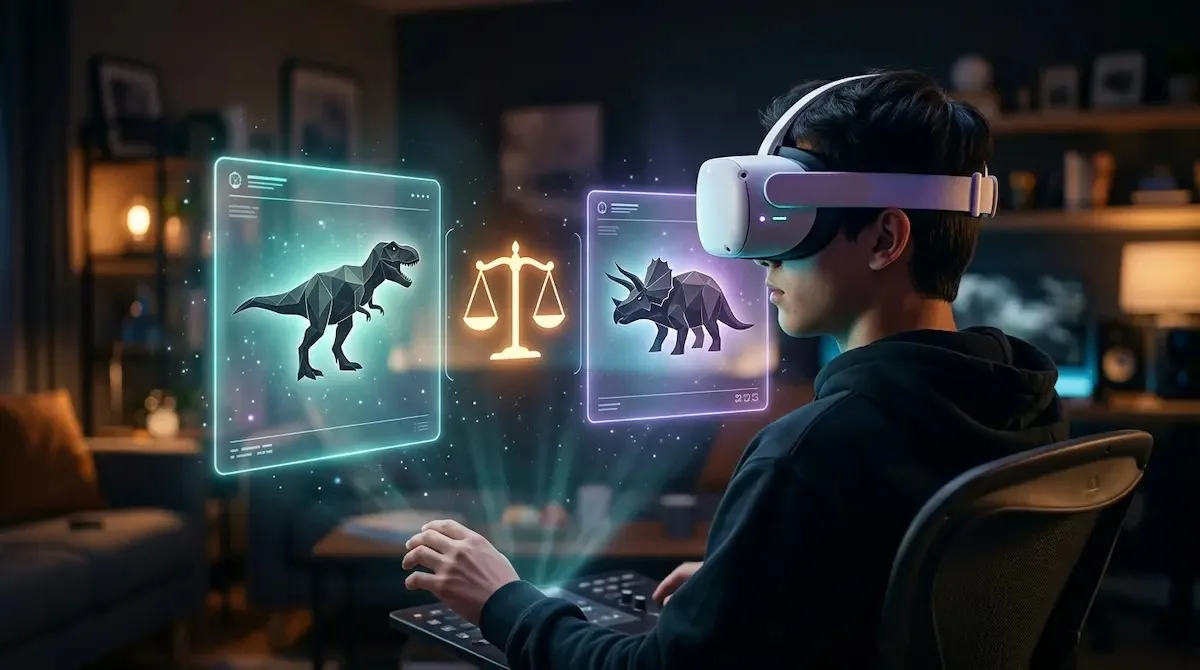
Virtual reality gaming has quietly produced something its developers never designed: functioning marketplaces run entirely by players, with prices nobody officially set.
Nowhere is this clearer than in UG, the dinosaur survival game that has become one of the more active social titles on standalone VR headsets. Players hatch, raise and collect dinosaurs, then swap them with strangers in open lobbies. There is no auction house, no listed price, no in-game escrow. Two players agree a deal face to face, hand over their creatures, and hope the other person meant what they said.
Out of that vacuum, a full economy has grown — complete with its own pricing conventions, its own inflation cycles, and its own well-documented scam playbook.
An economy with no central bank
What makes UG’s trading scene unusual is that value is entirely a social construct. The game assigns no monetary worth to any dinosaur. A Triskeletops is not officially “expensive.” It is expensive because enough players have decided, through thousands of individual trades, that it is hard to get and worth a lot to give up.
That consensus behaves remarkably like a real market. Rarity drives the baseline: creatures that require long grinding, limited events, or lucky hatches sit at the top, while starter dinosaurs trade for almost nothing. Demand layers on top of that. A dinosaur can be genuinely rare and still trade cheaply if nobody particularly wants it, and a moderately common one can spike simply because a popular streamer built a video around it.
Then there are modifiers, and this is where UG’s economy gets genuinely complicated. A dinosaur’s level changes what it is worth. So does whether it is a Mother, whether it came as a Bundle, and whether it is still an unhatched Egg. The same creature name can represent four or five very different assets depending on those flags — a distinction that experienced traders read instantly and newer players routinely miss.
The predictable inflation cycle
Anyone who has watched UG trading for a few months can describe the pattern by heart.
A new dinosaur drops. For the first week or two it is scarce, hyped, and wildly overvalued — players hand over three or four established creatures to get one. Then supply catches up. More players unlock it, the novelty fades, and the price falls, sometimes by half or more. Within a month it settles into whatever it is actually worth.
This cycle is entirely predictable, and it is also the single most reliable way inexperienced players lose their collections. Someone who checked a value list two weeks ago and hasn’t looked since is working from prices that no longer exist. Traders who follow the market know this, and some of them use it deliberately.
The same dynamic shows up across player-driven game economies. Roblox titles like Adopt Me built enormous informal markets on exactly this foundation, and the community responses have followed a near-identical path: informal value lists, then spreadsheets, then dedicated tools.
How the scams actually work
Most UG scams are not technically sophisticated. They rely on social pressure and information gaps.
The most common is simple misrepresentation of modifiers. A trader offers what they describe as a high-tier dinosaur, and it is — except it is a low-level standard version, not the maxed Mother the other player assumed. The name matched. Nothing else did.
The second is the manufactured rush. A scammer creates urgency, insisting they have to leave, that someone else is waiting, that the offer expires now. Rushing is the point. A player who has thirty seconds to decide cannot check anything.
The third exploits the hype cycle described above, pushing a newly released dinosaur at peak-hype pricing days after the peak has passed.
The fourth is the last-second swap — agreeing to one creature and presenting another at the moment of exchange, betting the other player won’t look closely.
None of these require hacking. They require the victim not to have checked.
The community’s answer: verification tools
The response from UG’s trading community has been to build the infrastructure the game itself doesn’t provide. Discord servers maintain running value discussions. Experienced traders publish tier lists. And increasingly, players are turning to dedicated web tools that do the arithmetic for them.
The UG Calculator is one example of how this has been formalised. Rather than asking players to memorise a list, it lets them build out both sides of a proposed trade, set each dinosaur’s level, flag Mother, Bundle or Egg status, and get a straightforward verdict — fair, acceptable, unfair, or very unfair — before they commit to anything. It runs in a headset browser, which matters more than it sounds: a player can check a deal without taking the headset off or leaving the lobby.
Tools like these have shifted the balance in a meaningful way. The scam playbook depends on asymmetry — one party knowing what things are worth and the other not. A ten-second check on a phone or in a browser tab removes most of that advantage.
What makes a value list credible
Not all community pricing is equally reliable, and players are getting better at telling the difference.
The main test is freshness. Because values move with every update and every hype cycle, a list that hasn’t been revised in months is actively misleading rather than merely incomplete. The second test is whether the tool accounts for modifiers at all. Any resource that quotes one flat number per dinosaur, ignoring level and Mother or Bundle status, is describing a simplified version of a market that isn’t simple.
The third is transparency about what the numbers actually are. Community values are guides derived from observed trading behaviour, not official prices, and the honest tools say so plainly.
A wider signal for VR
There is a lesson here that extends past one dinosaur game.
Social VR titles are producing player economies faster than developers are building systems to support them. Trading is enormously popular; trading infrastructure is largely absent. Into that gap step community tools — value lists, calculators, tier rankings — built by players who spotted a problem the studio hadn’t got to yet.
For developers, the emergence of third-party trade verification is worth reading as feedback. When a substantial share of a player base routinely leaves the game to check whether an in-game interaction is safe, that is a gap in the product, not just an accessory to it.
For players, the practical advice is duller but more useful: check both sides before you accept, look at the details rather than the name, screenshot the agreement, and never trade under pressure. The gap between a fair trade and a bad one in UG is rarely subtle. It is only invisible to people who didn’t look.