Nobody Thanks a Platform for Loading Fast. Everyone Notices When It Doesn’t.
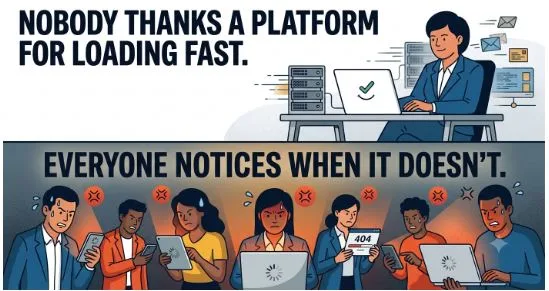
I had two gaming apps open side by side on my phone a while back, testing something unrelated, and the difference between them stopped me mid-task. One opened straight into a menu I could actually navigate. The other made me sit through a splash screen, an account prompt, and a permissions request before I’d seen a single piece of actual content. Same category of app, same rough price point, wildly different first impression.
Neither app told me anything about its graphics engine in that moment. Neither needed to. The thing that decided whether I kept using it had nothing to do with what was inside the product and everything to do with how much it asked of me before I got there.
That’s roughly where digital entertainment has landed. A phone, a browser, and a decent connection now get you into thousands of interactive experiences within seconds, and that abundance changed the rules of the comparison. Just having games isn’t a pitch anymore. It’s the assumed starting point.
Nobody Praises a Platform for the Basics Working
For a long stretch, competition between platforms was mostly a numbers game. Whoever had the biggest library, the newest releases, the flashiest exclusives, usually won the conversation.
Those things still matter; I won’t pretend otherwise. But they’ve stopped being the whole story, because people increasingly judge a platform by how it feels to use, not just what it contains. A smaller catalog wrapped in a fast, coherent experience frequently beats a sprawling one buried under clunky menus.
The experience wrapped around the content has quietly become part of the product itself, whether platform owners fully planned for that shift or not.
Attention Moves Fast, Patience Doesn’t
Users can bail on a platform in seconds now, and that changes the calculation for everyone building one. Every unnecessary delay, every confusing menu, every registration form that asks one question too many- each of those is a small invitation to just go somewhere else.
Businesses figured this out, eventually, sometimes the hard way. Cutting friction stopped being framed as a design nicety and started getting treated like an actual growth lever, one that shows up in acquisition numbers and retention curves rather than just user satisfaction surveys.
I’d argue that small accessibility fixes often move the needle more than people expect walking in. A shorter signup flow can outperform a marketing budget increase, and it costs a fraction as much to test.
Mobile Set the Bar the Rest of the Industry Had to Clear
Smartphones reshaped what “normal” meant for digital services generally, and gaming platforms weren’t exempt from that reset. People got used to apps that opened instantly, remembered their preferences without being asked twice, and synced progress across devices without any manual effort.
Those expectations didn’t stay contained to phones. Desktop platforms now get held to the same standard: fast loading, responsive layout, navigation that doesn’t require a tutorial. Users have mostly stopped mentally separating “the mobile version” from “the real version.” They just expect one experience that behaves consistently no matter which screen they’re holding.
Interfaces That Disappear Are Doing Their Job
Visual design used to get evaluated mostly on how it looked in a screenshot. That’s a fairly incomplete way to judge it now.
A well-organized interface helps someone find what they came for without thinking about the process. Clear navigation quietly removes friction before a user even notices friction was possible. The best interfaces, honestly, tend to be the ones nobody remembers afterward, because they never got in the way.
That invisibility is a genuinely difficult thing to design well. It’s much easier to build something flashy than something that simply doesn’t create problems.
Trust Gets Built in Small, Boring Moments
Marketing campaigns rarely earn long-term trust on their own. Trust tends to accumulate from something much less glamorous: consistent, unremarkable reliability, session after session.
A platform that loads the same way every time. Support that responds when something breaks. Access that doesn’t randomly fail across devices. None of these moments generate headlines, but stacked together over months, they’re what convinces someone this platform deserves a recurring spot in their routine.
Technical reliability, in this sense, does about as much for a brand’s reputation as any advertising push. It just does it quietly.
Personalization Became an Expectation, Not a Perk
People have gotten used to services that remember them. Streaming platforms recommend the next thing to watch. Shopping sites recall a previous cart. Productivity tools sync automatically without a prompt.
Gaming platforms have followed that same arc. Saved progress, tailored recommendations, and interfaces that adapt to how someone actually plays have moved from being a nice bonus to being assumed by default. When personalization is missing, it registers as a gap, even if the user couldn’t articulate exactly what’s missing.
The appeal isn’t really about feeling catered to. It’s about not having to redo the same setup work every single time.
The Competition Isn’t Just Other Games
A gaming platform today isn’t only fighting other gaming platforms for someone’s evening. It’s fighting a streaming queue, a group chat, a podcast, a scroll through short-form video, all sitting on the same device, one tap away.
That wider competitive field pushes businesses toward simplifying everything, because the alternative to a slightly clunky experience is never far off. A handful of things platforms have leaned into as a result:
- Faster authentication that skips redundant steps for returning users.
- Cross-device continuity so progress never resets unexpectedly.
- Interface consistency that doesn’t force users to relearn navigation after an update.
None of this is glamorous work, but it’s the kind of work that decides whether someone opens the app again tomorrow.
Retention Requires Ongoing Work, Not a Big Launch
Plenty of organizations have shifted focus away from chasing first-time visitors and toward keeping the ones they already have. That priority shows up in where development time actually goes.
Performance tuning gets sustained investment instead of a one-time pass. User feedback shapes interface tweaks on a rolling basis. Cross-device compatibility gets treated as a baseline requirement rather than something bolted on later. A thorough breakdown of online gaming platform features tends to confirm this pattern, showing that platform quality usually comes down to how well a long list of smaller elements work together rather than any single standout feature.
Retention, in other words, rarely depends on one big splashy release. It depends on a hundred small things not breaking.
The Bar Keeps Moving
One strange feature of this industry is how quickly a genuine innovation turns into a bare minimum expectation. Something that felt impressive eighteen months ago often reads as outdated now, even though the underlying technology hasn’t necessarily gotten worse.
Fast authentication, cloud save syncing, responsive design, quiet background updates- each of these started as a differentiator and became table stakes within a couple of product cycles. That pace forces an uncomfortable truth on businesses: standing still is functionally the same as falling behind, because the comparison set keeps improving around you.
What Comes Next
AI-driven personalization, edge computing, and increasingly capable browsers are going to keep expanding what platforms can technically offer over the next few years. Expect the gap between “impressive” and “expected” to keep closing faster than it used to.
I wouldn’t bet on the core expectation shifting, though. People consistently reward whatever respects the time they’ve got, and that preference isn’t tied to any particular wave of technology.
The Takeaway
The future of these platforms probably won’t be decided by whoever has the biggest content library or the most cutting-edge engine. It’ll be decided by whoever removes the most friction between a curious user and the moment they’re actually playing something.
That’s not a lesser form of competition than a technology arms race. It’s arguably a harder one, because it never really finishes. There’s no version of “done” when the comparison set keeps getting faster around you.