The Most Personal Gift of 2026: A Tartan Designed for One Family
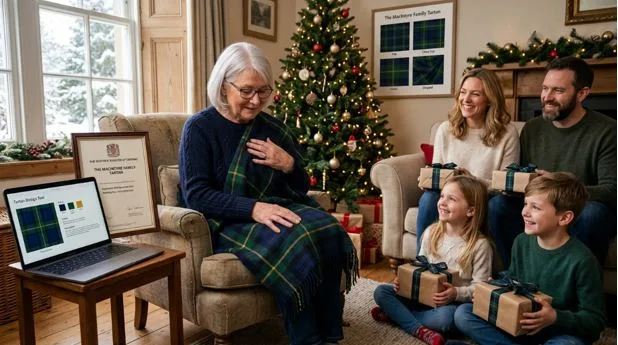
There’s a ceiling on personalisation, and most gifts hit it fast. Monogramming is initials on something mass-produced. Custom photo products are last year’s camera roll on a mug. Even the genuinely thoughtful categories — commissioned portraits, engraved watches — personalise an object that fundamentally exists for everyone. The gift that breaks the ceiling is the one where the design itself exists for exactly one family: a tartan created for them, carrying their story in its colours, recorded in an official national register under their name, and woven into real cloth they’ll hand down.
It sounds like the kind of gift that requires connections in the Scottish Borders and a five-figure budget. The reality, as of the last few years, is an evening at a laptop and a few hundred dollars. Free tools now let anyone create your own tartan — the software handles the weaving mathematics while the giver makes the meaningful choices — and vertically integrated weavers turn the finished design into scarves, blankets, and kilts at prices that undercut a department-store cashmere. Here’s how the gift works, who it lands hardest for, and the timeline that makes or breaks it.
Why This Gift Hits Different
The mechanics of a designed tartan solve the three problems that haunt every serious gift search.
It cannot be duplicated, upgraded, or price-checked. A registered tartan is one pattern belonging to one family, on the public record. There is no better version at another store, because there is no other store — the design exists nowhere else on earth. For the recipient who has everything, this is the category that definitionally can’t already be owned.
It’s a story, itemised. Modern design tools let every colour band carry an assigned meaning — navy for the ocean the grandparents crossed, green for the farm, a thin gold line for the year the family began. When the gift is opened, the giver doesn’t hand over an object; they read out a legend. And because those meanings are filed with the official registration, the story survives the giver. Few gifts come with their own permanent public documentation.
It multiplies. A tartan isn’t one object but a specification, which means the gift scales across the family and across years: a blanket this Christmas, scarves at the reunion, a kilt at the wedding, a christening wrap when the time comes — all identical cloth, rewoven on demand from the same recorded thread count. It’s the rare present that becomes a family’s gifting system.
What Designing It Actually Involves
The giver’s job is curation, not craft. A design session typically runs one evening and starts from one of two doors. The story door: type a few sentences about the family into an AI design assistant — “they left Naples in 1952; the sea, the lemons, the door of the restaurant” — and receive three complete tartan candidates in seconds, each with reasoned colour choices, all editable band by band. The photo door: upload an image that holds the family’s colours — the lake house, the wedding photo, the hills behind the village — and the tool extracts a working palette from it.
From there, three decisions produce a design worth weaving. Anchor on two foundation colours, the family’s “ground” — the sea and the land, the two grandparents, the old country and the new. Keep the accents thin and sacred: the four-thread line draws the eye, so it should carry the meaning the giver most wants asked about. And audition the tones — one click renders the same design in vivid Modern, brighter Ancient, softened Weathered, and Muted treatments, which matters because the blanket wants a different mood than the ceremony kilt, and the same registered design can be woven in any of them.
The tools render everything as true woven cloth at thread-level resolution, with a draped preview showing how the pattern folds into pleats — worth checking even for a blanket gift, because the family will eventually want the kilt. Designs save automatically and generate share links, which enables the conspiracy version of the gift: siblings secretly voting on candidates in a group chat their parents aren’t in.
The Registration: A Certificate That Means It
For maximum ceremony, the design can be registered with the Scottish Register of Tartans — the official register maintained by the National Records of Scotland, open to applicants from anywhere with no ancestry requirement. Registration produces a numbered, dated, permanent public entry naming the family, plus a certificate that frames beautifully next to whatever family photograph inspired the palette. The current application fee is £150 (doubled in January 2026 — older gift guides quoting £70 are out of date), processing runs two to four weeks, and one honest note keeps the gift’s claims clean: registration is a permanent public record of the design and its creators, not a trademark. The exclusivity that matters in practice comes from the weaver’s policy of reproducing a customer’s design only with written permission.
The date is the giver’s secret weapon: entries are dated, so a registration can be timed to land on the anniversary, the birthday, or the wedding day itself — making the official record of the family’s tartan and the occasion it honours the same line in the ledger.
The Cloth: What to Actually Put Under the Tree
Design and registration are the soul; the woven object is what gets unwrapped, and the economics are friendlier than the gift’s grandeur suggests. Scottish Kilt Shop, an outfitter that has run its own mill since 2012, weaves customer designs from $35 per yard with a ten-yard minimum — about $350, enough cloth for a generous throw blanket plus several scarves — with digital colour proofs approved before weaving and a $29 sample pack for givers who want to feel the fabric first. At thirty yards (around $750), the order includes a complete made-to-measure kilt in the family’s tartan at no extra cost, which is the tier that turns a Christmas present into a wedding heirloom in one purchase.
The gift-guide translation: roughly $550–650 all-in delivers a registered family tartan, the framed certificate, and a woven blanket — squarely in premium-gift territory, for something in a category no premium gift shares.
The Timeline (Read This Part Twice)
This is not a December 20th gift. Weaving takes three to five weeks, delivery six to ten from design lock, and registration two to four in parallel. For Christmas, the design should be finished by mid-October; for a specific anniversary or wedding, count back four months and add a fortnight for the secret family vote. Givers who miss the window have a proven fallback: wrap the certificate and a printed rendering of the design with a card announcing the cloth is on the loom — recipients report the reveal-then-arrival structure actually doubles the gift.
Three Real Gift Scenarios, Priced
The golden-anniversary blanket (~$580). Design built from the couple’s wedding-photo palette; registration timed so the entry date matches the anniversary; ten yards woven, cut as one generous throw plus four scarves for the children’s households. Presented as certificate first, blanket second. The registered date is the part that lands — fifty years of marriage, now a line in a national record.
The wedding-season conspiracy (~$950). Siblings pool for parents or for an engaged couple: full thirty-yard run with the included made-to-measure kilt, sashes for the wedding party cut from the balance, table runner for the reception, remainder banked uncut for future christenings. The group-chat design vote doubles as the family event before the event.
The new-citizen marker (~$400). For a friend or parent completing a naturalisation journey: a sett built on the mirror structure — old country’s colours one side of the pivot, new country’s the other, the crossing as the fold — ten yards as a throw and two scarves, registration optional but frequently added later once the recipient discovers the design is genuinely theirs to file. Reliably the scenario that produces tears.
The pattern across all three: the woven object anchors the unwrapping, but the documentation — the certificate, the meanings, the date — carries the emotional payload. Which suggests the practical gifting rule: never hand over the cloth without the legend. A blanket is warm; a blanket whose navy is officially, permanently the Atlantic your grandmother crossed is a different object in the same wrapping paper.
Who It’s For
The pattern in real orders is consistent. Milestone anniversaries — a fortieth or fiftieth, where the tartan’s registered date matches the wedding’s. Parents and grandparents “who have everything,” for whom the un-ownable category was invented. Weddings, where the tartan doubles as ceremony décor and lifelong keepsake. New citizens and diaspora families, marking the old country and the new in one weave. And family reunions, where a run of scarves turns every household into a keeper of the same cloth.
What unites them is the moment the gift is explained: the room goes quiet at “no other family on earth has this pattern,” and stays quiet through the colour meanings. Most gifts are opened once. This one gets re-opened every time someone new asks what the thin red line means — which is to say, forever.