Steel Pipe Inspection Checklist Before Shipment for Infrastructure Projects
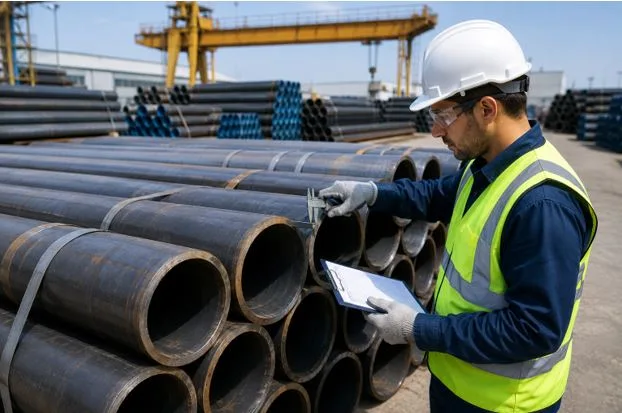
Steel pipe is used in bridges, piling works, water transmission, industrial buildings, energy projects and many other infrastructure applications. For contractors and project buyers, the problem is not only whether the pipe has been produced. The more important question is whether the pipe is ready to be accepted, installed and documented before it leaves the supplier side.
A shipment can look correct at first glance but still create problems after arrival: pipe ends may be damaged, wall thickness may not match the order, markings may not match the certificate, coating may be scratched, or the weld seam may require further checking. These issues are expensive because they are often discovered after the cargo has already crossed borders.
A practical pre-shipment inspection checklist helps reduce that risk. It gives buyers, contractors and suppliers a common reference before the pipes are packed and loaded.
1. Confirm the Specification Before Inspecting the Pipe
Inspection should start with the purchase specification, not with the pipe bundle. The inspector should compare the physical pipe against the purchase order, approved drawing, standard, grade and packing requirement.
- Product type: seamless, ERW, LSAW, SSAW or hollow section
- Standard and grade, such as API 5L, ASTM A53, ASTM A252, EN 10219 or project specification
- Outside diameter, wall thickness or schedule, and length
- End type: plain end, beveled end, threaded end or grooved end
- Coating or surface treatment requirement
- Testing, MTC and third-party inspection requirements
- Marking, bundle tag and packing instructions
For buyers comparing welded pipe routes, a supplier’s welded steel pipe category should be reviewed together with the actual standard and end-use requirement, because ERW, LSAW and SSAW pipes do not carry the same inspection focus.
2. Check Dimensions and Tolerances
Dimensional inspection is one of the simplest checks, but it is also one of the most important. A pipe may be described correctly on paper while the delivered product still has tolerance problems that affect welding, fitting, coating or installation.
- Measure outside diameter at several positions, especially near pipe ends.
- Check wall thickness at different clock positions around the pipe body.
- Confirm length tolerance, especially for fixed-length orders.
- Check straightness where the pipe will be used for piling, structural frames or fabrication.
- Check pipe end roundness when field welding or mechanical connection is required.
For infrastructure projects, wall thickness should not be treated as a commercial weight issue only. It can affect pressure design, corrosion allowance, welding preparation and final acceptance.
3. Inspect Weld Seam Condition
For welded steel pipes, the weld seam is a critical inspection area. Visual inspection should check whether the seam is continuous, stable and free from visible defects such as cracks, undercut, holes, burn marks or abnormal reinforcement.
The inspection focus changes by pipe type. ERW pipe has a longitudinal weld line and may require internal bead control. LSAW pipe has a straight submerged-arc weld and is often used for large-diameter or heavy-wall projects. SSAW pipe has a spiral weld, so weld continuity and NDT coverage are especially important.
When the project uses LSAW steel pipe or SSAW steel pipe, buyers should confirm whether ultrasonic testing, radiographic testing, hydrostatic testing or other inspection records are required by the standard or project specification.
4. Review Coating and Surface Protection
If the pipe is painted, galvanized, epoxy coated, 3PE coated or FBE coated, surface condition should be inspected before packing. Coating damage is not just an appearance issue. It can become the starting point for corrosion during storage or after installation.
- Check whether coating thickness meets the agreed requirement.
- Look for scratches, peeling, bubbles, pinholes, rust marks or damaged pipe ends.
- Confirm whether holiday testing is required for anti-corrosion coating systems.
- Check whether repaired areas are recorded and retested.
- Make sure coated pipes are separated and protected during packing.
For buried or water transmission applications, buyers often review 3PE coated steel pipe or FBE coated steel pipe together with the pipe handling and loading method.
5. Match Marking, MTC and Packing List
Documentation problems are common in export orders. The pipe marking, bundle tag, material test certificate and packing list should tell the same story.
- Heat number on pipe marking should match the MTC.
- Size, grade and standard should match the purchase order.
- Bundle number should match the packing list.
- Customer shipping mark should be applied if required.
- Photos should be taken before loading for remote buyer verification.
6. Inspect Packing and Loading Condition
Even qualified pipes can be damaged by poor packing. Before loading, the inspector should check bundling, pipe end protection, lifting method, moisture risk and container or truck condition.
For coated pipes, avoid direct steel-to-steel contact. For threaded or beveled pipes, protect the ends. For galvanized pipe, avoid trapping moisture inside sealed wrapping because it can contribute to white rust during shipment.
Conclusion
A good steel pipe inspection checklist is not a formality. It is a risk-control tool for buyers, contractors and suppliers. The checklist should cover specification review, dimensional inspection, weld seam condition, coating quality, marking, documentation, packing and loading.
The best time to solve a pipe quality issue is before shipment. Once the cargo has arrived at the destination, every correction becomes slower, more expensive and harder to prove.
Forever Steel Manufacturing supports export steel pipe orders with inspection, documentation, packing review and shipment photo records. More technical resources are available at forever-steels.com.