The Writing Skills Schools Are Testing in 2026, and Why They Matter After the Exam
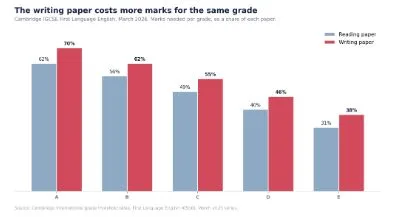
Exam boards are now marking writing on whether it does a job, not on whether it is decorative. In Cambridge IGCSE First Language English, the writing paper consistently demands more marks for the same grade than the reading paper does. In the March 2026 series a grade A on the writing component required 70 percent of the marks, against 62.5 percent on reading. That gap exists because writing is judged against level descriptors covering purpose, audience and structure, and examiners rarely award the top band. The skills being tested are the same ones that decide whether an email at work gets a reply.
What the numbers show
Cambridge publishes thresholds after every series. Here is how the two components compared in the most recent published sitting.
The pattern holds at every grade. Writing requires more at A, at B, at C, at D and at E.
The instinctive reading is that the writing paper is harder. That is not quite it. Grade thresholds are set after marking, at the point where candidates actually scored, so a higher threshold means the paper produced higher raw marks overall.
What that tells you is more useful. On the reading paper, a large share of candidates lose marks to comprehension errors, so the distribution spreads downward. On the writing paper, most candidates produce something competent, so the marks bunch higher and the boundary must rise to separate a strong piece from an adequate one.
The practical consequence is that competent writing is not enough. Producing a piece with no errors puts a candidate in the middle of a crowded band. The marks above come from writing and doing something.
What “doing something” means
Four things appear in the top bands and are absent from the middle ones.
The writing knows who it is for. A letter to a headteacher and a letter to a friend about the same complaint should share almost no sentences. Students are taught this and then write both in the same register under time pressure.
Structure carries an argument rather than filling a template. Introduction, three points, conclusion is a shape, not a plan. The higher bands reward writing where the second point builds on the first, and where the reader is somewhere different at the end.
Details are specific. “The facilities were inadequate” scores below “the two working showers served ninety students.” Specificity is the single most reliable way to move up a band and it costs nothing. For the article task in particular there is a worked guide to the IGCSE article format showing how the opening, body and close are actually weighted.
Register is controlled deliberately. Not formal throughout, but matched to the task and held there. Slipping into casual phrasing in a formal piece is one of the most common band-capping errors.
None of these is about vocabulary. Students who reach for elaborate words rather than precise ones usually score lower, because the strain shows.
Why this outlasts the exam
There is a version of this article that treats writing skills as an exam technicality. That undersells what is actually being assessed.
Most professional writing fails on the audience, not grammar. The email that gets ignored is usually grammatically fine and has simply not made clear what the reader is meant to do. That is the exact skill in the “purpose and audience” band descriptor.
Structure is how people navigate. Nobody reads a work document linearly. They scan for the part that concerns them. Writing that signals its shape gets acted on, and writing that buries the point does not.
Specificity is credibility. In a professional context, vague claims read as weak ones. The habit of reaching for the concrete detail rather than the general statement transfers directly.
And the skill is getting scarcer in a useful way. Generative tools now produce fluent, structurally correct prose on demand. What they produce less reliably is writing with a specific reader in mind and a specific point to land. The competence floor has risen, which means the differentiator has moved up to exactly the things these exams reward.
What actually helps students
Write for real readers, not for the marker. The single most effective exercise is asking a student who this piece is for and what they want that person to do differently. Most cannot answer, and the writing shows it.
Read the level descriptors rather than the indicative content. Students check whether they included the right points. The descriptors describe the quality of writing required, which is where the marks live.
Practise the same content in two registers. Take one scenario, write it as a formal report and as a message to a friend. This teaches the audience faster than any amount of explanation.
Cut, then cut again. Most middle-band writing is 20 percent longer than it needs to be, and the padding actively lowers the mark.
Work from the format, not from memory. Articles, letters, speeches and reports each carry conventions that examiners expect, and writing to the wrong one caps the mark regardless of quality.
The honest summary
Writing assessment has moved away from correctness and toward effectiveness. The published thresholds reflect that, which is why the writing paper sits higher than the reading paper at every grade.
For students preparing this year, the useful shift is small but real: stop asking whether the piece is good and start asking whether it works on the person it is aimed at.
That question does not stop being relevant after the exam. It is most of what separates writing that gets read from writing that gets skimmed, in an inbox as much as in a mark scheme.