5 Best Medical Concierge Services in Arizona for Hospital Arrivals and Check-in
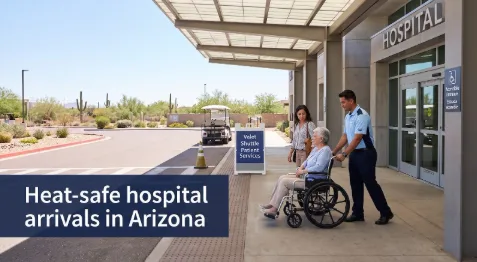
Step outside an Arizona hospital at 3 pm in July and you’ll feel the pavement soar to 170 °F (77 °C), hot enough to cause third-degree burns in seconds. Last summer the Arizona Burn Center treated 136 pavement-burn patients, and fourteen of them died.
This guide ranks the five best medical concierge services in Arizona for hospital arrivals, parking, and check-in. These non-clinical teams greet you, park your car, roll the wheelchair, drive the shuttle, and escort visitors inside. Getting that journey right keeps patients off scorching asphalt and into care faster.
How we built the ranking
We locked the data on August 4, 2026, then applied one hard filter: Arizona proof. If a company could not show an active hospital contract, a current campus job post, or a service page tied to real Arizona operations, it never made the scorecard.
Each contender was graded on eight weighted factors that mirror what facilities directors juggle every shift.
- Verified Arizona healthcare evidence: 25 percent
- Facility-service breadth across valet, parking management, shuttle, wheelchair and wayfinding: 15 percent
- Front-door integration of those services: 15 percent
- Heat-readiness indicators: 15 percent
- Healthcare training and accessibility: 10 percent
- Technology and measurable KPIs: 10 percent
- Arizona management depth: 5 percent
- Price and value transparency: 5 percent
Public board packets, hospital web pages and regulatory filings counted as gold-standard sources. Current job listings acted as live location signals. We tagged any self-published case study as vendor-reported and weighted it below third-party evidence.
Scores rolled up to a 100-point scale. The five winners outpaced the rest by at least ten points, creating a clear, defensible hierarchy you can audit line by line.
What Arizona hospitals should demand at the front door
Before comparing vendors, set your own baseline. Draft a whole-campus arrival plan covering visitor zones, employee lots, shuttle loops and accessible loading, then hold it to live targets such as drop-off-to-lobby time, average shuttle headway and wheelchair response under five minutes. Without that roadmap, even the best valet crew spends July chasing fires instead of hitting targets. A practical template lives in this operations brief on healthcare parking management.
Next, build the RFP around two Arizona non-negotiables: extreme heat and accessibility. Shade every queue, stage wheelchairs curbside, and keep shuttles on five-minute intervals. Require bidders to include a written heat protocol that lists pavement-temperature triggers at 140 °F (60 °C), hydration breaks and staff rotation limits, then attach last July’s staffing roster as proof.
Accessibility is just as clear. The Americans with Disabilities Act requires an accessible passenger-loading zone connected to an accessible route. Valet is an add-on, not a substitute.
Then insist on bilingual greetings and signage. Census Bureau language data puts the share of Maricopa County residents age five and older who speak a language other than English at home at roughly 26 percent. Spanish-first directions speed wayfinding and cut liability.
Lock these fundamentals now and the ranking that follows becomes a shopping list, not a leap of faith.
The five best medical concierge services in Arizona
FC Parking / FC Health: why it sits at no. 1
FC Parking does more than park cars; it manages the entire arrival chain. A Valleywise Health board packet shows the system extended FC’s golf-cart shuttle contract through December 13, 2027 for $378,366.55 in its final year. That renewal signals board-level trust, because leadership kept the incumbent rather than risk service gaps for vulnerable patients.
Beyond Valleywise, FC runs a Phoenix hospital valet team and lists statewide shuttle coverage. The menu stretches past the curb into wheelchair transfers, wayfinding and check-in support, giving facilities directors one accountable SLA rather than three. Breadth, verified Arizona evidence and tight integration powered its top score: a perfect 25 out of 25 on local proof, and first place on service bundling.
LAZ healthcare services: built for sprawling campuses
Banner Health’s Phoenix network is massive. Its University Medical Center Phoenix campus alone holds 746 beds and a 1,100-car garage, plus employee lots and shuttles. LAZ won the parking and shuttle contract in 2017 and still staffs valets, drivers and greeters on site.
Scale is the hallmark. Founded in 1981, the company grew into a national mobility platform. Its healthcare unit repurposes airport-grade technology: patients text a claim ticket, license-plate cameras locate the car, and a dashboard alerts staff as retrieval nears the five-minute SLA. You see live volume counts instead of anecdotal busy-day chatter.
That breadth matters on a campus this spread out. LAZ runs remote-lot shuttles, dispatches ambassadors by radio so a lost visitor is walked rather than waved to cardiology, and folds wheelchairs, mobility scooters and EV chargers into the same contract, trimming the vendor sprawl that clogs a curb.
Why second? We found no public Arizona heat-response standard, such as shaded-queue metrics, staff-rotation plans or pavement-temperature triggers. Banner prizes operational resilience, so press for that policy before renewal. If your campus map looks like a transit diagram, LAZ has the fleet, the technology and the bench to keep it moving.
American Parking & Services: deep Arizona roots with Mayo-tested chops
American Parking was born in Phoenix and still calls the city home. Founded in 1980, it started at Phoenix Country Club and now covers more than 80 Valley locations with a 600-person workforce.
Healthcare is led by the Mayo Clinic Arizona shuttle program, where drivers thread multiple patient towers and partner hotels under a five-minute pick-up SLA. Current shuttle-driver job posts confirm the route is active. Because managers live where they work, staffing gaps close in hours rather than days, which matters during monsoon surges and oncology-clinic peaks.
The menu spans valet, self-park management, shuttle dispatch, garage traffic control and front-desk concierge cover, so you can layer services onto an existing contract without a full RFP.
Two items belong on your due-diligence list:
- Clarify any connection between this Phoenix entity and Parking Management Company acquisitions in other states.
- Request the current digital-valet roadmap covering LPR integration, text-to-retrieve and dashboard access, so tech deliverables match the national players.
If you prize local control and want a bench your board can call across town, American Parking earns its podium spot, provided the ownership details and tech specs are locked into the SLA.
ABM healthcare support services: one contract, many moving parts
ABM is best known for HVAC and janitorial work, yet its healthcare arm bundles valet, shuttle dispatch, patient greeters and EV-charger upkeep into a single SLA. Nationally the division supports more than 300 hospitals and 700 medical facilities, tracking unified KPIs for wait time, first-contact resolution and parking revenue. In Phoenix it lists a dedicated downtown curb-management crew, showing it can hire and rotate staff in a tight labor market.
If you are juggling separate purchase orders for parking, wheelchair transport and garage cleaning, you can swap them for one invoice and often free budget for clinical gear without cutting curb support.
The trade-off is proof. We could not find a public Arizona hospital valet contract, so ask for two local references plus a written heat plan covering shaded queues, hydration breaks and staff rotation once pavement hits 140 °F (60 °C).
Epic Valet: the boutique choice with home-field advantage
Epic started in 1998 when two friends parked cars outside Scottsdale restaurants, and now lists more than 50 locations. It markets healthcare valet across Arizona and cross-trains attendants in wheelchair etiquette and curbside safety.
Local control is the real separator. Headquarters sit minutes from most Phoenix hospitals, so managers fill staffing gaps the same day, which is a lifesaver when monsoon storms or clinic surges hit. Valets carry spare scooter batteries and offer umbrella escorts, small touches that matter to mobility-challenged visitors.
The gap is proof. Epic bid on Valleywise Health’s 2021 golf-cart shuttle RFQ but lost to FC Health, and we found no public record of a current Arizona hospital contract. Before you award work, ask for two hospital references, a written heat plan that triggers staff rotation at 140 °F (60 °C), and a timeline for adding shuttle or patient-transport capability if your campus needs it.
Which provider fits which campus?
Every hospital wants fewer vendors, faster curb flow and zero patient complaints, but the ideal partner depends on your footprint.
| Your top need | Best-fit operator | Key proof point |
| End-to-end arrival coverage, from golf carts to check-in dashboards | FC Parking / FC Health | Valleywise shuttle contract through December 13, 2027 |
| Taming multiple entrances and remote lots | LAZ Healthcare Services | 746-bed Banner University Medical Center Phoenix campus |
| Rapid surge staffing plus local ownership | American Parking & Services | 600-employee Phoenix roster across 80 sites |
| One invoice for parking, shuttles, facilities and EV charging | ABM Healthcare Support Services | 300+ hospitals served nationally under bundled SLAs |
| Nimble, relationship-first service with manager access in minutes | Epic Valet | 50+ locations and Phoenix headquarters |
FC tops the list on verified Arizona contracts. LAZ scales technology and labor across sprawling systems. American delivers hometown agility. ABM offers one-bill simplicity for CFOs looking to consolidate spend. Epic leans into personal service, so verify healthcare references before signing.
Match these strengths to your campus map and risk profile, then invite two finalists for on-site walks before the summer heat returns.
Frequently asked questions before you issue that RFP
How much will arrival-concierge service cost?
Hospitals usually pay a fixed management fee plus reimbursable hourly labor, while patients may cover part of the tab through a posted valet charge. One public benchmark: Valleywise Health pays $378,366.55 for a year of golf-cart shuttles, not valet, under its 2026 to 2027 contract. Treat that figure as a scope example, not a market average.
Can valet replace our accessible parking?
No. The Americans with Disabilities Act still requires an accessible passenger-loading zone connected to an accessible route. Valet adds convenience but never removes that obligation.
What heat safeguards belong in the contract?
Ask bidders for a written plan that specifies shaded queue capacity, curb waits under five minutes, staff rotation every 30 minutes once pavement tops 140 °F (60 °C), hydration stations, and an escalation path when air reaches 115 °F (46 °C).
Which KPIs should we track?
Start with vehicle drop-off-to-lobby time, shuttle on-time percentage, wheelchair response under five minutes, and average retrieval wait. Add incident counts and patient-satisfaction scores so the numbers reflect safety and experience.
How long does a transition take?
Plan 30 to 60 days for a like-for-like hand-over when the incoming operator hires the current staff. Add another month if you introduce new shuttles, technology or extended hours. Build overlap so patients never feel the switch.
Is tipping required?
Arizona hospitals use every model: flat fee, tip-optional, or fully complimentary. Whatever you choose, post it clearly at the kiosk and in appointment reminders. Transparency cuts awkward curbside moments and shields frontline staff from guess-and-grumble exchanges.
Conclusion
Arizona summers will keep pushing pavement toward 170 °F (77 °C), and patient expectations will keep climbing. Treat the curb as the first point of care rather than a hospitality extra and you win on arrival.
Run a focused 30-day arrival audit. Log curb dwell times, wheelchair requests, shuttle headways and surface temperatures. Then invite at least three of the vetted operators to walk your campus, share the data, and draft an SLA. Let measurable numbers, not marketing, drive the award.