After Years Away, Vapor Shark Gets a Second Life in a Very Different Market
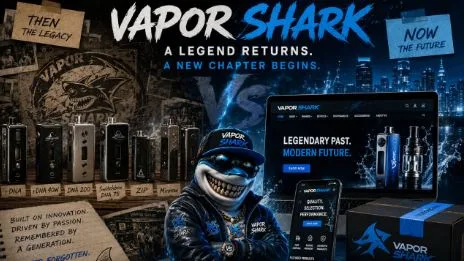
Consumer brands disappear all the time. Far fewer return years later under new ownership with an attempt to reconnect a familiar name to an industry that has changed dramatically in their absence.
That’s what is happening with Vapor Shark.
The name, associated with vaping hardware from the mid-2010s, has returned as an online business operated by V-Shark INC. The revived company is led by Jacob Cohen, who, according to Vapor Shark, was a longtime customer of the original business.
It is an important distinction that the new Vapor Shark is not simply the former corporation restarting operations. This is an independent company building a new business around a name remembered by some longtime members of the vaping community.
Remembering the Original Vapor Shark
Vapor Shark established its reputation during a hardware-focused period in vaping.
Devices including the rDNA, rDNA 40W, DNA 200 and Switchbox DNA 75 became part of the company’s identity, while products including the ZIP and Minnow expanded its historical lineup.
The company operated at a time when enthusiast-oriented devices played an especially visible role in the market.
Eventually, that chapter ended and the original business ceased operations.
Its absence coincided with significant changes across the industry.
The market consumers encounter today bears relatively little resemblance to the one in which Vapor Shark initially developed its following. Devices have changed considerably. Data published by the Centers for Disease Control and Prevention illustrates the scale of that transformation: as of June 2024, nearly 6,300 different e-cigarette products were available for purchase in the United States, and disposable e-cigarettes accounted for 58.1% of tracked unit sales.
Buying habits have evolved as well, and e-commerce has become increasingly central to American retail. According to the U.S. Census Bureau, e-commerce accounted for 16.9% of total U.S. retail sales during the first quarter of 2026, with online sales increasing compared with the same quarter a year earlier.
Starting Again Instead of Picking Up Where It Left Off
That makes the company’s return less straightforward than simply restoring an old website and selling products again.
The revived Vapor Shark needs to serve two audiences.
One consists of longtime consumers who recognize the name and may remember its earlier hardware. The other consists of shoppers who entered the category later and have no particular attachment to Vapor Shark’s history.
According to the company’s account of the revival, preserving that history is part of the plan, but the business itself has been redesigned around the current online marketplace.
It’s a balancing act familiar to many resurrected brands.
Lean too heavily on nostalgia and a company risks becoming relevant primarily to existing fans. Abandon the old identity completely and there may be little reason to revive the name in the first place.
An Unusual Route Back
The story is made more distinctive by Cohen’s connection to the original company.
Rather than being an executive returning to a former business, he approached Vapor Shark from the perspective of a customer. The company’s history describes him as a longtime customer who later became the person behind its revival.
That makes Vapor Shark part of an interesting category of brand comeback: one driven by affinity for what the name once represented.
There are no guarantees that recognition from an earlier generation of consumers will translate into success today. The revived business will ultimately be judged on what it does in the current market rather than what its predecessor accomplished.
Still, for people who followed vaping during the industry’s earlier hardware-driven years, Vapor Shark’s return is notable.
A name that appeared to have become part of vaping history is operating again – only this time, it’s doing so in a substantially different industry.